By noon, Aaron Pierce had written the same sentence three times in his keeper’s log and crossed it out each time. Atlas recognized the child. The words looked careless on paper, like something a visitor might say after seeing a gorilla turn his head at the right moment. Aaron had spent twenty-two years working with great apes at Red Oak Wildlife Park outside Columbus, Ohio, and he knew better than to dress uncertainty in dramatic language. He dealt in posture, appetite, vocalization, hierarchy, stress signals, sleep patterns, enrichment response. Recognition was a word he used carefully.
Still, his hand hovered above the page, and the memory of that morning would not let him choose a safer one.
It had started in the kind of quiet that zoo employees notice before visitors do. The primate wing usually had a living rhythm to it: sneakers squeaking across polished concrete, children pressing sticky hands to the rails, the muted chatter of parents trying to make lunch plans, the soft calls of tamarins from the next building over. In the gorilla habitat, the troop added its own steady undertone—brush moving, knuckles against earth, low grumbles exchanged beneath the rock ledge.
Visitors slowed before they understood why. A little boy with a plastic dinosaur in his fist stopped swinging it by the tail. A father lowered his phone without taking the picture. Near the front glass, a stroller bumped against the toe rail, and the sound seemed too sharp for the space.
Aaron was already moving toward the enclosure from the keeper corridor when he saw the troop gathered in the shaded back corner. The females were close together, the youngest juvenile half hidden against his mother’s side. No one was foraging. No one was sparring. Even the two-year-old who usually treated stillness as a personal insult sat tucked into himself, watching.
Atlas, the silverback, stood alone near the center of the habitat.
He was nearly five hundred pounds, broad across the chest, gray sweeping over his back like weathered stone. On an ordinary day, he carried that size without needing to prove it. He could quiet the younger males by turning his head. He could send the whole troop into motion with one hard step. But now he was not displaying, not challenging, not warning anyone away.
She was small enough that Aaron guessed kindergarten, maybe first grade. Her hair had been gathered into a lopsided ponytail that had already begun to loosen, and one sleeve of her sweatshirt had slipped over her knuckles. She stood with her feet together, not bouncing, not pointing, not pressing her face to the barrier the way children often did.
Her mother stood just behind her with a folded zoo map in one hand and a water bottle in the other. At first, she seemed only embarrassed by the attention gathering around them. Then she followed the line of Atlas’s gaze and went very still.
“Sophie,” she said softly. “Come here, honey.”
The girl did not step back. She did not act defiant, either. She simply kept her eyes on the gorilla, her face open and serious in a way that made Aaron’s stomach tighten before he could explain why.
Luis Moreno, the security guard posted near the primate building, came up beside Aaron. “Do we move people?”
“Not yet,” Aaron said.
He heard the strain in his own voice. Luis must have heard it too, because he stopped reaching for the portable barrier rope and waited.
Aaron knew Atlas’s moods better than he knew some people’s. He had seen irritation build in the tightening of Atlas’s mouth before visitors noticed a thing. He knew the difference between a bluff charge and a warning that needed to be taken seriously. He knew which sounds meant annoyance, which meant reassurance, which meant the troop had seen something outside the usual pattern.
This was outside every pattern he trusted.
Atlas took one step toward the glass. It was not fast, but his size made even restraint feel enormous. The visitors nearest the barrier leaned backward as one body, their breath catching in pieces. Sophie’s mother reached for her shoulder.
“Sweetheart, now,” she whispered.
“It’s okay, Mom,” Sophie said.
The girl’s voice was so quiet Aaron almost missed it. She did not sound brave. She sounded certain.
Atlas stopped less than three feet from the viewing glass. He lowered his head, not in submission, not exactly, but to bring his eyes closer to the child’s height. The scar over his left brow caught the overhead light, a pale seam against dark skin. He inhaled slowly, his nostrils widening, and then he settled his weight back as if making himself smaller required more care than movement.
Aaron lifted his radio. “Control, hold foot traffic at the east entrance to primates. No alarms, no announcements. Just keep it calm.”
A thin burst of static answered him. “Copy. Is there a situation?”
Aaron kept his eyes on Atlas. “I’m finding out.”
The mother turned toward him. Her face had changed completely. Whatever embarrassment she had felt was gone, replaced by the naked, practical fear of a parent who has realized no rule, sign, or uniform can guarantee anything.
“Sir,” she said. “Should I pick her up?”
Aaron wanted to say yes because it was the simplest answer, the one that would look best in a report if something went wrong. Clear the child. Reduce stimulation. Restore distance. But the glass between Sophie and Atlas was reinforced, the habitat secure, and Atlas was not escalating. More than that, he was calmer now than he had been when Aaron first came in.
“Just stay close,” Aaron said. “Don’t grab her unless I ask you to. Keep your voice low.”
The woman nodded, but her hand stayed curved around Sophie’s shoulder without pulling.
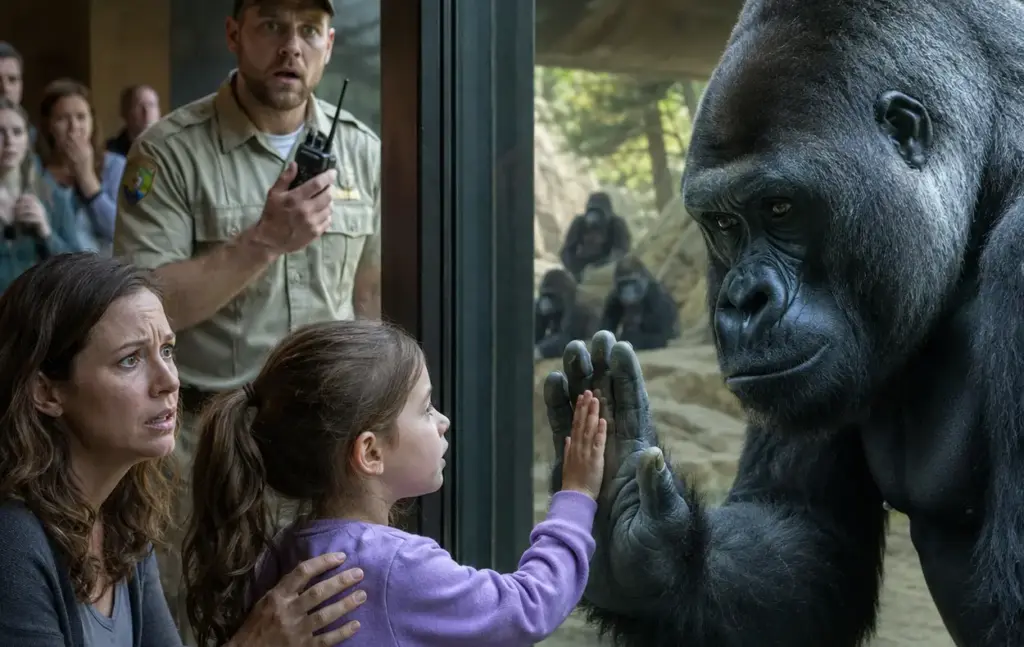
Sophie lifted her right hand.
The movement sent a nervous ripple through the crowd. Someone murmured, “Oh my God,” and Luis gave the visitors a look sharp enough to quiet them. Aaron took half a step forward before stopping himself.
Sophie placed her palm against the glass.
For one breath, Atlas did nothing. Then he raised one huge hand and brought it forward with a slowness that felt deliberate enough to hurt. His fingers, thick and dark, spread across the other side of the barrier. The shape of his hand swallowed hers completely, but he lined them up as carefully as if he understood exactly what the girl had offered him…
The sound that moved through the visitors was not applause or fear. It was smaller than that, a broken murmur, the sound people make when they have seen something intimate by accident.
Sophie leaned closer. Her mother’s hand tightened on her shoulder, but she did not pull her away.
“Hi,” Sophie whispered.
Atlas did not blink. His eyes stayed on the child’s face, and something in his expression changed so subtly Aaron would not have trusted anyone else to notice it. The hard alertness softened around the edges. The muscles above his brow shifted. His mouth relaxed by a fraction.
Aaron felt, absurdly and with immediate resistance, that Atlas had been waiting to hear that voice.
The thought did not belong in a keeper’s mind. It belonged in a story told by someone who had never cleaned an indoor holding room, never watched a dominance dispute unfold in less than two seconds, never made the choice to call the vet before a problem showed itself plainly. Aaron pushed the thought away and replaced it with the safer inventory of facts.
Child stationary. Silverback calm. No threat display. Troop observant but not alarmed. Crowd manageable. Mother compliant. Contact through glass only.
Then Sophie said, almost under her breath, “You remember.”
Aaron’s radio crackled again, but he did not answer. Atlas exhaled, a low, resonant breath that rolled through the glass and into the floor. Sophie’s mother flinched. A child in the crowd began to cry, and his father lifted him without looking away.
Aaron’s mouth had gone dry.
Eleven years earlier, before Atlas had a name that schoolchildren knew, before he had a troop and a habitat and a careful diet plan, Aaron had stood in a storm outside a failing roadside animal park in eastern Kentucky while a young gorilla lay sick under a tarp in the back of a transport trailer. The gorilla had been underweight, infected, half wild with fear, and too exhausted to fight the people trying to save him. Aaron had stayed near him long after the emergency team told him he could step back.
He had talked through the rain because silence seemed cruel.
Now, in the filtered light of a clean public viewing room, Atlas kept his hand against Sophie’s, and Aaron felt that old storm rise inside him with such clarity he had to grip the radio to steady himself.
Sophie’s mother looked at him. “What is happening?”
Aaron could have given her procedure. He could have said that gorillas sometimes fixate, that unusual colors or movements could draw attention, that the barrier was secure and staff were monitoring the interaction. None of those things would have been lies.
None of them would have answered her.
“I don’t know yet,” he said.
The mother looked as if that frightened her more than any warning could have.
Sophie, meanwhile, seemed untouched by the fear gathering around her. She held her small palm to the glass, and Atlas held his there too, not pressing, not testing, only meeting. The rest of the troop watched from the shade without a sound.
Aaron lowered his radio and made a decision that went against the stiffest parts of his training. He did not clear the room. He did not separate the child from the glass. He stayed close enough to act and far enough away not to break whatever fragile thing had opened in front of them.
Because whatever this was, Atlas had not started it with force.
He had started it with remembering.
Aaron did not believe in miracles at work. He believed in locks checked twice, gates latched by hand and eye, records updated before memory had a chance to improve itself. Animals had paid too high a price for human sentimentality, and he had spent most of his career pushing against the easy stories people wanted to tell about them.
Visitors looked at Atlas and saw a king, a brute, a gentle giant, a sad prisoner, a celebrity, depending on what they had brought with them through the zoo gates. Aaron tried to see the animal in front of him. That had always felt like respect.
But when Sophie stood at the glass, the clean categories he had built over two decades began to feel less like respect and more like shelter.
He crouched a few feet behind her, careful not to crowd her mother. “What’s your name?” he asked, though he had already heard it.
Sophie turned only partway, as if she did not want to lose sight of Atlas. “Sophie.”
“I’m Aaron. I help take care of him.”
“I know.”
Her mother looked down sharply. “Sophie, you don’t know that.”
Sophie’s brow creased, not in argument but in puzzlement. “He does.”
Aaron felt the words move through him in a place he did not want them to reach. “Do you mean Atlas?”
The girl nodded toward the silverback. “He knows you.”
Luis shifted beside the visitor rail. Aaron knew the security guard well enough to recognize that he wanted instruction and was not getting it quickly enough. Around them, the crowd had changed shape. People were still watching, but most phones had lowered. A few visitors seemed embarrassed to be present, as if they had walked into a hospital room without knocking.
Aaron kept his voice even. “Are you afraid of him, Sophie?”
“No.”
“Why not?”
She looked back through the glass. Atlas’s hand remained lifted, though the weight of his arm must have been considerable. He seemed unwilling to be the first to lower it.
“Because he’s sad,” Sophie said.
Her mother closed her eyes briefly, and when she opened them, there was moisture along the lower lashes. “She says things like that sometimes,” she told Aaron, trying to explain and apologize at once. “About animals. About people too, honestly. I’m sorry, I don’t know why she—”
“You don’t have to apologize,” Aaron said.
He meant it, though he did not know what else he meant.
Sadness was not a word he avoided with gorillas. He had watched a female refuse to release the body of her stillborn infant for three days. He had seen a young male lose his appetite after a transfer separated him from the brother he had slept beside since infancy. He had listened to a troop go quiet after the death of an elderly matriarch and stay quiet in a way no enrichment schedule could fix.
The public liked to argue about whether those things counted as grief, as if the answer mattered more than the behavior. Aaron had stopped arguing years ago. He knew sorrow when he had to sit beside it.
What disturbed him now was not that Sophie sensed sadness. It was that Atlas seemed to accept being seen.
The gorilla lowered his hand first. The motion was so careful that Sophie did not startle. He settled onto his knuckles, then eased himself down until his chest touched the ground. A silverback did not make himself vulnerable in front of a noisy viewing room for no reason. Even through glass, posture mattered. Witnesses mattered.
Sophie sank to the floor.
“Sophie,” her mother whispered, alarmed.
“It’s okay.” The girl crossed her legs and placed both hands in her lap. She was small against the wide pane, her sneakers barely reaching the metal edge below it. “He’s tired.”
Atlas remained low. His eyes moved once toward Aaron, held there, and returned to Sophie.
That glance took Aaron backward before he could stop it.
The rescue in Kentucky had happened in late March, during a week of rain that turned every access road into brown water and every field into mud. The place had called itself Oak Hollow Exotics, though by the time state authorities shut it down, half the signs had peeled off the fences. It had been one of those roadside attractions that survived on birthday parties, bad decisions, and the public’s willingness to confuse proximity with care.
There were big cats in undersized pens, parrots half plucked from stress, a black bear that paced until the ground beneath him had become a trench. And in a back enclosure built of rusted panels and poured concrete, there had been a young male gorilla with infected wounds around both wrists and a fever high enough that the veterinarian’s face went flat when she read the numbers.
He had no name worth keeping. On intake paperwork, he was listed as Male Gorilla, estimated age 13–15. The owner claimed he had been “difficult.” Aaron remembered the word because of how neatly it tried to bury everything else.
Difficult meant frightened. Difficult meant hurt. Difficult meant the animal had learned that human hands brought pain, restraint, noise, and panic.
The sedation had been complicated by his condition. Twice his breathing scared them. Once, while rain beat against the roof of the temporary trailer, he opened his eyes before anyone expected him to. The vet team froze, all except Aaron, who was closest and had no safe place to move without startling him.
So Aaron stayed still.
He had been younger then, though not young, and less careful about the distance between professionalism and feeling. His rain jacket was soaked through. Mud covered his boots to the ankle. The gorilla’s eyes, clouded with medication and fever, fixed on him with a terror so complete it did not look like rage anymore.
“Easy,” Aaron had said, low enough that the others barely heard. “Nobody’s leaving you here.”
He repeated that sentence for nearly an hour. Maybe it was for the gorilla. Maybe it was for himself. He had not known then, and he did not know now.
Atlas survived the transport, the surgery, the long quarantine, the slow work of teaching him that doors could open without punishment and people could enter without cruelty. He earned his name later, after one of the keepers joked that he carried the whole room on his shoulders. The name stayed because it fit him. He became steady. Watchful. Not tame, never that, but less haunted.
Aaron had let himself believe the worst of the past had faded into behavior patterns that could be managed.
Now Atlas lay on the habitat floor in front of a child who had not been alive when Oak Hollow was shut down, and the past looked very much awake.
Sophie leaned forward until her forehead almost touched the glass. Her mother made a small sound but did not stop her. The girl’s reflection hovered faintly over Atlas’s face, small and pale over dark skin and silver hair.
“You don’t have to watch so hard,” Sophie said.
The words were strange, but her voice was ordinary. Not theatrical. Not dreamy. She spoke the way children speak to dogs under tables, to dolls tucked into blankets, to adults who think children are not listening.
Atlas closed his eyes.
The crowd shifted. Aaron heard someone inhale sharply. He raised one hand behind him without looking, and Luis understood, moving gently along the visitor line.
“Let’s give them space,” Luis said. “Step back a little, folks. Nice and easy.”
For once, people obeyed.
Sophie’s mother knelt beside her, the zoo map crushed in her fist. “Honey,” she said, and her voice trembled despite her effort to keep it steady. “Look at me for a second.”
Sophie turned. “I’m okay, Mom.”
“I know you feel like you are.” The woman swallowed. “I need you to listen to Mr. Aaron, all right?”
Sophie nodded, but her eyes went back to Atlas.
Aaron chose his next words carefully. “Sophie, have you visited this zoo before?”
“No.”
Her mother answered at the same time. “No. This is our first time here.”
Sophie frowned down at her own hands. “Maybe not here.”
Aaron waited. Good keepers learned the value of not filling silence. Parents often rushed in to translate children into adult logic, but Aaron held up a small hand when Sophie’s mother began to speak.
“Tell me what you mean,” he said.
Sophie rubbed her thumb over the seam of her sweatshirt cuff. “I don’t know. It feels like when you forget a song but still know how it goes.”
Her mother’s face changed at that. Fear remained, but another emotion moved beneath it, something softer and more painful. Aaron wondered if she had heard Sophie say things like this before and had trained herself not to ask too much.
Atlas opened his eyes again. He looked at Sophie, then at Aaron, and the look had no simple category. It was not pleading. It was not accusation. It was not gratitude, a word Aaron distrusted almost as much as miracle. But it contained attention, and attention was never nothing.
Aaron’s radio buzzed. This time the voice belonged to Dr. Karen Whitfield, the zoo’s head veterinarian. “Aaron, I’m outside primates. Do you need me in?”
He lifted the radio without turning away. “Come in slow. No dart kit visible.”
A pause. “Understood.”
Sophie heard that. She looked over her shoulder, suddenly more child than mystery. “You’re not going to hurt him, right?”
“No,” Aaron said. “No one is going to hurt him.”
The promise left his mouth before he could measure it. In his line of work, promises were risky. Animals got sick. Doors failed. Weather turned. People made decisions from offices far from the habitats they affected. But the sentence had been waiting inside him for eleven years, and when it came out, Atlas stirred.
The silverback pushed one finger toward the glass, not his whole hand this time, just one thick knuckle. Sophie smiled and placed her palm across from it again. She was not trying to touch him. She understood, somehow, the shape of the boundary.
That understanding settled over the room more powerfully than any warning sign.
Dr. Whitfield entered quietly from the staff side, white coat absent, radio clipped low on her belt. She watched for less than ten seconds before her expression shifted from professional alertness to something more cautious.
“What am I looking at?” she murmured to Aaron.
“I don’t know,” he said.
Karen glanced at him. “That’s twice today.”
“I know.”
Atlas remained low, breathing slow and steady. Sophie stayed seated. Her mother knelt beside her, one hand resting against the floor now, as if she had given up pretending she was ready to stand.
Aaron looked at the glass, at the child, at the gorilla who had once opened his eyes in a storm and found a human voice beside him. He understood protocol. He respected it. But protocol existed to prevent harm, and what he saw in front of him was not harm forming. It was the opposite, though he had no professional word for that either.
“Keep the area calm,” he told Karen. “No crowd rotation for a few minutes.”
She studied him. “You’re sure?”
“No,” Aaron said. “But I’m responsible.”
Karen looked back at Atlas, then at Sophie. After a moment, she nodded.
Sophie sat with her hands open on her knees. Atlas rested his chin low, almost level with her. Nothing dramatic happened after that. No roar, no charge, no sudden proof that would satisfy the people who needed the world to divide itself cleanly.
Only a gorilla closing his eyes in front of a little girl.
Only a child whispering, “I’m here,” as if that were enough.
The first video appeared online before the zoo had finished its incident report. It had been filmed by a teenager from behind three rows of visitors, shaky at the start, then strangely steady once Atlas lowered himself to the floor. By evening, the clip had been trimmed, slowed, captioned, argued over, and shared by people who had never heard of Red Oak Wildlife Park until that morning.
The zoo’s communications team wanted language by 6:00 p.m. Aaron gave them none they liked.
“No threat display was observed,” he wrote. “The silverback remained calm throughout. Staff monitored the interaction and controlled visitor movement.”
The public relations director stared at him across the conference table. “That’s accurate, but it doesn’t explain why he did it.”
“It shouldn’t,” Aaron said. “We don’t know why he did it.”
She sighed, not unkindly. “People are asking whether the child had some prior connection to him.”
“She didn’t.”
“Whether he was trained to do that.”
“He wasn’t.”
“Whether the zoo plans to allow follow-up visits.”
Aaron looked through the conference room window toward the darkening primate building. The public paths were empty now, the benches shining faintly from a late sprinkle of rain. “That’s not a media question.”
Dr. Whitfield leaned back in her chair. “It’s an animal welfare question.”
Aaron nodded. He was grateful she had said it before he did.
By the next morning, three local news stations had called, along with a morning show producer in New York who used the phrase heartwarming moment as if it were a scientific classification. Aaron refused to appear on camera. Sophie’s parents refused too, which made him trust them more than he would have otherwise.
Rachel Miller came back two days later without advance notice. She wore jeans, a rain jacket, and the cautious expression of someone afraid that returning might be a mistake but more afraid of not returning. Sophie held her hand and carried a small stuffed rabbit by one ear.
Aaron met them near the service door before they reached the public glass. “You don’t have to do this,” he said.
Rachel looked past him toward the habitat. “She asked all yesterday. I told myself it would pass.”
Sophie leaned into her mother’s side but did not hide. “Is he awake?”
“He’s outside,” Aaron said. “He may not come over.”
“That’s okay.”
It was not a child’s disappointment-avoidance answer. She meant it. Aaron led them through the visitor area, which he had arranged to be quieter than usual for the first half hour after opening. Luis stood near the entrance. Karen waited in plain clothes by the wall, a detail Aaron appreciated.
Atlas was at the far end of the habitat, seated near the fallen sycamore trunk that the troop used for climbing. His back was turned. One of the younger males picked through straw several yards away while a female groomed an infant under the ledge.
Sophie stopped at the glass.
Atlas did not turn immediately. Aaron watched his shoulders, his hands, the angle of his head. A few seconds passed. Then Atlas went still in a way that had nothing to do with sleep or distraction.
He turned.
The movement was unhurried, but everyone saw the moment of recognition. His gaze found Sophie, and the rest of the habitat seemed to adjust around that fact. The juvenile paused with straw hanging from his mouth. The female looked up, then settled again.
Atlas rose, crossed half the habitat, and stopped well short of the glass. He sat there facing her, leaving enough distance that even Rachel’s body loosened slightly.
“Hi, Atlas,” Sophie said.
This time she did not press her hand to the glass. She waved, small and private. Atlas watched the gesture and lowered his head by a fraction.
Aaron wrote down the time. He recorded distance, posture, troop response, visitor density, all the things a careful keeper should record. Beside those notes, in the margin where no one else needed to look, he wrote: remembered her without prompt.
He hated himself a little for writing it.
The visits did not become regular enough to explain anything away. Rachel worked at a dental office in Dublin and could not bring Sophie whenever the internet demanded another clip. Sophie’s father, Matt, came when he could, a quiet man in a ball cap who seemed uneasy around cameras and protective of his daughter’s strangeness in a way Aaron respected. Some weeks Sophie came twice. Some weeks she did not come at all.
Atlas noticed both.
On the days she came, he did not always approach the glass. Sometimes he remained under the ledge, watching from shade. Sometimes he let the young ones tumble near him while he kept Sophie in view. Once, when Sophie sat on the floor and drew in a spiral notebook, Atlas settled across from her and stripped bark from a branch with careful fingers, the two of them occupied in separate tasks that somehow seemed shared.
On the days she did not come, Atlas began spending more time near the front of the habitat.
At first, Aaron resisted the connection. The weather had changed. Visitor patterns varied. The troop’s internal dynamics were shifting as the younger male, Jasper, began testing boundaries more boldly. There were plenty of reasons a silverback might alter his resting spots.
Then a Monday came when Sophie had been expected after school and did not arrive. Rachel called the zoo office apologetically around 3:30 p.m., saying Sophie had a fever and was home on the couch, furious and miserable. Aaron thanked her for letting them know, feeling foolish for the relief that she had called.
Atlas had already been at the glass for nearly forty minutes.
He did not pound on it. He did not refuse all food. He ate part of his afternoon produce, ignored the rest, and returned to the place where Sophie usually stood. When closing announcements began and visitors drifted toward the exit, Atlas stayed seated, eyes on the empty walkway.
Aaron entered the staff corridor and stood behind the secondary barrier where Atlas could see him through the mesh. “She’s home sick,” he said, keeping his voice low.
Karen, beside him, gave him a look that was half warning, half sorrow. “Aaron.”
“I know.”
Atlas turned his head toward him. For a moment, Aaron had the unnerving impression that the gorilla was not waiting for sound but for intention. Then Atlas looked back at the public path.
“She’ll come when she’s better,” Aaron said.
It was ridiculous. It was necessary.
The next afternoon, Sophie returned pale and annoyed under a pink baseball cap. Rachel had clearly not wanted to bring her but had lost an argument no parent could explain to another adult without sounding helpless. Sophie carried a paper cup of water and moved slowly, still not fully well.
Atlas was at the glass before she reached it.
He did not rush. He never rushed for her. He simply stood from the place where he had been waiting and came forward with the grave restraint that had become his way with her. Sophie smiled, tired but real, and placed her hand on the glass.
“I was sick,” she told him.
Atlas breathed out. His hand rose, then stopped an inch from the barrier. He did not complete the gesture this time. Instead, he lowered his body and sat, steady and near, as if her return required less touching than witnessing.
Aaron’s throat tightened so sharply he had to look away.
That night, he stayed in his office long after the education wing had gone dark. He pulled studies he had read years before and read them again with a different kind of attention. Long-term memory in chimpanzees. Social recognition in apes after years of separation. Elephants returning to bones. Corvids remembering human faces associated with threat. Gorillas recognizing former caretakers after long absences.
He had taught some of this material to interns. He had said the right words about cognition and welfare and the danger of underestimating nonhuman animals. Yet somewhere inside him, he had still kept a private fence standing. Humans remembered as story. Animals remembered as function.
Atlas was dismantling that fence without touching it.
Aaron opened the file from Oak Hollow again. The photos loaded slowly on his aging desktop. Rusted gates. Flooded gravel. The transport trailer with its open back. A younger Atlas lying on clean blankets under emergency lights, wrists wrapped, eyes half open.
Aaron remembered how his own hand had shaken when he held the water bottle for the vet tech. He remembered being warned not to stand where the gorilla could focus on him too long. He remembered ignoring the warning because every person on that property had already left Atlas too many times.
Nobody’s leaving you here.
He had said it again and again until the words lost shape. He had not expected them to matter beyond that night. Kindness, in his younger mind, had been something given because it was right, not because it could survive as a trace in another body.
A knock came at the open office door. Karen stood there with two paper cups of coffee and the expression of someone who had stopped pretending she was only checking on records.
“You’re going to wear a hole through those files,” she said.
Aaron leaned back. “Maybe there’s something I missed.”
“Like what?”
“I don’t know.” He rubbed both hands over his face. “A volunteer. A child nearby. Some sound Sophie makes that matches someone from the rescue. I keep looking for a bridge.”
Karen set the coffee on his desk. “Maybe the bridge is simpler than that.”
He looked up.
“Not simple,” she corrected. “Just not the kind you can document in a file.”
Aaron wanted to argue. Instead he looked at the photo of Atlas in the trailer, eyes open in the rain-bright dark. “He shouldn’t have had to remember any of it.”
“No,” Karen said. “But maybe he also remembers what came after.”
The sentence stayed with Aaron. It followed him through the next morning’s rounds, through food prep, through the low rumble of Atlas greeting the troop at first light. It followed him when Sophie came again that weekend and sat on the floor with a picture book she did not read aloud because she said Atlas liked quiet better.
Rachel sat on the bench behind her, no longer gripping the zoo map or apologizing for her daughter. Matt stood beside Aaron with his arms folded, trying to look casual and failing.
“She talks about him at home,” Matt said after a while.
Aaron nodded. “That can happen after a strong experience.”
Matt gave him a faint, tired smile. “That’s the sentence you use when you don’t know what to say?”
“Pretty much.”
“She says he remembers being left.” Matt watched Sophie turn a page. “I don’t know what to do with that.”
Aaron looked through the glass. Atlas sat several yards away, his hands resting in the grass, his eyes on the girl.
“Neither do I,” Aaron said. “But I’m trying not to waste it.”
By fall, the crowds had moved on.
The clip still resurfaced now and then when someone reposted it with new music or a different caption, but the urgent noise around it faded. That was the way of public attention. It arrived hungry, took what it wanted, and wandered off. Red Oak Wildlife Park returned to field trips, stroller traffic, donor tours, weather delays, and schoolchildren who cared more about the gift shop than the animals their parents wanted them to appreciate.
The people closest to Atlas did not return to normal so easily.
Aaron noticed the changes first in small, practical ways. Atlas corrected Jasper less harshly when the younger male pushed too far. He still intervened, still held authority, still carried the troop’s center of gravity, but he used less force than before. A glance lasted longer before a step followed. A warning rumble stayed low instead of rising. When the juveniles played too near the indoor door, he guided them away with the side of his body rather than scattering them.
Karen warned Aaron against reading too much into every adjustment. Aaron agreed with her out loud. Then he wrote the details down anyway.
Sophie’s visits became part of the habitat’s life without becoming a performance. The zoo never advertised them. Rachel would text Aaron only when the family planned to come, and sometimes plans changed because a child’s life did not arrange itself around an old gorilla’s patience. There were spelling tests, dentist appointments, stomach bugs, birthday parties, snow days, bad moods, and one memorable afternoon when Sophie refused to leave the car because she had fought with a friend and did not want Atlas “looking at her feelings.”
When she did come in, Atlas always knew.
He recognized her in winter with a striped hat pulled low over her ears. He recognized her in spring when she lost both front teeth and became self-conscious about smiling. He recognized her when she grew tall enough that her hand landed higher on the glass than it used to. He recognized her even on a crowded Saturday when she stood three rows back and never came forward, pinned between a stroller and a group of college students.
That day, Atlas was half asleep under the ledge. Sophie laughed at something her father said, a quick bright sound different from the soft voice she used near the glass. Atlas opened his eyes. He did not rise or turn fully. He only tilted his head enough to place her in view, then settled again.
Aaron saw it and stopped mid-sentence during an explanation to two interns.
One of them, a senior from Ohio State, followed his gaze. “What did he do?”
Aaron considered giving the standard answer. Auditory cue recognition. Familiar visitor response. Behavioral association. All of it had value. None of it was wrong.
“He heard someone he knows,” Aaron said.
The intern waited for the rest, but Aaron had learned that not every truth improved when dressed in larger words.
As months became a year, Atlas aged in the ordinary, visible ways that caretakers notice and visitors often miss. He took longer to rise after naps. The silver across his back brightened. His right wrist stiffened during cold weather, a leftover from the injuries at Oak Hollow that never fully stopped speaking. Karen adjusted his care plan. Aaron adjusted the enrichment schedule. The troop adjusted around him, as good troops do when leadership becomes less about force and more about presence.
Sophie changed too. She stopped sitting on the floor every visit. Sometimes she stood with one shoulder against her mother’s side, talking about school or pointing out the baby to younger children nearby. Sometimes she brought drawings for Aaron, not for Atlas, because she understood paper could not cross the barrier and seemed offended by adults who pretended otherwise. Once she brought a drawing of the habitat with Atlas in the shade and herself outside the glass, both of them looking at trees that existed only in crayon.
Aaron kept it in his office, pinned beside the Oak Hollow intake photo.
The two images did not belong together in any official record. One showed harm, documented because institutions require proof before they will act. The other showed a child’s simple understanding of distance and company. Aaron looked at them on difficult days, especially after meetings where budget numbers flattened animal lives into line items.
He began teaching differently.
New keepers still learned safety first. Aaron remained strict about doors, barriers, shift procedures, and the plain fact that love did not make a wild animal safe. He corrected sloppy language and romantic assumptions. He did not allow interns to call Atlas sweet, harmless, or basically human. Respect required better words than that.
But he also stopped teaching as if control were the highest form of care.
He asked students what an animal might carry from one room to another, one keeper to another, one year to the next. He made them watch before speaking. He asked them to identify not only fear and aggression but hesitation, anticipation, preference, and loss. When they used the word instinct as a way to end a question, he made them start over.
“Instinct is real,” he told one group during a winter training session, while Atlas watched from the indoor habitat behind him. “But don’t use it as a trash can for everything you don’t understand.”
Some students wrote that down. Some looked politely overwhelmed. Aaron did not mind. He had spent years learning too slowly.
One evening in early April, after a cold rain had emptied the zoo ahead of closing, Sophie came with Rachel for a short visit. She was seven by then, taller and less solemn, though the old quiet returned whenever she approached Atlas. She wore yellow rain boots and carried a library book under her jacket to keep it dry.
Atlas was inside because of the weather, seated behind the glass in the public room. The overhead lights reflected faintly against the pane, layering Sophie’s face over his shoulder. Aaron stood near the back wall with Rachel while mother and daughter shook rain from their sleeves.
“He’s sore today,” Aaron said. “You might not get much from him.”
Rachel smiled. “She said she didn’t need much.”
Sophie walked to the glass and stopped a few feet away. She did not press her hand to it. She had not done that for a while unless Atlas offered first. Instead, she stood quietly, letting herself be seen.
Atlas lifted his head.
“Hi,” she said. “It rained today.”
His eyes remained on her. Outside, water slipped down the windows beyond the corridor, blurring the parking lot lights into pale streaks. The building smelled faintly of wet coats, hay, and disinfectant.
Sophie glanced back at Aaron. “Do you think he remembers rain?”
Aaron could have answered with caution. He could have explained sensory association, trauma triggers, environmental cues. He could have protected himself with language polished smooth by years of professional restraint.
Instead he looked at Atlas, at the old scars beneath the silver hair, at the great hands resting open on the floor.
“Yes,” he said. “I think he does.”
Sophie accepted that without surprise. She turned back to the glass. “But he knows this rain is different.”
Atlas shifted his weight and, with visible effort, brought one hand forward. He did not lift it high. He only rested his knuckles against the glass near the lower edge, where Sophie’s hand had fit when she was smaller.
Sophie crouched. Rachel inhaled beside Aaron, not in fear this time but because memory had its own pressure. Sophie placed her palm across from Atlas’s knuckles, matching the lower place rather than making him reach.
For a while, no one spoke.
Aaron thought of the storm in Kentucky, of mud on his boots and fever in a gorilla’s eyes. He thought of every clean report he had filed afterward, every box checked, every careful sentence that had made suffering legible to people who had not stood in the rain. He thought of Sophie on the floor the first morning, unafraid not because she was foolish, but because she had understood something the adults were too busy managing to see.
The glass remained between them. It always would. That mattered. Boundaries were not the enemy of connection; often they were what allowed connection to survive without becoming possession.
Atlas lowered his head until his brow nearly touched the pane. Sophie stayed crouched, hand open, face calm. She no longer looked like the tiny girl who had first stopped him in front of a room full of strangers. Atlas no longer looked like the younger silverback who had carried his old injuries as if watchfulness alone could keep them from returning.
Recognition had not frozen either of them in that first moment. It had moved with them.
When Rachel finally touched Sophie’s shoulder, the girl stood without protest. “Bye, Atlas,” she said.
Atlas did not follow her to the edge of the glass. He watched her go, then turned his gaze toward Aaron. The look lasted only a few seconds, but Aaron felt the full weight of it: not a request, not thanks, not forgiveness for anything humans had done. Simply acknowledgment.
After the Millers left, Aaron stayed behind to finish the evening checks. The public room emptied. Lights dimmed across the path. Rain kept tapping at the roof, a gentler sound than the storm that had carried Atlas into Aaron’s life years earlier.
Atlas remained near the glass.
Aaron stood on the visitor side, hands in his jacket pockets. He had no audience, no camera, no reason to turn the moment into anything more than it was.
“She’s getting bigger,” he said.
Atlas blinked slowly.
“I guess we all are,” Aaron added, then gave a small laugh at himself because the sentence was more sentimental than he allowed from interns.
Atlas eased back from the glass and settled with his shoulder against the wall, tired but calm. He closed his eyes while Aaron watched, not asleep yet, only resting in a room where no one was asking him to perform, explain, or prove what lived inside him.
Long after that first morning, people still asked Aaron what had really happened between the gorilla and the little girl. They wanted one answer. A trick of scent. A memory of rescue. A child’s unusual stillness. A coincidence made beautiful by the human need for meaning.
Aaron had learned to let them want it.
What he knew was less tidy and more demanding. Atlas had been harmed, and he remembered. Atlas had been helped, and he remembered that too. A child had stood before him without taking anything, and some old part of him had answered with restraint instead of fear.
That was enough to change the way Aaron opened a gate, the way Rachel listened to her daughter, the way young keepers learned to stand in silence before deciding what they understood.
The staring had lasted only minutes.
The remembering stayed.