Marcus Bell had imagined the arrivals hall so many times that the picture had started to feel dangerous. Tessa would be near the railing, trying not to cry in public. Ava would be bouncing on her toes with a handmade sign, her missing front tooth showing when she smiled. He would drop his duffel, scoop both of them into his arms, and for the first time in fourteen months, no one would be bleeding, shouting, or calling for a medic.
By the time his plane dipped toward Riverton, his eyes burned from lack of sleep. Twenty-two hours of travel had wrinkled his uniform and hollowed out his face, but his phone buzzed in his palm, and for a few seconds the fatigue loosened its grip.
A text from Tessa waited on the screen.
Marcus smiled with his head against the window. The city lights below blurred through the oval glass, gold and white in the dark. He typed back with his thumb.
Landed soon. Fifteen minutes after bags. Tell my girl I’m coming.
Ava had been five when he left. She was six now, which felt impossible and unfair, as if the world had kept raising his child without asking permission. He had missed the unicorn birthday cake, the first loose tooth, the first day of kindergarten, and too many bedtime calls where her face froze on the screen while her voice kept talking from a continent away.
In the duffel above him was a lavender stuffed bunny, soft as a secret and already a little worn from being carried across half the world. He had bought it in a small exchange in Kuwait because Ava loved purple and because he needed something to hold on to that had nothing to do with war. It had traveled with him through dusty tents, hot cargo holds, and one night when a mortar landed close enough to shake grit down from the roof.
He did not like looking at it. The paper made a clean thing out of a day that had not been clean. Four months earlier, a convoy outside Forward Operating Base Sparrow had hit an explosive buried beneath the road. Marcus remembered the sharp white flash first, then the heat, then the ringing that swallowed every sound except screaming.
A vehicle lay on its side, burning at the edges. A young lieutenant was trapped beneath twisted metal, pale under the dust, one leg bent wrong, blood spreading too fast through the sand. Marcus had not paused to measure courage or fear. He had moved because training lives in the body before thought can catch up.
The lieutenant grabbed at him with a hand slick from blood. “Don’t leave me. Please, man. My name’s Caleb.”
“I’ve got you, Caleb,” Marcus said, pressing both hands where the bleeding was worst. “Look at me. Keep looking at me.”
The medevac could not land right away. Smoke rolled low across the road, and someone shouted coordinates Marcus barely heard. His arms cramped. His fingers went numb. The lieutenant begged him not to let go, and Marcus kept saying the same thing, steady as he could make it.
“I’m here. I’m not moving.”
Eleven minutes was not long in ordinary life. In the sand, with a man trying not to die beneath your hands, eleven minutes became a country of its own. By the time the helicopter finally took Caleb away, Marcus’s sleeves were soaked through, and his knees shook when he stood.
Two weeks later, Brigadier General Samuel Whitaker came out to the base for a medal ceremony. Marcus stood in line with the other soldiers and tried not to think about how badly he wanted to be home. When the general reached him, he pinned the Bronze Star to Marcus’s chest with fingers that trembled only once.
“You did more than your duty, Staff Sergeant,” Whitaker said.
“Thank you, sir.”
The general held his hand a second longer than regulation required. His eyes shone in a way Marcus did not understand, not from weakness but from something held too tightly for too long. Then the ceremony moved on, and Marcus put the moment away with all the other things he did not have room to carry.
Thirty rows ahead of him now, in seat 2A, that same general sat in a navy blazer and khakis, his posture too straight for a commercial flight. Whitaker had noticed Marcus during boarding, exhausted in a window seat, already half asleep. He had almost gone back to speak to him, then stopped himself.
Let the man rest, he had thought. There would be time.
The plane touched down at 6:34 p.m. Marcus waited for the aisle to clear, shouldered his duffel, and followed the slow river of passengers into Riverton International Airport. Terminal C smelled like floor polish, coffee, and fast food grease. Suitcases clattered over seams in the tile, and the monitors above baggage claim flickered with delayed flights and carousel numbers.
Flight 2187: Carousel 6.
Marcus descended the escalator with one hand on the rail and one thumb resting over Tessa’s last message. He was already picturing Ava’s glitter sign when he stepped onto the baggage level and turned toward the carousel.
Across the hall, Sergeant Frank Harlan watched him.
Harlan was forty-two, square through the shoulders, with a face that had learned to look bored while enjoying itself. He had been with the Riverton Airport Police for nearly two decades. Fourteen civilian complaints sat in his file, all dismissed, all smoothed over by people who knew which forms to lose and which witnesses not to call.
Officer Evan Crowe stood beside him, young enough to still believe cruelty could look like confidence. Officer Miles Denton lingered half a step back, uneasy but quiet. He saw Harlan’s gaze lock onto Marcus and knew, without being told, that the evening had just narrowed around one person.
“That one,” Harlan said.
Crowe followed his line of sight. “The soldier?”
“Uniform’s too clean in the wrong places and too wrinkled in the others.” Harlan’s mouth tilted. “I’ve seen this act before.”
Denton shifted. “Maybe he’s just tired.”
Harlan glanced at him. “Did I ask you?”
Denton looked away.
Twenty yards behind Marcus, General Whitaker pulled a black roller bag from a neighboring carousel. Nothing about him announced rank. No ribbons, no stars, no aides trailing behind. But his eyes stayed on the three officers as they began moving, and the old instinct in him tightened.
He stopped beside a column.
Marcus did not notice any of them until Harlan stepped into his path.
“Sir,” Harlan said, with a politeness too sharp to be real. “Identification.”
Marcus turned, surprised but not alarmed. “Sure, officer.”
He set the duffel down, reached into his pocket, and handed over his military ID. His movements were careful. He had learned long ago that careful could keep a situation from becoming something worse.
Harlan took the card between two fingers as if it were dirty. He looked from the photo to Marcus’s face, then back again. The baggage carousel hummed to life behind them.
“Where’d you get this?”
Marcus blinked. “It’s mine.”
“That wasn’t the question.”
“I’m active-duty Army. Staff Sergeant Marcus Bell, Second Brigade, Ninety-Fourth Airborne.”
Crowe stepped closer. Denton moved to Marcus’s other side because Harlan expected it, not because he wanted to. Travelers flowed around them at first, annoyed at the obstruction, then slowed as the tone of the exchange changed.
Harlan turned the card in his hand. “This is supposed to impress me?”
“No, sir. It’s just my ID.”
“Looks fake.”
Marcus felt the first cold thread of worry move through him. “It isn’t. You can scan it. The hologram’s on the back.”
“I know how to spot a fake.” Harlan let the card drop. It skidded across the tile and landed near Marcus’s boot. “Putting on a uniform doesn’t make you a soldier.”
A woman behind them stopped walking. A man in a business suit lifted his phone, then pretended he was checking a message. Marcus looked down at the ID and then back at Harlan, measuring every breath.
“Officer, I’m just trying to get home to my wife and daughter.”
Harlan smiled then, small and flat. “You hear that, boys? Family man.”
Crowe reached for Marcus’s duffel before Marcus could stop him. “Mind if we take a look?”
Marcus did mind. He minded with every part of himself. But Harlan was close enough that Marcus could smell stale coffee on his breath, and Crowe’s hand was already on the zipper.
“I have nothing illegal in there,” Marcus said.
“Then you won’t mind,” Harlan replied.
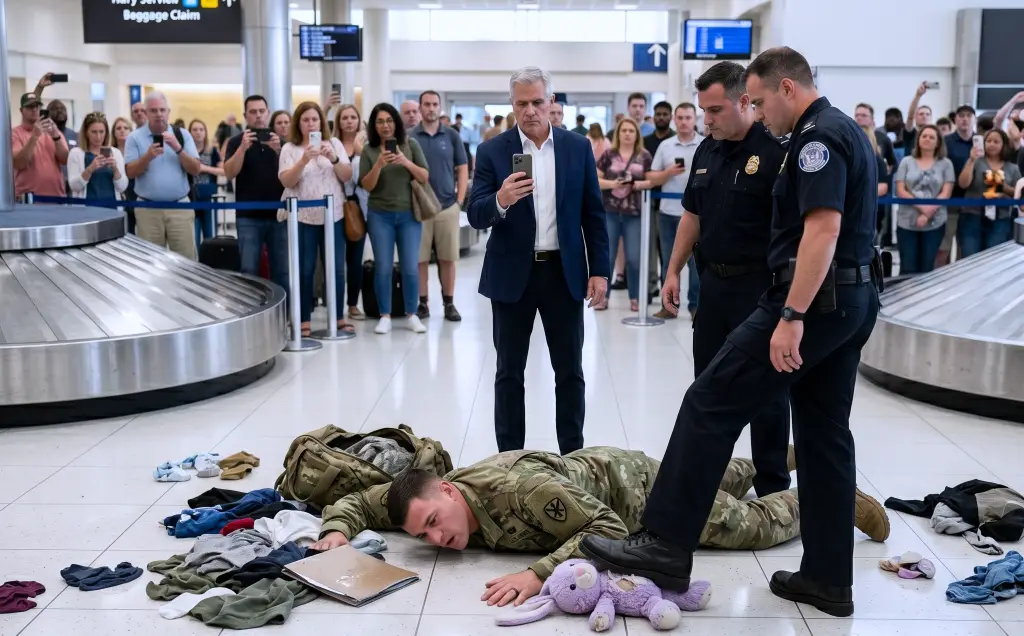
Crowe unzipped the duffel and dumped it upside down. Socks, T-shirts, a shaving kit, a paperback, the folder, and the lavender bunny spilled across the polished floor. Shampoo popped open and leaked in a clear streak toward the Bronze Star citation.
Marcus’s chest tightened. “Careful with that folder.”
Crowe laughed under his breath. “He’s got paperwork.”
The bunny rolled once and stopped beside Denton’s boot. Its stitched smile faced up, one ear bent from travel. Marcus looked at it and thought of Ava asleep with both hands tucked under her cheek, waiting for morning because he had missed too many nights.
“That’s for my daughter,” he said quietly.
Denton looked down. For one second he seemed embarrassed. Then Harlan’s eyes found him, and whatever small decency had surfaced in him disappeared under the need to belong. Denton pressed his boot onto the bunny’s soft foot.
He did not stomp. He ground down slowly.
Marcus’s hands curled at his sides and opened again. His daughter’s gift flattened under airport grime while a dozen phones rose around him. He could feel the shape of the trap closing.
“Pick up my ID,” he said.
Harlan stepped nearer. “What did you say?”
“I said pick up my ID, please.”
“Get on your knees.”
The words fell between them, and all the movement in Marcus’s body stopped. He saw Crowe’s hand drift toward his cuffs. He saw Denton’s jaw working. He saw Harlan waiting, hungry for the smallest wrong motion.
Marcus thought of Tessa at arrivals with Ava’s glitter sign. He thought of the men he had worked on in dust and smoke. He thought of all the ways a story could be written afterward if he gave them even one twitch to use against him.
So he lowered himself to his knees.
“Hands behind your head,” Harlan said.
Marcus obeyed.
The crowd had thickened into a loose half-circle. People held their phones at chest height, eye level, shoulder height. A teenage boy whispered something about views. An older woman covered her mouth, then turned away as if distance could excuse silence.
“Face down,” Harlan said.
“I’m cooperating.”
“Face down.”
Marcus lowered himself, but not fast enough for Harlan. A boot struck the back of his knee, and his cheek hit the tile hard enough to send pain through his teeth. The floor was cold. A smear of spilled shampoo touched his sleeve. Ava’s damaged bunny lay inches from his face.
Crowe pulled Marcus’s wrists back and cuffed him tighter than necessary. The metal bit into skin. Marcus breathed through his nose and held still, because stillness was the only defense left to him.
Harlan circled him with the lazy confidence of a man performing for an audience. “You people think a costume gives you respect. You think nobody’s going to ask questions if you walk around dressed like a hero.”
Marcus stared at the bunny’s plastic eye and said nothing.
“Got quiet now, didn’t you?” Harlan crouched. “No speeches? No brave soldier routine?”
Behind them, General Whitaker lifted his phone and began recording.
He was close enough now to read Marcus’s name tape. Close enough to see the scrape blooming red on the soldier’s cheek. Close enough to hear the word costume and understand that this was not confusion, not caution, not procedure gone wrong.
This was pleasure.
Crowe picked up the folder from the shampoo and shook it once. “What’s this supposed to be?”
Marcus closed his eyes briefly. “Don’t damage that.”
Crowe opened it anyway. His voice rose, mocking the formal language. “Awarded for gallantry in action. That’s rich.”
He dropped the paper back onto the floor, and when his boot came down over one corner, Marcus felt something in him go very quiet. Not peaceful. Not calm. Just sealed off.
Harlan turned toward the watchers. “Folks, step back. We’ve got a possible impersonation situation. Stolen military property, fraudulent identification, maybe more. We’re taking care of it.”
A few people shifted backward. Nobody left.
Crowe picked up the bunny by one ear. “This part of the act too?”
Marcus lifted his head a fraction. “Please. That’s my little girl’s.”
Crowe tossed it. The bunny struck Marcus near the temple and landed in front of him, dusty now, its foot crushed flat. Something in the crowd moved, a soft collective discomfort, but still no one stepped forward.
Harlan began to speak again, and then a voice came from behind him.
“That’s enough.”
It was not loud. It did not need to be.
Crowe spun first. Denton followed, one hand dropping from his belt as if he suddenly remembered where he was. Harlan turned last, irritated at being interrupted, and found himself facing a tall man in a navy blazer with silver hair and eyes that did not blink.
“Sir, back up,” Harlan said. “This doesn’t concern you.”
General Whitaker looked past him to Marcus on the floor. Then he looked at Harlan again.
“You’re wrong about that.”
“I said move back.”
“I heard you.” Whitaker held up his phone. “I’ve also heard the last three minutes. Every word.”
Harlan’s expression tightened. “This is an active police matter.”
“And that is an active-duty soldier under my command.”
For the first time, Harlan really looked at him. The irritation drained out of his face and left something stranger behind, a flicker of recognition so quick most people would have missed it. Whitaker did not miss it. He had spent thirty years noticing what men tried to hide.
Denton’s voice came out thin. “Who are you?”
“Brigadier General Samuel R. Whitaker, United States Army. Commanding officer, Second Brigade Combat Team, Ninety-Fourth Airborne Division.”
The terminal seemed to draw in around them. Phones shifted. Someone whispered, “Oh, man.”
Whitaker stepped closer to Harlan, not touching him, not raising his voice. “Get those cuffs off him.”
Crowe looked at Harlan. Harlan said nothing. Denton moved first, kneeling beside Marcus with hands that had begun to shake. Crowe fumbled with the cuffs, and when they finally opened, Marcus pushed himself up slowly, every movement measured.
“Staff Sergeant,” Whitaker said, his voice changing. Softer now, but no less firm. “Stand up.”
Marcus rose. His cheek burned, his wrists ached, and his uniform was stained with whatever had spilled from his bag. He looked at Whitaker and swallowed once.
“General.”
Whitaker turned back to the officers. The crowd had gone silent in the way people do when they realize they are witnessing consequences arrive in real time.
“Staff Sergeant Marcus Bell is a combat medic,” Whitaker said. “He returned tonight from a fourteen-month deployment. He has saved seven soldiers under fire. Four months ago, outside Forward Operating Base Sparrow, he pulled a lieutenant from burning wreckage and kept that man alive with his hands until evacuation arrived.”
Harlan’s face had gone gray at the edges.
“Eleven minutes,” Whitaker continued. “That’s how long he held pressure on a severed artery while rounds were still being called in and smoke covered the landing zone. I pinned a Bronze Star on him for it. The citation your officer just stepped on is not a prop. It is a record of what this man did when someone else was dying.”
Crowe looked at the paper on the floor as if he had never seen it before.
Whitaker lowered his phone. “You threw his identification on the ground. You dumped his belongings. You damaged a child’s toy. You put a decorated soldier face-down on an airport floor while people filmed him like an animal in a cage.”
Harlan opened his mouth. “General, we had reason to believe—”
“No.” Whitaker cut him off quietly. “You had an opportunity. There’s a difference.”
No one moved.
“This recording has already been uploaded to secure storage,” Whitaker said. “Copies are going to Army legal, civilian counsel, and federal oversight offices. I’d choose my next words with care.”
Harlan looked over Whitaker’s shoulder, searching for an exit that was not there. Crowe stared at the floor. Denton’s face had settled into the pale misery of a man realizing too late that silence had been a choice.
Whitaker turned to Marcus. “Gather your things.”
Marcus bent down. The movement hurt more than he expected. He picked up his ID, the damp folder, his clothes, and finally the bunny. He brushed at its flattened foot with his thumb, but the dirt did not come off.
For a moment, he looked at Harlan.
He had words for him. Plenty of them. But Ava was waiting, and Tessa was waiting, and Marcus had spent fourteen months learning which battles kept a person alive and which ones swallowed him whole.
He said nothing.
Whitaker took the duffel from him without asking and walked beside him toward arrivals. Behind them, three officers remained where they were, surrounded by phones, scattered shame, and the first sound of their own undoing…
Tessa knew something was wrong before she saw Marcus.
The arrivals doors kept opening, releasing families into the waiting crowd. People cried out names, dropped bags, hugged hard. Ava stood on the toes of her sneakers, her sign clutched in both hands, purple glitter flaking onto the floor. Every time a soldier appeared, she gasped and then sagged when it was not him.
When Marcus finally came through, he was not alone. A gray-haired man in a blazer walked beside him with Marcus’s duffel in one hand. Marcus’s cheek was scraped. His uniform was dirty. The folder he carried looked damp at one corner, and the lavender bunny in his hand seemed smaller than it had in Tessa’s imagination.
Ava dropped the sign anyway.
“Daddy!”
Marcus crouched just in time for her to hit him full force. He folded around her, one hand on the back of her head, the other holding the ruined bunny behind him where she could not see it yet. Tessa reached him a second later and touched his face with shaking fingers.
“What happened?”
Marcus closed his eyes for a breath. “I’m home.”
Tessa looked past him at Whitaker, then back at the scrape on her husband’s cheek. “Marcus.”
“I’ll tell you,” he said. “Not here.”
Ava leaned back in his arms and studied him with the blunt concern of a child. “Did you fall?”
He smiled because she needed him to. “A little.”
She noticed the bunny then. Her smile faltered. Marcus held it out carefully, as if it were hurt and needed gentleness.
“It got dirty on the way,” he said.
Ava took it and pressed it to her chest. “We can wash him.”
Tessa watched her daughter hold that damaged toy like it was precious. Then she looked at Marcus, and he knew she understood more than he had said.
Three days later, General Whitaker did not begin with a complaint form. He began with a call that went through layers of gatekeeping before the second ring had finished.
“I need records on Sergeant Frank Harlan and the two officers with him,” he said. “Complaints, disciplinary notes, incident reports, internal reviews, settlements, anything with his name attached. I want the whole history, not the version polished for public release.”
Within hours, Lieutenant Colonel Marisol Vega was assigned to help assemble the record. She was Army legal, precise in her speech and relentless in her follow-through. She warned Whitaker immediately that the military could not simply prosecute civilian airport police.
“I’m aware,” Whitaker said.
“Then we’re building a file for outside authorities.”
“We’re building the file they’ll wish we didn’t have.”
Vega started with public-records requests. She asked for Harlan’s personnel history, the incident report, all body-camera footage, internal communications concerning Marcus Bell, and the airport security recordings from Terminal C between 6:30 and 7:20 p.m. The requests were clean, formal, and ordinary enough that the denial should have been impossible.
It came anyway.
Records unavailable pending internal review.
Vega read the response at her desk, then read it again with a red pen in her hand. The reasoning was thin enough to tear. An internal review did not magically seal everything from public scrutiny, and it certainly did not explain why a routine request had been frozen so quickly.
She called the records office. A clerk transferred her to a supervisor. The supervisor sent her to voicemail. When she called back from a different number, the same clerk answered and claimed the supervisor had stepped out.
That evening, Vega called Whitaker. “Someone got there first.”
“Who?”
“Someone high enough to scare the records people.”
By the twelfth day, the airport videos were everywhere.
Not Whitaker’s recording. Not yet. These were bystander clips, three angles stitched by strangers into one ugly timeline: Marcus kneeling in uniform, Marcus on the floor, Crowe holding up the citation, Denton’s boot on the bunny, Harlan standing over him with the calm authority of a man used to being believed. The internet found the general in the background and circled him in red.
Who’s the guy in the blazer?
Look at him recording.
The officer doesn’t even know he’s standing there.
For a few hours, the country knew Marcus’s name for the right reason. Veterans posted about him. Medics found the Bronze Star citation. People demanded names, suspensions, resignations. Ava’s bunny became the detail no one could forget.
Then the attention began to shift, as it always did. Other stories rose. Other arguments took over. But the videos remained in hard drives, messages, and saved folders.
On the fourteenth day, Vega received an email from an address that disappeared as soon as she tried to trace it.
Check the signature. Not the header. The signature.
The attachment was a scan of the records denial. At the bottom was the name of Riverton Police Chief Robert Vale.
Vega sat back slowly.
Police chiefs did not personally sign denials for airport baggage-claim incidents. They had legal departments and records managers for that. A chief’s signature meant the complaint had climbed to the top of the building before anyone outside the building was supposed to know.
She called Whitaker. “This is bigger than Harlan.”
“I assumed it might be.”
“No, sir. I mean structurally bigger.”
The airport authority, separate from police channels, finally released its security footage three days later. It showed what the bystander videos could not fully capture: Marcus’s complete compliance from first contact to cuffs, the three officers closing around him, Harlan’s body language before he spoke, Whitaker standing close behind them for nearly three minutes with his phone raised.
Then came the body-camera problem.
Harlan’s camera file, according to the department, had suffered a “technical upload failure.” Only thirty-eight seconds remained. The clip showed Harlan approaching Marcus, asking for ID, and then a burst of static.
Vega sent the note to Whitaker with one sentence.
That file did not fail. Someone touched it.
The personnel file arrived through a state-level request five days later, from an office that apparently had not received the same warning. Harlan had fourteen complaints in eight years. Men and women traveling alone. Black travelers. Latino travelers. People with accents. People without lawyers waiting nearby. Every complaint had been marked unsupported.
The same internal affairs captain had signed off on every dismissal: Milton Pryce.
Vega spread the documents across a conference table and walked Whitaker through them one by one. “Same officer. Same kind of target. Same reviewer. Same outcome.”
Whitaker looked at the pages, his hands flat on the table. “A pipeline.”
“A shield,” Vega said. “And there’s a political layer.”
She slid another folder toward him. Inside were campaign reports, committee notes, and police union donations arranged by date.
“Councilman Gerald Kane chairs the public safety committee,” she said. “He’s received forty-two thousand dollars from the Riverton Police Protective League PAC over three election cycles. His committee has killed every oversight proposal brought before it in the last two years. I can’t prove the exchange yet, but the shape is there.”
Whitaker read the name in silence.
Vega watched him. “You’re not fighting three airport officers anymore.”
“No,” he said. “We’re fighting everyone who taught them they could do it.”
The private forensic firm took the body-camera storage device on day twenty-five. Whitaker paid the bill himself. The technicians were careful, quiet, and unimpressed by official explanations.
By midnight, they had recovered four minutes and seventeen seconds.
Vega watched the footage alone first. Afterward, she sat with both hands around a cold paper cup of coffee and let the office lights hum above her. Then she called Whitaker in.
The video began with Harlan walking toward Marcus. No provocation. No raised voice. No suspicious behavior. Just a tired soldier standing near carousel 6.
At thirty-nine seconds, Harlan’s hand moved toward his camera. He believed he had shut it off. But the camera retained a buffer before fully ending the file, and those seconds survived.
Harlan turned slightly toward Crowe. His voice came through clearly.
“Watch how fast he folds.”
Crowe laughed.
A few seconds later came Harlan’s line about the uniform, the one already captured by bystanders from farther away. On body cam, there was no crowd noise to soften it. There was only his voice, close and clear, reducing Marcus to suspicion before Marcus had done anything at all.
The rest was worse because it was undeniable. Marcus lowering himself. Harlan forcing him down. Crowe mocking the citation. Denton stepping on the bunny. Whitaker’s voice entering from behind them.
Vega stopped the video at the end. “They buried this because it ends every argument.”
Whitaker did not answer. His jaw worked once, and then he stood.
The recovered footage went to the city attorney, federal civil rights contacts, and select oversight staff. Every file was time-stamped and copied before it left Vega’s hands. Whitaker spoke with journalists he had trusted over decades of public service and told them only that a story was coming.
For the first time since the airport, Marcus let himself exhale.
That night, after Ava went to bed, he sat on the couch with Tessa’s hand in his. The house was dark except for one lamp. The repaired bunny, still faintly stained near one foot, sat on the coffee table where Ava had left it tucked under a dish towel blanket.
“Maybe now,” Tessa said.
Marcus nodded, but carefully. Hope had become a thing he did not want to hold too tightly.
Two days later, Chief Robert Vale held a press conference.
He stood in front of city hall with flags behind him and microphones crowded at his chest. His uniform was immaculate, his face solemn, his voice trained to sound like patience.
“After reviewing the available evidence,” Vale said, “the department has found no violation of policy by Sergeant Harlan or the officers involved in the Terminal C incident.”
Marcus watched from his living room. Ava sat on the floor behind him building a crooked tower from wooden blocks. Tessa stood in the doorway with one arm folded across her stomach.
“The individual involved appeared agitated,” Vale continued, “and our officers responded under established safety protocols. We are also mindful that combat veterans may carry invisible injuries. That reality requires compassion and caution.”
Marcus lowered the volume, but he did not turn it off.
Tessa whispered, “They’re using it against you.”
The next sentence confirmed it.
“We ask the public not to draw conclusions from edited videos distributed without context. Out of respect for privacy, we cannot release the full record, but that record supports the officers’ actions.”
The full record was sitting on secure drives in three places. Marcus had seen Harlan smile into his own camera. He had heard the words. Now the chief was asking the city to believe the evidence proved the opposite of what it showed.
By evening, the headlines had softened around the officers and sharpened around Marcus.
Questions remain about veteran’s conduct.
Police cite possible combat stress in airport incident.
The comments followed. Some were kind. Many were not. Strangers diagnosed him, mocked him, thanked him for his service and then doubted every word he said. His uniform, once evidence of sacrifice, became evidence in someone else’s argument about danger.
Tessa’s manager called the next afternoon.
The conversation lasted four minutes. Tessa listened, said very little, and hung up with her face empty.
“Paid leave,” she told Marcus. “Until things calm down.”
“That’s not leave.”
“I know.”
Ava came home the following day without her usual rush of stories. She put her backpack by the stairs, walked into the kitchen, and stood beside Marcus while he packed her lunch container into the sink.
“Daddy?”
He knelt. “What’s up, Bug?”
“Madison said her mom saw you on TV. She said you scared people because your brain got hurt in the Army.”
Tessa turned away from the counter.
Marcus kept his voice steady. “My brain isn’t hurt.”
“Then why did they say it?”
He looked at his daughter’s small face, at the glitter still trapped under one fingernail from the sign she had never gotten to hold up. He had answered questions under pressure in war zones. He had talked men through pain and fear. He had no answer that fit inside six years old.
“Sometimes grown-ups say things because they want people to stop looking at what they did,” he said.
Ava thought about that. “So they lied?”
Marcus touched the end of one of her braids. “Yes.”
She nodded, but her eyes did not clear. Children could accept an answer and still carry the wound.
On the thirty-second day, Marcus sat at the dining room table with a withdrawal statement in front of him. The language was neat and bloodless. He would withdraw his complaint. He would decline further action. He would request privacy for his family.
All he had to do was finish signing.
Tessa sat across from him in a sweatshirt, her eyes swollen from too little sleep. The television had been unplugged three days earlier because turning it off had not been enough.
“I’m not asking you to give up because they deserve it,” she said. “They don’t. I’m asking because I don’t know how much more Ava can take.”
Marcus looked at the paper. “I know.”
“She hears things at school. I get calls from people who used to eat lunch with me and now don’t know what to say. You go to the grocery store and people stare like they’re waiting for you to prove the news right.”
“I know,” he said again, softer.
Tessa’s voice cracked. “I want my husband back. I want our little girl to stop asking whether her daddy is bad.”
Marcus pressed his thumb into the edge of the paper until it bent. “And if I sign, what does that tell her?”
“That you chose us.”
The answer hurt because it was not wrong.
Near midnight, Tessa went to bed. Marcus stayed at the table. He picked up the pen, wrote Marcus, and stopped before Bell. One more word, and the city could close its file. Harlan could call it vindication. Vale could claim the department had been right all along.
One more word, and maybe Ava could go to school without carrying his name like a bruise.
A knock came at 11:52 p.m.
Marcus opened the door to find General Whitaker on the porch, still in a blazer despite the warm night. He looked older than he had at the airport.
“May I come in?” Whitaker asked.
Marcus stepped aside.
Whitaker saw the paper before he sat down. Tessa appeared in the hall, tying her robe closed, her face tense with sleep and worry.
“I’m sorry for the hour,” Whitaker said to her. “I wouldn’t be here if it could wait.”
Marcus pushed the statement toward him. “Sir, I can’t keep doing this to them.”
Whitaker did not pick it up.
“My wife has been pushed out of work without being fired. My daughter thinks people hate me because of something on TV. They’re not just coming after me.” Marcus’s voice thinned, and he hated that he could hear it. “They figured out where to hit.”
Whitaker sat quietly for a long moment. The refrigerator hummed. Somewhere outside, a car passed slowly through the neighborhood.
“Do you remember the lieutenant from the convoy?” he asked.
Marcus frowned. “Caleb?”
“Yes.”
“Of course I remember him.”
“You never got his last name.”
“No, sir.” Marcus looked down at his hands. “I asked about him later, but nobody told me much. I knew he made it to surgery. That was all.”
Whitaker’s mouth tightened as if the next words had weight he had carried too long.
“His name is Caleb Whitaker.”
Tessa’s hand went to the doorframe.
Marcus stared at him. “Sir?”
“My son,” Whitaker said. “My only child.”
The room seemed to rearrange itself around that sentence. The medal ceremony, the general’s wet eyes, the hand held too long, the way Whitaker had looked at him in the airport as if the sight of Marcus on the floor had struck somewhere personal—all of it made a terrible new sense.
Whitaker leaned forward, elbows on his knees. “Caleb told me about you after surgery. He said you kept talking to him. He said he begged you not to let go, and you told him you weren’t going anywhere.”
Marcus could feel the desert again, the slick heat under his palms, Caleb’s fingers clamped around his sleeve.
“The surgeon told me thirty more seconds would have changed the outcome,” Whitaker said. “Thirty seconds, and I would have received a folded flag instead of a phone call from a hospital.”
Tessa covered her mouth.
“When I pinned that medal on you, I wanted to tell you. I wanted to put both hands on your shoulders and say that my son was alive because you refused to move. But you were standing there with other soldiers, and I was still your general, and it wasn’t the place.” His voice roughened. “I should have found the place.”
Marcus shook his head once. “I didn’t do it for that.”
“I know.” Whitaker looked at the half-signed paper. “That’s why I’m here.”
Marcus said nothing.
“They want you alone,” Whitaker continued. “They want you tired. They want your wife scared and your child confused. They want you to decide peace is worth more than truth because that is how men like Harlan stay protected.”
Tessa moved to the table and sat beside Marcus.
Whitaker’s voice lowered. “I can’t promise this won’t cost more. I won’t lie to you in your own home. But I can promise you won’t carry it by yourself.”
Marcus looked at Tessa. Her face was wet now, but she was not looking at the paper. She was looking at him.
Whitaker extended his hand across the table, palm down, steady. “You kept my son alive with your hands. Let me stand beside you now.”
Marcus stared at the signature, the unfinished surrender. Then he picked up the statement and tore it once, slowly, from top to bottom. He tore it again and set the pieces in the center of the table.
“What happens next?” he asked.
Whitaker folded the torn paper together and pushed it aside.
“Next,” he said, “we stop asking them to do the right thing quietly.”
Part 3
Whitaker’s counteroffensive began without speeches.
He called people who remembered him from war rooms, oversight briefings, appropriations hearings, and memorial services. He did not raise his voice. He did not threaten. He simply told them he had evidence of police misconduct, a buried body-camera file, a false public statement, and a decorated soldier being turned into a scapegoat.
Vega prepared the package. Sixty-seven files. Airport footage, recovered body-camera video, records denials, complaint histories, campaign donations, internal timelines, and sworn statements from witnesses who had watched the officers surround Marcus at carousel 6.
Then a whistleblower added more.
The encrypted folder landed with an investigative team at The National Ledger three days later. The reporters did not publish immediately. They called sources, verified documents, checked metadata, and gave the city an opportunity to respond. The city responded with a sentence about “ongoing internal processes,” which told the reporters almost everything they needed to know.
The story broke on the forty-fifth day.
Riverton Police Chief Helped Suppress Body-Camera Footage in Airport Detention, Records Show
The article did not ask readers to feel anything. It laid out the record until feeling became unavoidable. Harlan had targeted Marcus without cause. His report had claimed Marcus was loud, agitated, and noncompliant. Airport footage showed the opposite. His body-camera file had been deleted after the incident and later described as corrupted. Internal emails suggested the deletion was not the only thing being hidden.
One email from Chief Vale to Captain Pryce appeared in the middle of the story.
Make Bell complaint disappear. Harlan has cover. Handle as usual.
Pryce’s reply was shorter.
Marked unsupported. Same process.
Then came the political layer.
Chief Vale to Councilman Kane: Need committee quiet on airport video. Protective League concerned.
Kane to Vale: Understood. No hearing unless I approve one.
The article followed the money. Forty-two thousand dollars in campaign support from the Riverton Police Protective League PAC had flowed into Kane’s elections over three cycles. The same PAC backed Harlan’s legal defense. The same PAC fought civilian review. The same committee Kane chaired controlled whether oversight proposals moved or died before reaching a public vote.
By noon, every local station was reading from the Ledger’s reporting. By evening, national panels that had called Marcus unstable were using different language. The shift did not feel like repair. It felt like people repainting a wall after leaving the hole underneath.
Marcus watched none of it. He sat on the floor with Ava and helped build a block castle with one crooked tower. When his phone buzzed over and over on the couch, Tessa turned it face down.
The most personal document in the leak was not in the headline. It sat on page fifty-three of the file index, easy to miss unless you knew which name to search.
Franklin D. Harlan. United States Army Military Police Corps.
Enlisted 1998.
Assigned to Fort Larkin, North Carolina.
Separated 2009 under other than honorable conditions.
Reason: sustained excessive force complaint during detainee training exercise; pattern concerns documented.
Final approving commander: Colonel Samuel R. Whitaker.
Vega brought the file to Whitaker before anyone else called him about it. He read the page once and then sat with it in both hands.
“I remember the case,” he said after a while. “Not the man’s face. The file. A training detainee with a broken cheekbone. Witnesses afraid to speak. Harlan said the soldier had resisted, but the injuries and reports didn’t match.”
“You signed the separation.”
“I did.”
Vega leaned against the edge of the desk. “At the airport, he saw Marcus’s unit patch.”
Whitaker’s eyes lifted.
“He knew your brigade,” she said. “Maybe not at first glance. But he knew enough. And when you stepped in, that look you mentioned? That was recognition.”
Whitaker closed the file. The office felt suddenly smaller.
“He wasn’t punishing Marcus for being tired in an airport,” he said.
“No, sir.”
“He was sending it through him.”
Vega did not soften the answer. “That’s what it looks like.”
Fifteen years had passed between the discharge and the baggage claim floor. Fifteen years in which Harlan found another uniform, another badge, another system willing to mistake aggression for authority. Then a soldier wearing Whitaker’s patch stepped into his path with a duffel bag and a child’s toy, and Harlan saw a chance to settle an old debt against someone who did not even know he owed it.
Whitaker called Marcus that night.
Marcus listened from the back porch while Tessa put Ava to bed. The backyard was dark except for the neighbor’s porch light and the faint glow from the kitchen window.
“So it wasn’t random,” Marcus said.
“No.”
Marcus looked out at the grass. “I don’t know if that makes it better or worse.”
“Worse,” Whitaker said. “But clearer.”
For a while, neither man spoke.
Then Marcus said, “He didn’t know me.”
“No.”
“He knew you.”
“Yes.”
“And I was close enough.”
Whitaker shut his eyes. “Marcus—”
“I’m not blaming you, sir.”
“I am.”
Marcus turned toward the window. Inside, Ava ran past in pajamas, the repaired bunny under one arm. Tessa followed with a hairbrush.
“Don’t,” Marcus said. “He owns what he did. Not you.”
The collapse began the next morning.
Chief Vale was placed on administrative leave before lunch. His official statement mentioned a desire not to distract from the department’s mission. Nobody believed it. Reporters camped outside city hall, outside police headquarters, and outside the modest brick building where the public safety committee usually met without cameras.
Two days later, Councilman Kane announced medical leave. His office stopped answering calls. By then, volunteers had already started collecting signatures for a recall.
Captain Pryce hired a lawyer and began talking. People who had spent years writing unsupported on complaint forms suddenly wanted to explain who told them to write it. Crowe and Denton, facing possible charges and the end of their careers, reached Vega through an attorney. They had statements to offer. They wanted consideration.
Marcus did not celebrate any of it.
Justice, he discovered, did not feel like the neat opposite of harm. It came slowly, surrounded by paperwork, and asked victims to relive the worst hour of their lives in rooms full of strangers. It made people who had ignored you suddenly eager to stand near you. It did not uncrush a toy or erase a child’s question.
But it did change the way Ava walked into school.
After the Ledger story, the principal called Tessa and apologized. Not vaguely. Not carefully. She used the words should have protected your daughter. A teacher walked Ava to class the next morning, and Madison’s mother sent a note Tessa read once before throwing it away.
Tessa’s company called too. Human resources apologized for “the unfortunate timing” of the leave. Tessa listened, then asked whether that phrase had come from legal. There was a long pause before the woman on the phone offered reinstatement.
“No,” Tessa said. “You can put that in writing first.”
Marcus heard her from the kitchen and smiled for the first time all week.
The city council scheduled an emergency public safety hearing for day fifty-two. Open session. Cameras allowed. Witnesses under oath.
The night before, Marcus stood in Ava’s doorway and watched her sleep. The lavender bunny lay beside her pillow, one foot still a little misshapen from Denton’s boot and Tessa’s careful repairs. Ava had insisted it looked “brave” now. Marcus did not know whether to laugh or leave the room before he cried.
Tessa came up behind him and slipped her hand into his.
“You don’t have to testify tomorrow,” she said.
“I know.”
“Do you?”
He nodded. “Vega says the documents carry most of it.”
“That’s not what I mean.”
Marcus looked at his daughter. “I spent fourteen months trying to come home in one piece. Then I got here and thought staying whole meant staying quiet.”
Tessa rested her head against his shoulder.
“I’m tired,” he said.
“I know.”
“I’m angry.”
“I know that too.”
He watched Ava turn in her sleep and pull the bunny closer. “I’m going anyway.”
Tessa squeezed his hand. “Then I’m going with you.”
Part 4
The Riverton City Council chamber had never been built for that many cameras.
Tripods lined one wall. Reporters filled the aisles. People stood shoulder to shoulder along the back until fire marshals stopped letting anyone else inside. Chief Vale sat behind his attorney in the gallery, no longer at the table reserved for department leadership. Councilman Kane’s chair on the dais remained empty, a printed card reading medical leave placed neatly in front of the microphone he would not use.
Marcus sat beside Tessa in the second row. Ava was with Tessa’s sister across town, coloring at a kitchen table far away from cameras and microphones. Marcus had kissed her forehead that morning while she was still half asleep.
“Are you going to work?” she had murmured.
“Something like that.”
“Wear your medal.”
He had not planned to. The Bronze Star felt too heavy for a city hearing. But Ava had said it with such simple certainty that he pinned the ribbon to his dress uniform and wore it beneath the chamber lights.
Vega called the pattern witnesses first.
Denise Carter, a middle-school teacher, testified about a 2022 detention at the same terminal. She had been returning from a conference, traveling alone, when Harlan accused her of using someone else’s identification. Her hands shook as she read from her old complaint.
“I was told there was no evidence,” she said. “No one interviewed the passenger who stood next to me and gave me her phone number. No one asked for the security video. Captain Pryce sent the letter himself.”
Next came Malcolm Reyes, a consultant who had missed a client meeting in 2019 after Harlan detained him for ninety minutes over a “suspicious” boarding pass that turned out to be perfectly valid. Then Elena Torres, visiting family from Puerto Rico, described being searched, questioned, and released without apology while her teenage son waited outside baggage claim crying because he did not know where she had gone.
Three voices did what fourteen buried complaints had not been allowed to do. They made the pattern breathe in public.
When Vega played the recovered body-camera footage, the chamber watched Harlan’s face fill the screen. There was no static now. No missing context. No police chief standing at a podium to explain away what everyone could see.
Harlan’s voice came through the speakers.
“Watch how fast he folds.”
A low sound moved through the room. Not a gasp exactly. More like people recognizing, all at once, that the official story had required them not to trust their own eyes.
The footage continued. Marcus kept his gaze forward and did not look at the screen. Tessa held his hand under the table. When Crowe mocked the citation, her fingers tightened. When Denton’s boot came down on the bunny, Marcus heard someone behind him whisper, “God.”
Harlan testified after the video.
His attorney leaned close before every question, although the advice never changed. Harlan sat stiffly, jaw clenched, the color in his face uneven.
“Sergeant Harlan,” Vega said, “did you have any reasonable suspicion that Staff Sergeant Bell had committed a crime before you approached him?”
Harlan stared at the microphone. “On advice of counsel, I decline to answer.”
“Did you state in your official report that Staff Sergeant Bell became aggressive?”
“I decline to answer.”
“Did you manually delete your body-camera footage after the incident?”
“I decline to answer.”
“Did you recognize the unit patch on Staff Sergeant Bell’s shoulder?”
For the first time, Harlan’s eyes flicked toward Whitaker, seated behind Marcus in the gallery.
“I decline to answer.”
“Did you serve under then-Colonel Samuel Whitaker before being separated from the Army in 2009?”
His throat moved. “I decline to answer.”
Eleven questions. Eleven refusals. Each one landed heavier than the last because the evidence had already answered for him.
Vega closed her folder. “The committee calls First Lieutenant Caleb Whitaker, United States Army.”
The room stirred. The name had not appeared on the public witness list.
The rear doors opened, and a young officer entered in dress uniform. He walked without assistance, though the limp was visible if you knew where to look. General Whitaker did not move when his son passed him, but his hand closed over the armrest of his chair.
Marcus turned.
Caleb looked different from the man in the desert. Clean uniform, shaved face, color in his cheeks. But Marcus knew his eyes. He knew the way they had fought to stay open while smoke dragged across the road.
Caleb took the witness chair and adjusted the microphone.
“My name is First Lieutenant Caleb Whitaker,” he said. “Six months ago, I was in a convoy outside Forward Operating Base Sparrow when our lead vehicle hit an explosive device. I was pinned under wreckage. My femoral artery was severed.”
The chamber quieted until even the reporters stopped shifting.
“I remember heat. I remember not being able to move. I remember thinking I was going to die before anyone could reach me.” Caleb’s voice remained steady, but his hand flattened against the table. “Staff Sergeant Marcus Bell reached me. He pulled me out far enough to get pressure on the wound. He kept both hands there until the medevac arrived.”
He looked at Marcus then, not at Harlan.
“I kept asking him not to leave. I don’t remember everything I said. Pain does that. But I remember his answer. He told me he was staying.”
Marcus looked down.
“The surgeon told my family I had almost no time left. Staff Sergeant Bell gave me that time.” Caleb turned toward Harlan. “That is the man you accused of pretending. That is the man you put on the floor. That is the man your department called unstable when the truth became inconvenient.”
Harlan would not meet his eyes.
Caleb’s voice hardened, not with theatrics, but with the restraint of someone who had earned the right to be heard. “You didn’t just humiliate him. You tried to take the meaning of what he survived and use it as a weapon against him.”
The silence afterward did more than applause could have.
The committee vote came quickly. Independent investigation of the Riverton Police Department’s internal affairs division: unanimous. Recommendation for immediate termination of Sergeant Frank Harlan: unanimous. Referral of Chief Robert Vale and Captain Milton Pryce to federal prosecutors for obstruction and civil rights violations: unanimous. Suspension and continued review for Officers Crowe and Denton: unanimous.
Councilman Kane’s absence was recorded in the minutes.
Marcus did not feel triumph when the vote passed. He felt Tessa’s hand in his and the ache in his wrists, a memory more than pain. Across the room, General Whitaker embraced Caleb carefully, as if some part of him still expected the desert to take his son back.
Sixty days after the airport, the formal letters arrived.
Frank Harlan was terminated and charged with perjury and obstruction. His pension was frozen pending the outcome of the criminal case. Chief Vale was dismissed and placed under federal investigation. Captain Pryce cooperated and named everyone who had told him which complaints to bury. Crowe and Denton were suspended, then left the department before their hearings were finished.
Gerald Kane lost his seat in a recall election that drew the largest turnout the district had seen in years. The PAC money that once looked like protection became evidence in an ethics investigation.
The city announced reforms with careful language and new committees. Marcus did not trust announcements. He trusted names on paper, deadlines, outside audits, and the ordinary people who had finally been allowed to say, under oath, what had happened to them.
At home, life returned in small pieces rather than all at once.
Tessa went back to work after receiving a written apology and back pay. She framed neither. Ava’s teacher moved her seat away from Madison without making a show of it. The principal invited Marcus to speak at the school’s Veterans Day assembly, and Marcus politely declined. He was not ready to become a lesson.
The welcome-home sign stayed on the refrigerator. The glitter had shed into the vegetable drawer and under the magnets, and one corner had curled from kitchen steam. Ava refused to let anyone take it down.
On the mantel, Tessa placed the Bronze Star citation after having it cleaned and reframed. Beside it sat a photograph Caleb had sent from the hospital courtyard months after surgery. In it, Marcus stood with one arm around Caleb’s back, both of them squinting into the sun, both thinner than they should have been and alive.
Caleb had written on the white border in blue ink.
For the eleven minutes I couldn’t hold on by myself.
The lavender bunny sat on the arm of the couch, one foot still a little crooked. Ava had sewn a tiny felt star over the damaged spot with Tessa’s help. She said it looked better that way.
One evening, Marcus came home from a medical appointment and found Ava asleep against Tessa, the bunny tucked beneath her chin. The house was quiet. No television voices, no ringing phone, no reporters leaving messages. Just the dishwasher running and Tessa’s thumb moving slowly over Ava’s shoulder.
Marcus stood in the doorway for a long moment.
Tessa looked up. “You okay?”
He thought about the airport floor, the phones, the paper he had almost signed, and the general on his porch just before midnight. He thought about Caleb walking into the council chamber on a leg that had nearly been lost. He thought about Ava asking whether he was dangerous and the way she now slept with the repaired bunny pressed safely under her arm.
He crossed the room and sat beside them.
“Getting there,” he said.
Tessa leaned into him, careful not to wake Ava. Marcus rested his cheek against his daughter’s hair and looked at the sign on the refrigerator, the crooked glitter letters catching the kitchen light.
WELCOME HOME DADDY.
This time, he let himself believe it.