By the time Caleb Turner rattled up to the North Star Community Clinic in his old John Deere, the babies had stopped crying. That silence frightened him more than the wailing had. Both infants lay against the cracked vinyl seat, breathing in short, uneven pulls while Caleb drove one-handed and kept the other hand near them, as if he could steady the whole tractor by will alone.
Nurse June Hall came outside ready to complain about farm equipment blocking the clinic doors. Then she saw Caleb climbing down with two babies gathered against his chest, mud on his boots, blood drying across one knuckle, and his face gone the color of ash.
“June,” he said. “I found them out by the timber.”
“In a crate,” Caleb said, barely above a whisper. “The wolves got to them before I did.”
Less than an hour earlier, his morning had belonged to ordinary work. Spring came late around Ash Creek, Minnesota, and the fields were just beginning to open after months of snow. The air had that sharp clean smell that made Caleb feel as if the whole county had been washed down to its bones.
He liked mornings like that. Caleb had never been much for porch gossip or long conversations at the feed store. People called him quiet when they were being kind and standoffish when they were not, but Megan knew there was more to him than silence. Their children knew it too. Twelve-year-old Lily could pull a laugh out of him with one crooked joke, Grace still climbed into his lap at eight, and little Noah believed his father could fix anything with baling wire and patience.
“You save all your softness for the kids,” Megan had told him once.
That morning, he hooked a disc harrow to the tractor and headed for the far strip of rented ground bordering the state forest. He was glad to get that field: no traffic, no men leaning on truck doors, just the tractor, the thawing earth, and the dark line of woods.
He had just lowered the harrow when a howl rose out of the trees.
Caleb lifted his boot from the pedal and listened through the open cab door. Wolves were part of life in the north, especially after a hard winter, but they kept away from engines and men. This was not one lonely call. It was several urgent voices mixed with sharp yips that made the skin along his forearms prickle.
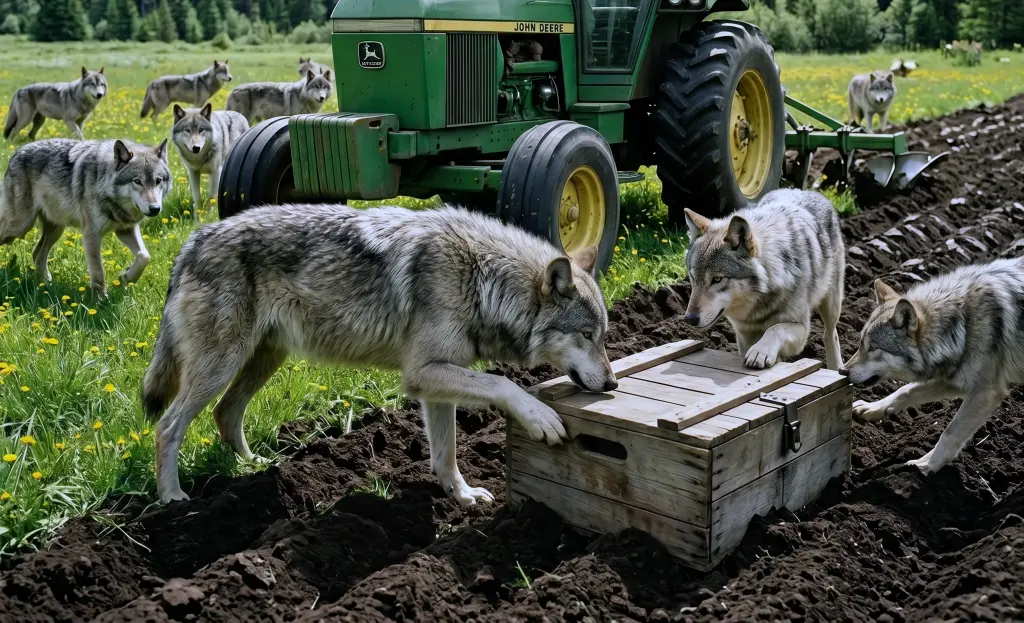
He eased forward. The tractor coughed smoke and pulled the harrow forward until he reached the grassy corner where the field narrowed toward the trees. There, in open daylight, stood eight or ten wolves around a dark wooden box.
Some circled with their heads low. Others faced the tractor as if waiting for him to notice. The box sat in the dead grass, no bigger than a feed crate, slapped together from mismatched boards and scrap plywood.
Caleb stopped but left the engine running. He had seen wolves from a deer stand and once from a snowplow, but never so many, never this close. One of the larger animals trotted toward him, stopped short, and threw its head back. Then it darted to the box, where another wolf was clawing hard enough to scrape pale lines through the muddy wood.
“What are you trying to show me?” Caleb whispered.
The pack did not rush him or bare their teeth. They moved between the tractor and the box with a frantic purpose, as if they had already tried everything their paws and jaws could do.
Caleb climbed down with a pry bar in his hand. The moment his boots touched the ground, the wolves began to fall back. One slipped between the birches, then another. The largest one stayed a few seconds longer, watching him with a stillness that felt almost human, before turning into the brush.
He waited until the clearing seemed empty. Then he walked toward the box, each step slow, his eyes flicking between the boards and the trees. Up close, he saw crooked nails, uneven seams, and claw marks raked across the top where the wolves had tried to open it.
Then something inside cried.
The sound was thin, almost swallowed by the tractor engine, but Caleb knew it at once. He dropped to one knee and drove the pry bar beneath the top board. Rusted nails shrieked loose. A splinter cut his hand, but he kept tearing at the crate until a gap opened wide enough to see inside…
A baby lay on its side in a dirty towel. Beneath him, half hidden by a piece of flannel, a second infant squirmed weakly. Twins. Boys, Caleb thought, though in that moment all that mattered was that they were alive, cold, and far too small to have been left anywhere but in someone’s arms.
He gathered them up awkwardly, terrified his big hands might hurt them. One baby blinked at him with exhausted dark eyes. The other caught Caleb’s shirt in a fist no bigger than a walnut.
“Who did this to you?” Caleb asked, though there was no one in that clearing who could answer.
He carried them to the tractor, made a nest with his jacket, and unpinned the harrow so he could drive straight for town. Before he turned away, he looked once toward the woods. The wolves were gone, but Caleb nodded to the timber as if someone there had stayed long enough to hand him the children.
The clinic filled quickly after June called 911. She and the physician’s assistant wrapped the boys in warm blankets while Caleb stood against the wall, useless and unable to leave. A sheriff’s deputy arrived, then a child protective services caseworker who went quiet when she saw the mud still clinging to the towels.
Deputy Carla Benton asked Caleb to tell the story twice. He could tell she wanted to believe him, but wolves leading a farmer to abandoned infants was not the kind of report anyone filed without standing in the field themselves.
“I know how it sounds,” Caleb said.
Carla closed her notebook. “Then take me there.”
They drove back with two deputies and a conservation officer from the DNR. The crate sat where Caleb had left it, broken open under the gray spring sky. Around it were tracks: Caleb’s boot prints, tire marks from a vehicle that had come in during the night, and wolf prints layered beside the box.
By nightfall, everyone in Ash Creek had heard some version of the story. By the next morning, people were calling Caleb a hero, which made him stop answering his phone. He had almost driven past two babies who would not have survived another cold night.
The sheriff’s office found the boys’ mother two days later in a sagging rental house outside Pine Hollow, about twenty miles away. Her boyfriend was with her. What came out afterward traveled through the county in lowered voices: they had driven the twins out after midnight and claimed someone would find them after sunrise.
They also claimed the crate was meant to protect the babies from animals.
Deputy Benton repeated that part to Caleb only once, and even then she looked ashamed to say it. Caleb stared past her toward the clinic window, where a paper mobile turned slowly over a bassinet.
“Protect them,” he said. “From the only ones trying to get them help.”
The boys were moved into temporary care while the courts began their slow work. Caleb returned to the fields because spring did not wait for anger, but he was not the same man who had driven out there before sunrise. He held Noah longer. He listened more carefully when Grace told him stories from school. When Lily came into the shop asking if she could help sand the wing of a model airplane, he handed her the block and showed her how to move with the grain.
Soon neighborhood kids were spending Saturday afternoons in Caleb’s machine shed, building balsa planes, rubber-band cars, and lopsided boats. Megan watched from the doorway the first day and shook her head with a tired smile.
“You used to hide out here to get away from people,” she said.
Caleb looked at the children bent over the workbench, their faces serious with glue and concentration. “I know.”
The twins came back into his life through visits at first. A caseworker asked whether he and Megan would consider weekend respite care, because the boys seemed to settle when Caleb held them. That night, after the dishes were done and the children were asleep, Megan sat across from him at the kitchen table with both hands wrapped around a mug of tea gone cold.
“We already have three,” she said.
“I know.”
“We’re tired already.”
“I know that, too.”
She studied him for a long moment. “But you’re not going to stop seeing them when you close your eyes, are you?”
Caleb looked down at the scar across his knuckle, the one the crate had left behind. “No,” he said. “I don’t think I am.”
The adoption took months: interviews, background checks, home studies, court dates, and long stretches of waiting while the twins learned the sounds of the Turner house: Grace singing in the hall, Lily thumping down the stairs, Noah whispering through the crib rails. By the time a judge signed the final papers, the boys were no longer strangers from a field. They were Ben and Miles, two sturdy little sons who reached for Caleb’s beard whenever he leaned close.
Years later, people in Ash Creek still told the story of the wolves. Caleb never corrected every detail. He only knew what he had seen: a pack of wild animals refusing to leave a wooden box alone, and two children inside it who grew up under his roof.
On early spring mornings, he still paused sometimes at the edge of that field and looked toward the timber before starting the tractor. The woods never answered. They did not need to.