The first time I saw the trail camera photo, I had to look at it twice before I understood what I was seeing. A wolf sat beside the rusted gate of an abandoned cabin, his body straight and still in the snow, his eyes fixed on the empty yard beyond it. He wasn’t sniffing around for food. He wasn’t passing through. He looked like an animal waiting for a door to open.
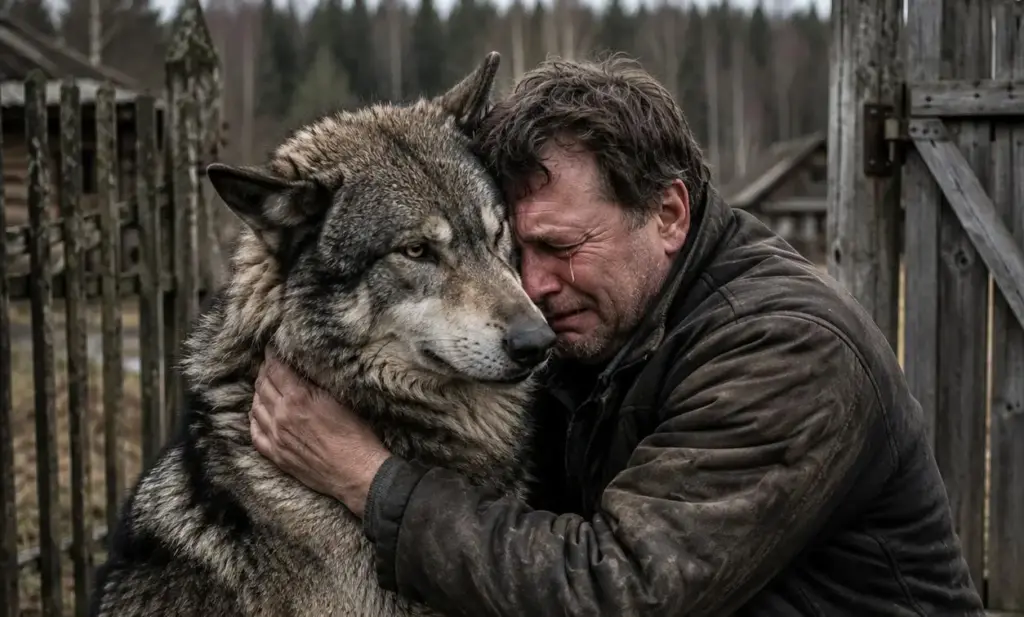
The timestamp in the corner made the picture feel even stranger. Same hour. Same place. Day after day.
For years.
We had ended up in the same hotel lounge after dinner, talking over coffee while rain clicked against the windows. The conversation drifted from bad winters to bear encounters to strange animal behavior. Walter listened more than he spoke. When the others started telling louder stories, he went silent and stared down at his cup.
Then he pulled out his phone.
“There’s one I don’t usually tell,” he said.
He tapped the screen a few times and held it out to me. On it was that wolf at the gate, sitting in the blue-gray light just before dawn.
I looked up at him, expecting some hint that he was exaggerating. There wasn’t any. His expression had gone plain and tired, the way people look when a memory has stopped being a story and gone back to being something they survived.
The man the wolf was waiting for was named Caleb Turner.
Caleb was thirty-eight that winter, unmarried, and more at ease with spruce trees and frozen rivers than with people. He worked as a state wildlife officer in the northern Maine woods, on a district so large that most folks from town couldn’t picture it properly. On a map it looked like a clean green stretch of public land. On the ground, it was twenty thousand acres of timber, bog, ridge, and old logging roads that broke axles in summer and disappeared under snow by December.
The nearest year-round town was nearly seventy-five miles away by a road that only deserved the name in good weather. In February, it became a narrow white scar through the trees, and even experienced drivers treated it with respect.
Caleb liked it that way. He had a small cabin near the edge of a service road, a woodstove that smoked when the wind came from the east, and a porch that looked toward a stand of black spruce. He kept a rifle above the mudroom door, a stack of field notebooks on the kitchen table, and more patience for wounded animals than he ever seemed to have for small talk.
The winter of 2018 had been hard even by Maine standards. Snow came early and stayed. The rivers locked under ice, and the wind scraped across the ridges with a dry, bitter sound that made the cabin walls creak at night.
One afternoon in late February, Caleb was following an old poaching trail near a fast-running creek that never froze cleanly. He had been checking for illegal snares and steel traps, the kind of things careless men left behind when enforcement got too close. The woods were dim under the evergreens, and the air smelled of sap, iron, and snow.
At first, he thought the sound was the wind.
Then he heard it again.
A thin, broken cry came from somewhere off to his right, buried in the tight growth of spruce and fir. It wasn’t a fox. It wasn’t a bobcat. Caleb had spent enough years in those woods to know the difference between ordinary animal noise and suffering.
He stopped, pulled one glove off with his teeth, and listened.
The cry came again, weaker this time.
Caleb shifted his pack and pushed into the trees. Branches snapped against his coat. Snow slid down the back of his collar. He moved slowly because the ground dropped and rose under the drifts, hiding roots and old deadfall, and because the sound had stirred something in him he did not want to name too quickly…
It took him nearly half an hour to find the animal.
At the base of a blown-down spruce, half covered by snow, an old steel trap had closed around the front leg of a wolf pup.
The pup was small, maybe three months old, all long legs and oversized paws beneath a matted gray coat. Blood had darkened the snow under him and frozen in places along the fur of his foreleg. He had fought until he had no strength left. His sides moved in shallow, uneven pulls, and his eyes had the glassy look of an animal standing near the edge of shock.
Caleb crouched several feet away and swore under his breath.
The trap was old, illegal, and ugly. Rust had eaten into the jaws. Whoever set it had likely forgotten it or left it there on purpose, which in Caleb’s mind was worse. A trap like that didn’t choose between coyote, fox, dog, or wolf pup. It simply closed and let the woods do the rest.
For a moment, Caleb considered the rule every wildlife officer knows but rarely says out loud: nature is not kind, and a person can’t save every living thing that hurts.
Then the pup lifted his head.
He did not bare his teeth. He did not lunge. He looked at Caleb with yellow eyes too steady for such a young animal, as if some part of him understood that panic would not help anymore. There was fear in that look, and pain, but there was also a strange, trembling patience.
Caleb had seen trapped animals before. They thrashed, snapped, twisted, fought the air. This one only watched him.
“Easy,” Caleb said softly, though he knew the pup could not understand the word the way a dog might. “I’m not here to make it worse.”
The pup blinked once.
That was all.
Caleb set his pack down and took out a pair of heavy gloves, a folding tool, and a length of rope. He moved slowly, speaking in the low, steady tone he used around frightened animals. Every motion mattered. Even a wolf pup could tear a hand open if terror took over, and this one had every right to be terrified.
The trap fought him. The spring was stiff with rust. Ice had hardened around one hinge. Each time Caleb shifted the metal, the pup’s body tightened, but he only made a faint sound in his throat and pressed his muzzle into the snow.
It took almost an hour.
By the time the jaws finally loosened, Caleb’s fingers ached inside his gloves and sweat had chilled against his back. The pup’s leg slipped free, thin and bloodied, and for one second Caleb expected him to bolt into the trees on three legs and disappear.
He didn’t.
The little wolf sagged sideways, spent completely, and laid his head down as if the simple act of surviving had exhausted him.
Caleb stayed crouched beside him, breathing hard.
Leaving him there would have been the practical choice. Maybe the pack would find him. Maybe they wouldn’t. Maybe the leg was too damaged already. Maybe infection had begun. The temperature was dropping, and the sky above the spruce tops had turned the flat pewter color that meant a bad night was coming.
The pup’s breath hitched.
Caleb took off his coat.
“You’re going to make a fool out of me,” he muttered.
He wrapped the pup inside the coat and lifted him carefully against his chest. The animal weighed less than he expected. Beneath the fur and blood, Caleb could feel a small heart racing, fast and stubborn, against his forearm.
That was how Scout came into his life.
Caleb named him Scout because even half-dead and wrapped in a wool blanket by the stove, the pup kept lifting his head to study the cabin.
The first night was mostly work and worry. Caleb cleaned the wound with warm water and antiseptic, cut away mats of dirty fur, and bandaged the foreleg as carefully as he could. The pup trembled through it, but he never tried to bite. Once, when the pain became too much, he pressed his muzzle against Caleb’s wrist and made a low, broken sound that was not quite a growl and not quite a plea.
“I know,” Caleb said. “I know, buddy. Almost done.”
Outside, the blizzard came in hard after dark. Snow blew sideways against the windows and packed itself along the porch steps. The cabin lights flickered twice before settling. Caleb fed the stove until the room glowed warm and orange, then sat on the floor with his back against a cabinet, watching the little wolf breathe.
He told himself he would keep the pup alive long enough to release him.
That was the sensible plan. A wildlife officer did not turn a wolf into a pet. A man who lived alone in the woods did not invite a wild predator into his kitchen and call it fate. Caleb knew the regulations, the risks, and the arguments better than anyone.
But plans have a way of weakening when a living creature chooses trust before it has any reason to.
By morning, Scout had stopped shaking. By the third day, he drank broth from a shallow pan. By the end of the first week, he could stand for a few seconds at a time, though the injured leg buckled under him. Caleb slept in short stretches on the couch, waking whenever the pup stirred.
The first time Scout dragged himself across the braided rug and rested his head on Caleb’s boot, Caleb stood completely still for almost a full minute.
“Well,” he said at last, looking down at him, “that complicates things.”
Spring came late. The snow softened, then collapsed in on itself. Meltwater ran under the cabin steps and turned the yard to mud. Scout’s leg healed better than Caleb had dared hope, though a faint limp remained when he was tired. His ribs filled out. His coat grew thick and silver-gray. His ears, once too large for his head, sharpened into the alert, handsome lines of a young wolf.
Caleb tried three times to let him go.
The first time, he walked him deep into the timber and left him near a ridge where wolf tracks crossed the snow. Scout followed him back to the cabin before sunset and sat on the porch as if waiting for an apology.
The second time, Caleb drove him fifteen miles north and released him near a stream valley full of deer sign. Scout appeared two mornings later at the edge of the yard, wet, muddy, and offended.
The third time, Caleb didn’t even make it through the speech he had prepared in his head.
“You’re supposed to be out there,” he said, standing beside the open gate.
Scout looked past him into the forest, then back at the cabin. After a moment, he walked around Caleb, went up the steps, and lay down beside the door.
That was the end of it.
Caleb never called him tame. He would not have used that word because it wasn’t true. Scout remained a wolf in every way that mattered. He moved through the trees without sound. He vanished into shadows when strangers came too close. He watched the world with a wild intelligence that did not ask permission from anyone.
But he chose Caleb.
By early summer, Scout had become part of the daily rhythm of the district. When Caleb reached for his field jacket, Scout was already at the mudroom door. When Caleb loaded gear into the truck, Scout jumped into the back and settled against the tool box like he had been born to patrol those roads. When Caleb stopped in the woods, Scout stepped down, lifted his nose, and read the air before Caleb took three steps.
At first, Caleb thought he was imagining the pattern.
Then Scout found the first snare.
It was hidden along a deer trail, nearly invisible under leaves and old snowmelt, a loop of cable set low between two saplings. Caleb might have missed it. Scout didn’t. He froze, lowered his head, and gave a short, harsh breath through his nose. Not a bark. Not a whine. A warning.
Caleb followed his gaze and saw the wire.
After that, he watched more closely. Scout could smell metal under moss, old human scent on bark, gasoline where no engine should have been. He led Caleb to abandoned trap sets, fresh boot prints near closed logging roads, and piles of cut spruce hidden off-trail where someone had been taking timber without permits. He never rushed. He did not perform like a trained dog. He simply noticed what the forest knew and brought Caleb close enough to see it.
Word traveled, as it always does in country places. At first, the loggers laughed about the officer with the wolf riding in his truck. Then people started calling when they saw illegal bait sites or strange tire tracks, because they knew Caleb and Scout would come.
The bond between them settled into something quiet and practical. Caleb fed him, bandaged him when he got into trouble, and spoke to him like a partner. Scout slept by the stove on cold nights and on the porch when the weather warmed. He learned how to nose open the loose latch on the pantry door, which forced Caleb to fix it properly after losing half a bag of jerky.
There were evenings when Caleb sat outside with a mug of coffee and Scout lay nearby, both of them listening to the long hush of the trees. Caleb had never minded being alone. He had built a life around it, in fact. But Scout’s presence changed the shape of the silence. It no longer felt empty.
One August afternoon, that silence saved Caleb’s life.
They were working near a rocky rise the locals called Knifeback Ridge, clearing storm damage from an old access trail. A windstorm had come through two nights earlier and dropped trees across the track. Caleb was cutting branches and dragging them aside, sweating through his shirt despite the shade, while Scout moved along the tree line.
The wolf stopped so suddenly that Caleb noticed before he heard anything.
Scout stood with one paw lifted, nose pointed into the wind. The hair along his shoulders rose. A low sound rolled out of him, deep enough that Caleb felt it in his chest before he fully registered it.
Caleb set down the saw.
“What is it?”
Scout did not look at him. His eyes stayed fixed on a wall of young birch and alder about forty yards away.
Then the brush moved.
A black bear pushed through the saplings, but it did not move like a healthy bear. Its coat hung in rough patches. One side of its face looked swollen. Its eyes were dull and inflamed, and strings of saliva hung from its mouth as it swung its head toward Caleb.
Most bears wanted distance from people. Caleb had seen plenty, and almost all of them turned away when given a chance. This one didn’t. Something was wrong with it—sickness, hunger, injury, maybe all three—and wrong animals do not follow the rules people count on.
Caleb’s rifle was in the truck, a hundred and fifty yards downhill.
The bear rose partway on its hind legs, then dropped forward and came on.
Caleb had time for one clear thought: he had made a mistake.
Not a small one. Not the kind a man can laugh about later. He had left the rifle because he was only clearing deadfall. He had let the truck sit too far down the trail. He had trusted routine in a place where routine could kill you.
Scout moved before Caleb could reach for the hatchet on his belt.
The wolf launched across the uneven ground in a gray blur, not with blind panic but with terrible precision. He angled toward the bear’s shoulder instead of running straight at its jaws, then cut sideways at the last instant, forcing the larger animal to turn. The bear roared and swiped. Scout twisted away, close enough that the paw tore through the air where his ribs had been.
“Scout!” Caleb shouted.
The wolf didn’t come back.
He went in again.
The fight was ugly and fast. It did not look like the clean, heroic battles people imagine when they tell stories indoors. It was dirt, teeth, claws, torn moss, and the heavy stink of a sick bear in the heat. Scout snapped and dodged, drawing the bear away from Caleb one yard at a time, giving him the only thing that mattered.
Distance.
Caleb stumbled backward, grabbed a fallen branch, and shouted until his throat burned. The bear swung toward him once, but Scout hit it from the side and latched near the thick fur below its jaw. For several seconds, both animals crashed through the brush, locked together in a furious blur of muscle and sound.
Then the bear broke away.
It bawled, shook its head, and barreled into the trees, smashing through alder stems until the noise faded down the slope.
For a moment, the woods held still around Caleb.
Scout stood between him and the place where the bear had vanished. His chest heaved. Blood ran from a cut above one eye, darkening the fur along his muzzle. One ear hung torn at the edge, and there were muddy streaks across his shoulder where the bear’s claws had grazed him.
Caleb took one step toward him, then another.
“Hey,” he said, but his voice came out rough. “Come here. Let me see.”
Scout turned his head and looked at him.
There was no triumph in the wolf’s face, no wild display, no demand for praise. He looked almost annoyed, as if Caleb had ignored good advice and forced him to make a point the hard way.
Caleb laughed once, shakily, then dropped to one knee in the leaves. Scout came to him and pressed his head against Caleb’s chest with enough weight to nearly knock him backward.
“I know,” Caleb whispered, gripping the thick fur at his neck. “You warned me.”
He cleaned the wounds back at the cabin with hands that still weren’t steady. Scout endured the washing, the stitching, and the bandage around his ear with the same grave patience he had shown as a pup in the trap. Every now and then, he rested his eyes on Caleb’s face, not accusing him, not pleading with him, simply watching.
That night, Caleb did not sleep much. Scout lay by the stove, breathing deep under the dull glow of the fire. The cabin smelled of antiseptic, wet fur, and woodsmoke. Caleb sat at the kitchen table with his field notebook open, but he wrote only three words.
Scout saved me.
After that day, Caleb stopped thinking of the wolf as an animal he had rescued.
Rescue was too small a word for what had grown between them. It suggested one life reaching down to lift another, neat and one-sided. What Caleb had with Scout was not neat. It was a debt that had crossed back and forth so many times neither of them could have measured it.
In the months that followed, their partnership became the quiet legend of the northern woods. Truckers on logging roads knew to slow when they saw Caleb’s green state vehicle because Scout might be riding in the back. Hunters coming through the checkpoint asked about him, pretending casual interest while craning their necks for a glimpse. Children from the school in Millbridge sent drawings after Caleb visited during wildlife week, nearly all of them showing the wolf bigger than the truck and braver than any animal had a right to be.
Caleb kept the drawings in a folder by the radio.
He never made Scout into a showpiece. He didn’t bring him to town unless he had to, and he warned people not to approach him. Scout tolerated a few trusted humans at a distance, but his world stayed narrow by choice: the cabin, the woods, the truck, and Caleb.
That was enough.
By late fall, the limp in Scout’s old injured leg had almost disappeared. The torn ear healed with a notch that gave him a permanently rugged look. Sometimes, when he stood in the first snow of the season with his head lifted to the wind, he looked less like a companion than a piece of the wilderness itself—untouchable, ancient, impossible to own.
Caleb understood that better than anyone.
“You don’t belong to me,” he told him one evening, while stacking firewood beside the porch.
Scout sat by the gate, watching the tree line.
Caleb set another split log on the pile and smiled faintly. “I know. You just keep showing up.”
The wolf’s ears flicked back at the sound of his voice, but he didn’t turn around. He didn’t need to.
Winter settled again over the Maine woods. Snow filled the old tracks, sealed the bogs, and softened the world to white. Each morning before first light, Caleb opened the cabin door and Scout stepped out ahead of him, pausing at the gate the way he always did. He would stand there for a few seconds, nose working, eyes on the timber, waiting until Caleb came down the steps.
Then they would go together.
From the outside, it might have looked like habit. To Caleb, it felt like an agreement renewed every day without words.
A man had once knelt in the snow and opened a trap.
A wolf had remembered.