The late afternoon sun baked the limestone soil of the Texas Hill Country, casting long, wavering shadows across the Arcadia Exotic Animal Sanctuary. Out in the main paddocks, the distant, low-frequency rumbles of the resident herd vibrated through the dry earth. But here, in the isolation wing built for critical intakes, the only sound was the rhythmic, mechanical click of an oscillating fan and a shallow, ragged wheeze.
Dr. Jim Holden stood at the edge of the quarantine enclosure, his forearms resting heavily on the top rail of the steel fence. At fifty-two, he had spent the better part of two decades pulling large animals out of the worst situations human negligence could invent. He was used to the smell of iodine, the sting of sweat in his eyes, and the grim calculus of veterinary triage. But the scene in front of him was testing the limits of his professional detachment.
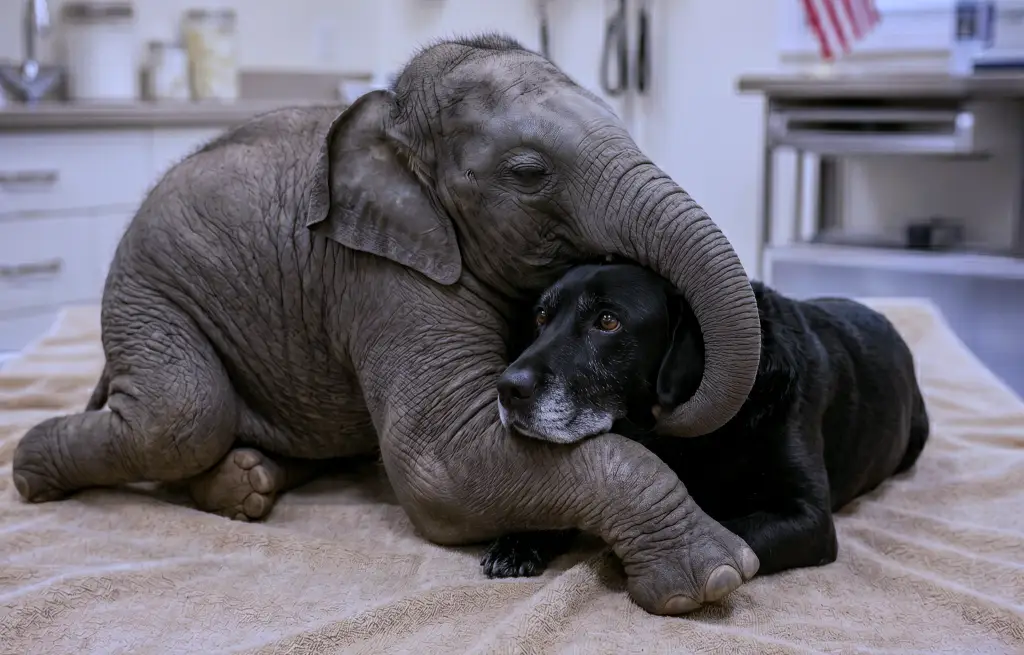
Toby, a three-week-old calf, lay in the center of the rubberized matting. He was curled into the tightest ball his skeletal frame would allow. His gray skin, which should have been thick and taut with healthy baby fat, hung in loose, dehydrated folds over his ribs. A severe, untreated bacterial infection had sealed his eyes shut days ago, leaving tracks of dried fluid trailing down the sides of his face. The sanctuary’s medical team had thrown every broad-spectrum antibiotic they had at the infection, stabilizing his vitals but losing the battle for his sight. The damage to the corneas was irreversible.
Since his arrival at Arcadia, Toby had systematically shut down.
He refused the specially formulated milk replacer. He ignored the fresh coastal bermuda grass. He flinched at the vibration of human footsteps and showed zero interest when the staff brought Stella, a gentle fifty-year-old matriarch, to the fence line to offer comforting rumbles. He hadn’t even reacted to Daisy, a playful two-year-old rescue who usually drew every new calf out of its shell.
Footsteps crunched on the gravel path behind Holden. Sarah Mitchell, the sanctuary’s senior elephant keeper, stepped up to the rails. Her khaki uniform was stained with dirt and dried milk replacer, and she looked like she hadn’t slept since the USFWS truck pulled through the front gates.
“His respiration is up,” Sarah said, keeping her voice low. She didn’t look at Jim; her eyes stayed locked on the calf. “And his heart rate is getting reedy.”
“We can’t tube him again, Jim. We just can’t.”
She was right. They had inserted a gastric feeding tube twice over the weekend. The physical restraint and the sheer panic it induced in the blind calf had spiked his cortisol levels so high that Jim feared the stress of a third attempt would trigger a fatal cardiac arrest. Starvation was killing him slowly; the tube might kill him in minutes.
Down in the enclosure, the heavy steel door unlatched with a dull, metallic clack. Sam Davis, one of Arcadia’s most experienced handlers, stepped inside. He moved with the agonizing slowness required when working with a blind, terrified prey animal. In his right hand, he carried a heavy plastic nursing bottle filled with two quarts of warmed formula. Jim and Sarah watched in tight silence as Sam knelt on the matting, a few feet from the calf’s head…
Sam unscrewed the cap of the bottle just a fraction of an inch. The sweet, heavy scent of warm coconut oil, human-grade infant formula, and probiotics drifted into the stagnant air of the enclosure. Sam didn’t reach out. He didn’t try to force the nipple into the calf’s mouth. He just stayed perfectly still, letting the smell do the work.
Toby’s trunk twitched. The tip—no larger than a human fist—curled back slightly, the sensitive prehensile muscles working to track the scent. For a second, a natural reflex seemed to kick in. His weight shifted forward. But then the calf froze. He dragged his fragile body backward until his rump hit the concrete block wall of the enclosure. He pressed himself into the corner, his ears pinned flat, trembling.
Sam stayed kneeling on the mat for another twenty minutes. He spoke in a low, gravelly murmur, the steady rhythm you might use to talk down a panicked horse. Toby didn’t move. Finally, Sam tightened the cap on the bottle, pushed himself up with a heavy sigh, and walked out. He caught Jim’s eye through the rails and shook his head.
Twenty minutes later, the main conference room in the administrative building smelled of stale coffee and dry-erase markers. The air conditioning hummed aggressively, fighting the afternoon Texas heat. Margaret Vance, the Director of Operations, sat at the head of the laminate table, studying the printouts of Toby’s latest blood panels.
“His BUN and creatinine levels are climbing,” Margaret said, her voice stripped of any sentimentality. She set the paper down. “He’s severely dehydrated, Jim. The IV fluids are a bridge, not a solution. We are watching this animal starve to death in slow motion.”
Sarah sat next to Jim, staring at the scarred surface of the table. “He lost another four pounds since yesterday. He’s just… he’s hollow.”
Margaret folded her hands over the file. “Jim. You know what the protocol is here. When an animal refuses food to the point of organ failure, when the stress of intervention outweighs the medical benefit… we have to talk about quality of life. We have to talk about the humane option.”
Euthanasia. The word hung in the chilled air of the room, unspoken but universally understood.
Jim leaned forward, resting his elbows on the table. “I’m not ready to call it.”
“Jim,” Margaret started, her tone softening with a terrible kind of professional pity. “He has no herd, no mother, and no sight. His depression—”
“It’s not just depression, it’s a sensory vacuum,” Jim interrupted, keeping his voice level. “But he is not brain-dead. When I was doing the chest auscultation this morning, I watched his ears. The AC compressor outside kicked on, and his left ear swiveled to track the vibration. His heart rate is reedy, yes, but the rhythm is strong. The neurological hardware is still firing. He’s processing his environment.”
“But he won’t eat,” Sarah whispered.
“Because he’s terrified of us,” Jim said. “We smell like the people who raided the zoo. We smell like the transport truck, the needles, the restraint chutes. I need more time. Let me try something else.”
Margaret sighed, rubbing her temples. “Something else like what? We’ve tried Stella. We’ve tried the other calves. We’ve tried every feeding nipple and formula mixture on the market.”
“I don’t know yet,” Jim admitted, a hard knot of frustration tightening in his chest. “Give me two weeks. Fourteen days. If his organ function crashes before then, or if he goes into irreversible shock, I’ll draw the phenobarbital myself. But give me two weeks to figure out how to reach him.”
Margaret looked at Sarah, who gave a slow, reluctant nod. Then Margaret looked back at Jim.
“Two weeks, Jim,” she said quietly. “But if his suffering escalates, we pull the plug sooner.”
After the room cleared, Jim stayed at the table alone. He stood up and walked over to the window, looking out across the dusty compound toward the isolation wing. He had just bought fourteen days of grace, and he had absolutely no idea what to do with them.
Part 3
That evening, the suffocating heat finally broke, giving way to the dry, cooling breeze of the Texas twilight. Before heading to his truck, Jim made his usual detour to the domestic animal rescue annex located just beyond Arcadia’s main gates. The sanctuary often shared veterinary resources, bulk feed, and expertise with the county-run shelter next door. Normally, Jim used these visits to clear his head, checking surgical incisions on stray dogs or consulting on a difficult intake.
Tonight, the smell of industrial bleach and dry kibble offered no comfort. He found Mary Carter, the shelter’s lead coordinator, hosing down the concrete walkway in the quarantine wing.
Mary shut off the nozzle and wiped her forehead with the back of her wrist. “You look like you went ten rounds with a cement mixer, Jim. Toby?”
“Still declining,” Jim said, leaning against the chain-link fencing. “I bought him some time, but unless a miracle falls out of the sky, we’re just delaying the inevitable. You got any easy cases back here to cheer me up?”
Mary gave a tight, sympathetic smile. “Not exactly. But I do have a dog you should see. A relative surrendered him a few days ago. He’s a long way from home.”
She led Jim past the noisy general population runs toward the quiet holding pens in the back. Behind the welded wire of the last kennel lay a large, heavy-boned black Labrador mix. He was resting on a raised Kuranda cot, his front paws crossed over the edge. His coat was a deep, glossy ebony, broken only by a jagged line of fresh pink scar tissue running down his left shoulder.
As Jim and Mary approached, the dog didn’t jump up. He didn’t bark, whine, or pace the fence. He simply lifted his head and watched them with the flat, heavy stare of an animal that had seen the worst of the world and survived it. After a moment, his tail gave one slow, deliberate thump against the canvas cot.
“His name is Shadow,” Mary said quietly. “He belonged to an outfitter up in Wyoming, a guy named David Kincaid. Led backcountry pack trips. From what the family told me, David and Shadow were tracking a stray pack mule in the Wind River Range when they spooked a grizzly off a fresh kill.”
Jim frowned, looking at the deep scar on the dog’s shoulder. “Shadow took a hit.”
“He tried to turn the bear,” Mary nodded. “Bought David some time, but it wasn’t enough. When the forest rangers found the site the next morning, Shadow was lying across David’s chest. He was bleeding out, dehydrated, and half-frozen, but he wouldn’t let the medics near the body. They had to tranquilize him to treat his wounds.”
David’s sister lived in Austin, Mary explained, and she had driven up to Wyoming to bring the dog down to Texas. But a small apartment and a busy work schedule were no match for a traumatized working dog. Shadow had completely withdrawn. He wasn’t aggressive, but he refused to eat unless Mary hand-fed him, and he spent his days staring at the cinderblock wall of his kennel.
Jim knelt on the damp concrete, bringing his face level with the dog. Shadow met his gaze calmly. There was no fear in the animal’s posture, just a profound, overwhelming absence.
“He’s grieving,” Jim murmured.
“Shutting down,” Mary corrected gently. “Same as your calf. Physically, his incisions are healing perfectly. But his cortisol is through the roof. He doesn’t want to be here, and he doesn’t want to connect with any of our staff. He’s a one-man dog who lost his man.”
Jim watched the slow, even rise and fall of Shadow’s ribs. The dog wasn’t panicking. He wasn’t frantic. He was simply anchored in his own loss, waiting for an end to the confusion.
An idea—reckless, dangerous, and entirely outside the bounds of conventional veterinary protocol—flashed through Jim’s mind.
He looked at Shadow, then thought of Toby curled in the corner of the isolation pen. Two animals. One was a highly social predator hardwired for pack loyalty, suddenly stripped of his leader. The other was a herd-dependent prey animal, plunged into a dark, silent void. Both were dying from a lack of physical and social tethering.
Introducing a domestic canine to a blind, terrified elephant was a liability nightmare. If Shadow barked or snapped, Toby could panic and fracture a leg against the concrete walls. If Toby lunged, a single blow from his trunk or a misplaced foot could crush the dog. It was the kind of decision that could get a facility shut down and a veterinary license permanently revoked.
But as Jim watched Shadow let out a long, shuddering sigh and rest his heavy chin back on his paws, the clinical risk assessment in his brain gave way to a sharp, unavoidable instinct. The dog wasn’t aggressive; he was steady. And the calf didn’t need medicine anymore; he needed a heartbeat he could trust.
Jim stood up, the joints in his knees popping in the quiet kennel.
“Mary,” he said, his voice completely serious. “I need to borrow this dog tomorrow morning.”
Part 4
Jim didn’t sleep. By 6:00 a.m. the next morning, he was pacing the scuffed linoleum of the clinic’s breakroom, a lukewarm mug of black coffee cooling in his hand. When Margaret, Sarah, and Sam walked in for the morning briefing, he didn’t bother with small talk. He laid out the plan.
For a long moment, the only sound in the room was the hum of the fluorescent lights.
“Absolutely not,” Margaret said, dropping her clipboard onto the table. “Jim, I gave you two weeks to find a medical or behavioral solution. I didn’t give you a blank check to run a circus experiment.”
“It’s not an experiment,” Jim said, setting his mug down. “It’s an ethological intervention. Shadow is a working dog with an incredibly high threshold for stress. He’s grieving, his energy is entirely suppressed, and he’s demonstrating zero prey drive. Toby needs a heartbeat that doesn’t smell like a human.”
“He’s a predator, Jim,” Sarah argued, her voice tight with disbelief. She crossed her arms, physically leaning away from the idea. “Toby is a prey animal. A blind, deeply traumatized prey animal. If that dog so much as barks, Toby will panic. He’ll hit the concrete wall, shatter a femur, and we’ll have to euthanize him on the floor. It’s too reckless.”
“If we do nothing, he’s dead by Friday,” Jim countered, holding Sarah’s gaze. “His kidneys are already struggling to filter. He’s giving up. But look at the behavioral overlap. Elephants and canines are both highly complex, socially dependent species. When they lose their herd or their pack, they lose their spatial and emotional anchor. We put them in a neutral space. No pressure, no forced contact. Just shared air.”
Margaret pressed her fingers to the bridge of her nose. She was thinking about the liability, the safety protocols, and the Board of Directors. But she was also thinking about the frail, gray calf dying in the isolation wing.
“One session,” Margaret finally said, her voice hard. “In the padded observation room. You draw up a syringe of xylazine and have it in your pocket. Sam stands by the heavy door with a catchpole. If the dog shows teeth, or if the calf spikes his heart rate into the danger zone, we abort immediately. No second chances.”
It took two hours to prep the space. The observation room, usually reserved for post-operative recovery, was a ten-by-ten square with thick rubberized walls and a drain in the center of the sloping floor. Sam removed the metal water troughs and anything else with a hard edge. Sarah set up a secondary camera on a tripod to monitor the room from the hallway. Jim prepped the sedative, slipping the capped needle into his chest pocket.
At nine o’clock, Jim walked over to the shelter. Mary had Shadow on a heavy nylon slip lead. The dog didn’t pull or strain against the collar; he just walked with a slow, mechanical gait, his head carried low.
When they reached the hallway outside the observation room, Sarah and Sam were already there. Toby was too weak to walk the fifty yards from isolation, so Sam had carried him. The calf looked horrifyingly small in the handler’s arms, his legs dangling limply, his trunk tucked tight against his chest.
“Ready?” Jim asked quietly.
Sam nodded, his jaw tight. He carried Toby into the room, gently lowering the calf onto a thick pile of coastal hay in the far corner. Toby immediately scrambled backward, his hooves slipping on the rubber matting until his hindquarters hit the corner. He curled into a tight, trembling ball, his blind eyes weeping a steady stream of clear fluid. Sam backed out of the room, leaving the heavy door cracked open just enough for him to intervene if things went wrong.
Jim unclipped the leash. He stepped inside, keeping his back to the door, and let Shadow walk in past his leg.
Out in the hallway, staring through the reinforced glass window, Sarah held her breath. Margaret stood beside her, arms crossed, her face pale.
Shadow didn’t rush forward. He stepped onto the rubber matting, his nails clicking softly in the quiet room. He lowered his heavy black head, his nose skimming the floor as he took in the overwhelming scent of the sterile room, the hay, and the terrified wild animal trembling in the corner.
Toby’s ears pinned back flat against his skull. His respiration hitched, turning into shallow, rapid gasps. He could smell the dog. He could feel the vibration of the paws on the floor.
Jim kept his hand hovering near the syringe in his pocket, watching the dog’s shoulder muscles for any sign of tension.
But Shadow didn’t lock his gaze on the calf. Instead, the dog stopped in the center of the room, turned his head completely away, and let out a long, exaggerated yawn.
It was a textbook canine calming signal—a physical broadcast of non-aggression.
Then, very slowly, Shadow turned his body so his side was facing the corner where Toby was huddled. He didn’t take another step toward the elephant. He simply let his heavy hindquarters drop to the matting, lowered his front elbows, and lay down in the exact center of the room. He rested his chin on his paws, his back facing the door, his side parallel to the calf.
He closed his eyes and let out a long, shuddering sigh.
Inside the observation room, the mechanical hum of the ventilation system droned on. Minutes stretched into a quarter of an hour. Neither animal moved. Jim stood perfectly still against the wall, his boots rooted to the floor, watching the slow, synchronized mechanics of two broken animals sharing the same quiet air.
Part 5
For forty-five minutes, the only movement in the observation room was the slow, synchronized rise and fall of two ribcages.
Jim stood frozen by the wall, his hand resting in his pocket over the plastic barrel of the syringe. Through the thick glass of the viewing window, he could see Sarah with both hands pressed flat against the pane, her face tense. Sam hovered just outside the heavy steel door, the catchpole gripped tightly in his fists.
Shadow hadn’t moved from the center of the mat. But as the first hour drew to a close, the Labrador shifted his heavy head. He didn’t look at the calf. Instead, he let out a low, continuous rumble deep in his chest—a steady, vibrating whine that dogs often use to self-soothe in high-stress environments. It wasn’t a growl, and it wasn’t a bark. It was a rhythmic, biological frequency.
Toby, huddled in the corner, was trapped in a world composed entirely of sound, scent, and touch. At the sound of the dog’s chest-vibration, the calf’s frantic, shallow gasps hitched. His ears, which had been pinned completely flat against his skull, relaxed a fraction of an inch. He couldn’t see the predator in the room, but he could hear the steady, non-threatening rhythm. The dog wasn’t hunting. The dog was simply existing.
Slowly, deliberately, Shadow began to close the distance.
He didn’t stand up. Rising to his full height would have projected dominance and triggered the calf’s prey drive. Instead, Shadow army-crawled. He pulled his heavy body forward using his front elbows, dragging his hindquarters across the rubber matting, inching forward while keeping his body strictly parallel to the elephant.
He stopped when there was about six feet of empty space between them. At this distance, the ambient body heat radiating from the eighty-pound dog was palpable. The scent of dried Wyoming dust, healing iodine, and canine fur drifted into the corner.
Shadow let out another long sigh, resting his chin back on the mat. Then, with a subtle shift of his shoulders, he extended his left front leg across the gap. His heavy, black-padded paw rested flat on the rubber, pointing toward the calf.
He didn’t push. He didn’t try to touch the elephant. He simply laid the paw there, exposing his limb, and waited.
Jim held his breath.
In the corner, Toby’s trunk twitched. The prehensile tip, tightly coiled under the calf’s chest, tightened. Slowly, agonizingly slowly, the trunk began to uncurl.
It extended across the matting, hovering an inch above the floor. The twin nostrils at the tip flared, pulling in the microscopic data of the room. Toby was mapping the space entirely by scent and air currents. The trunk swayed left, then right, moving closer to the source of the heat and the low, steady whine.
The tip of the trunk brushed the coarse black fur of Shadow’s paw.
Toby flinched immediately, jerking his trunk back a few inches. He froze, waiting for the retaliation.
Shadow didn’t move a muscle. He didn’t pull his paw away, and he didn’t lift his head. He just kept breathing, his tail giving a single, soft thump against the floor.
After a long minute, Toby reached out again. The gray, wrinkled trunk stretched across the gap, the muscles trembling slightly from exhaustion. This time, the prehensile tip settled deliberately across the top of the dog’s paw. It rested there, featherlight. Thick, leathery skin against soft canine fur.
Shadow responded with the smallest possible movement. He flexes his toes upward, pressing the top of his paw gently against the underside of the trunk. It was a firm, grounding counter-pressure—a physical acknowledgment that the contact was accepted.
Standing by the wall, Jim finally let go of the syringe. He pulled his empty hand out of his pocket and let out a slow, silent exhale, feeling the tight, hard knot of professional dread in his chest begin to loosen.
Part 6
The first session lasted exactly an hour and twenty minutes.
When it was time to end it, Jim didn’t want to break the fragile spell in the room, but he knew they couldn’t push their luck. He took a slow, deliberate step away from the wall. Shadow’s ears flicked back toward Jim, registering the movement, but the dog didn’t jump up. Instead, Shadow let out a soft, breathy chuff—a distinct auditory marker that the interaction was shifting.
Slowly, the dog pulled his paw back, sliding it out from under Toby’s trunk. He shifted his weight, stood up with a low groan of tired joints, and shook out his black coat.
Toby didn’t scramble backward. He didn’t retreat to the corner. The calf simply lay there on the rubber matting, his trunk resting on the empty space where the dog’s paw had been, his breathing slow and even. Jim clipped the heavy nylon lead back onto Shadow’s collar and led him out the heavy steel door.
Over the next three days, the padded observation room became the center of Arcadia’s daily operations. Every morning at eight o’clock, Jim brought Shadow in from the annex. Every morning, the dog would enter the room, do a quick olfactory sweep of the corners, and then lay down parallel to the calf.
The progress was measured in millimeters. On Tuesday, Toby stopped pinning his ears when the door opened. On Wednesday, the calf actively reached out to touch Shadow’s shoulder the moment the dog lay down.
But Toby was still starving. The IV lines were keeping his organs from shutting down, but his body was consuming its own muscle mass. He needed calories, and he needed them immediately.
On Thursday morning, Jim decided to push the boundary.
Shadow was already lying in the center of the matting, Toby’s trunk resting comfortably across the dog’s broad back. The door opened with a soft click, and Sam walked in.
Toby immediately tensed. His trunk slipped off Shadow’s back, and the calf’s muscles locked up, ready to bolt for the corner. Sam stopped moving. In his hands, he held a heavy plastic feed bucket containing a large, modified nursing bottle filled with warm milk replacer.
Shadow lifted his head. The Labrador was a highly trained working dog, but he was still a dog, and the sweet, heavy scent of coconut oil and human-grade formula filled the room. Shadow stood up and trotted over to Sam.
Outside the glass window, Sarah sucked in a breath, terrified the dog was about to knock the milk over or spook the calf.
But Shadow didn’t jump. Relying on years of backcountry obedience training, the dog simply sat down squarely on the mat, right next to the plastic bucket. He stared intently at the warm bottle, his tail sweeping back and forth across the rubber floor in an eager rhythm. Then, Shadow let out a sharp, high-pitched whine of anticipation.
In the center of the room, Toby’s ears swiveled forward like radar dishes.
The calf couldn’t see Sam. He couldn’t see the bucket. But he heard the familiar, safe whine of his anchor, and he smelled the overwhelming scent of the milk radiating from the exact same location.
For the first time since arriving at the sanctuary, Toby didn’t retreat from the smell of human food. He pushed himself up onto his shaky, skeletal legs. His joints popped in the quiet room. Slowly, blindly, the calf took a step forward, tracking the sound of the dog’s sweeping tail and the low, eager whine.
He walked until his front hooves brushed against Shadow’s side. Shadow didn’t move, just let out another soft whine, his nose pointed toward the bucket.
Toby lowered his heavy head. His trunk brushed past Shadow’s shoulder, followed the line of the dog’s front legs, and bumped directly into the hard plastic of the nursing bottle.
Sam didn’t speak. Moving with agonizing care, the handler lifted the bottle just a few inches, angling the oversized rubber nipple toward the searching trunk.
Toby didn’t flinch away from Sam’s hands. Anchored by the physical presence of the dog pressed against his legs, the calf wrapped the prehensile tip of his trunk around the nipple. He guided it into his mouth, clamped down, and began to suck.
The sound of the calf swallowing was loud and wet in the silent room. The milk level in the thick plastic bottle began to drop—one inch, two inches, three. Toby was drinking frantically, his throat working in deep, desperate gulps, while Shadow sat perfectly still beside him, serving as a living, breathing landmark.
Out in the hallway, Jim watched Margaret step back from the glass window. The Director of Operations pressed a hand tightly over her mouth, her shoulders dropping as the crushing weight of the last two weeks finally began to lift.
Part 7
By mid-July, the isolation wing was no longer a hospice. It was a functioning nursery.
Toby’s weight climbed steadily, the loose, dehydrated folds of his gray skin finally tightening over his ribs to accommodate a healthy layer of baby fat. His blood panels stabilized, and his respiration settled into the slow, powerful rhythm of a thriving calf. The irreversible damage to his corneas remained, leaving his eyes clouded and sightless, but his physical deterioration had completely stopped.
As Toby grew stronger, the crushing depression that had pinned him to the corner of the room began to lift, revealing the natural, inquisitive intelligence of a young elephant. And as Toby’s personality emerged, Shadow’s role naturally evolved from a static emotional anchor into a dynamic guide.
The transition wasn’t instantaneous, and it didn’t look like magic. It looked like the practical, daily mechanics of a working dog adapting to a new job.
Jim and Sarah started by opening the heavy steel doors of the observation room, allowing the animals access to a small, enclosed outdoor paddock. The first time Toby felt the hot Texas sun and the unpredictable currents of the wind, the sensory overload panicked him. He froze at the threshold, his trunk sweeping the air frantically, unwilling to step off the familiar rubber matting onto the loose dirt.
Shadow, already out in the sunlight, didn’t try to push or herd the calf. Instead, Jim watched the Labrador rely on the basic principles of spatial pressure.
Shadow trotted back to the doorway. He stood parallel to Toby’s front legs and gave a sharp, full-body shake. His heavy leather collar, newly fitted with three solid brass tags, jingled loudly. Toby’s ears swiveled toward the metallic sound. Shadow took two steps into the dirt. Jingle. He stopped and waited.
Toby took one hesitant step forward, his hooves leaving the rubber and finding the soft earth.
Shadow took another two steps. Jingle.
Within a week, that brass-tag jingle became Toby’s primary navigational beacon. The calf learned to follow the sound with astonishing precision, using the dog’s movements to build a mental map of the paddock. When Shadow walked at a steady pace, Toby followed confidently. When the jingling stopped, Toby stopped, sweeping his trunk to assess whatever obstacle the dog had paused to investigate.
Shadow also naturally developed a boundary system. If Toby wandered too close to the heavy steel pipe-rail fencing, the dog would quickly cut across the calf’s path, using his broad chest as a physical bumper against Toby’s front legs. If Toby kept pushing, Shadow would let out a single, sharp working-dog bark—a low boof that echoed off the metal rails. Toby quickly learned that the bark meant a hard stop.
The most profound change, however, happened when the sanctuary powered down for the night.
In the wild, infant elephants sleep lying down, usually wedged tightly against the massive, reassuring bulk of their mother’s legs. Without that physical contact, orphaned calves often suffered from severe sleep deprivation, waking up thrashing and disoriented in the dark.
During Toby’s first few weeks in the larger paddock, Sarah had prepared a thick bed of coastal hay under the lean-to shelter, assuming Shadow would sleep on the raised canvas cot they had placed nearby.
Instead, the dog ignored the cot entirely. Every night, after Toby collapsed into the hay with a heavy, exhausted sigh, Shadow would circle the calf once, trample down a spot in the hay, and wedge his eighty-pound body directly against the curve of Toby’s spine.
Late one evening, Jim stood outside the paddock fence, watching the monitors on a portable tablet. On the infrared screen, the two animals glowed in stark white against the dark background. Toby was fast asleep, his chest rising and falling in perfect synchronization with the dog pressed tightly against his back.
Shadow wasn’t just guiding the calf through the physical world. He was anchoring him in the dark.
“I’ve spent twenty years reading veterinary literature,” Jim said quietly, glancing up from the screen as Margaret walked up to the fence line to join him. “There is no clinical precedent for this. None.”
Margaret crossed her arms against the evening chill, watching the dark shapes in the lean-to.
“We’re going to need a bigger yard,” she said.
Part 8
By late November, the brutal Texas heat finally broke, bringing crisp, dry autumn winds down through the Hill Country. Toby was no longer a fragile, skeletal calf. He was consuming gallons of specialized formula and pounds of fresh bermuda grass every day, packing on thirty pounds a month. His shoulders broadened, and his trunk grew thick and muscular.
He was rapidly outgrowing the quarantine paddock, and the logistics of keeping a blind, growing elephant safely enriched required a completely new architectural approach.
Margaret Vance spent the month of December fighting with contractors, fencing suppliers, and the sanctuary’s Board of Directors to secure funding for a custom three-acre enclosure. It couldn’t be a standard pasture. Toby couldn’t see the heavy steel pipe-rails, and a sudden spook could send him crashing into a barrier at twenty miles an hour.
Instead, the new yard was designed entirely around tactile and auditory landmarks.
The contractors laid down a ten-foot-wide perimeter of loose, deep sand just inside the fence line. Whenever Toby’s hooves hit the soft, shifting sand, he knew he was running out of space. To help him find his way to the feeding stations, a wide ribbon of smooth, round river rock was trenched into the soil. For hydration, they installed a heavy-duty agricultural pump that constantly circulated water over a stack of concrete boulders, creating a steady, splashing baseline of sound that echoed across the yard.
When they finally opened the gates to the new enclosure, Shadow figured out the environmental map in less than a week.
It wasn’t abstract, magical canine genius; it was practical habit. Shadow liked the cool water, so he naturally trotted along the river rock to reach the splashing pump. Toby followed. The calf quickly learned to pair the sharp, rhythmic crunch of the dog’s nails on the smooth stones with the jingle of the brass collar tags. Together, the sounds created a perfect, moving auditory corridor. If Toby ever lost track of the dog, he only had to stand still and listen for the water, reorienting himself in the three-acre space.
But custom enclosures and specialized elephant care cost tens of thousands of dollars a month, and Arcadia relied entirely on donations and grants.
To secure funding for the new yard, Margaret had recorded a simple, unedited three-minute video on her phone. It showed Shadow walking along the river rock, occasionally pausing to let Toby’s trunk brush his back, guiding the massive calf safely around a live oak tree toward the water trough. Margaret submitted the clip alongside a grant application to a major wildlife conservation fund.
Somehow, the video made its way out of the committee.
It was picked up first by a regional Texas wildlife blog, then by a national syndicate. Within a week, the footage of the blind calf and the black Labrador was everywhere. The sanctuary’s phone lines jammed with calls from morning show producers, documentary filmmakers, and people wanting to drive out to the Hill Country to see the animals in person.
Jim hated the spotlight. He immediately vetoed any public viewing hours or media tours, fiercely protecting the quiet, low-stress environment Toby and Shadow had built. He refused requests to turn the animals into a sideshow.
“They aren’t a morning show segment,” Jim told Margaret, standing in the clinic office as she scrolled through a flood of emails. “If we put cameras in their faces and let strangers hang over the fence, Toby’s cortisol will spike right back to where it was in quarantine.”
“I know, Jim, and I agree,” Margaret said, holding up a hand to stop him. “No public tours. No news crews in the yard. But we can’t ignore the educational value here, and frankly, the donations coming in from that video just fully funded Toby’s feed and veterinary care for the next five years.”
They compromised. Jim agreed to partner with the ethology department at a state university. Instead of a media circus, a small team of animal behaviorists was allowed to set up passive, motion-activated cameras around the enclosure. They spent months quietly studying the mechanics of the interspecies bond, documenting how Shadow adjusted his pace to match the elephant, and how Toby used tactile feedback to monitor the dog’s stress levels.
The resulting peer-reviewed paper was published in a major veterinary journal. It didn’t launch a global institute or feature flashy headlines, but it fundamentally changed how rehabilitation centers across the country thought about herd dynamics and trauma recovery. Toby and Shadow had proved, clinically and undeniably, that a broken prey animal could find its anchor in a predator.
Part 9
The years folded into one another, marked only by the shifting seasons of the Texas Hill Country. The blistering, dust-choked summers gave way to brief, sharp winters, and as the decades passed, the isolation wing where Jim had once stood waiting for a calf to die became nothing more than a memory.
Toby grew. He transitioned from a fragile, skeletal calf into a towering, eight-thousand-pound bull. His shoulders broadened into massive walls of gray muscle, and his tusks came in thick and blunted, used mostly for stripping the rough bark off the live oak trees in his custom twenty-acre pasture. Despite his immense size, he moved with a quiet, deliberate grace, navigating the terrain with perfect spatial awareness.
Shadow, however, aged on a different timeline. A decade is a lifetime for a large working dog.
The deep, glossy ebony of his coat faded, turning coarse and dusting heavily with white around his muzzle, chest, and eyes. The damp winter mornings made his hips stiff with arthritis, and the sharp, energetic bark he had once used to herd Toby away from the fence lines softened into a low, raspy boof.
As the physical reality of their bodies changed, so did the mechanics of their partnership. The sanctuary staff watched the reversal happen in slow motion over the course of a year.
Shadow no longer led the way along the river rock. He didn’t have the energy, and Toby no longer needed the guidance. Instead, the massive bull became the anchor. When Shadow’s arthritis flared up, slowing his gait to a heavy limp, Toby didn’t march ahead. The elephant would stop, shifting his enormous weight, and wait patiently for the old dog to catch up.
The circle of their bond closed completely when Shadow turned fourteen.
The Labrador developed thick, milky cataracts. Within a few months, his vision dimmed until the bright Texas sun was nothing but a hazy, indistinct blur. His hearing began to fade shortly after. The working dog who had once guided a terrified, blind prey animal out of the dark was now becoming trapped in his own dimming, silent world.
Toby adapted instantly. He didn’t need a veterinary behaviorist to explain what was happening. He simply read the dog’s physical hesitation and adjusted his own behavior to fill the gap.
When Shadow stood confused in the center of the yard, unable to locate the water trough, Toby would walk over to the agricultural pump, fill his trunk, and deliberately splash a heavy stream of water against the concrete boulders. The loud, percussive splashing provided the exact auditory landmark Shadow needed to orient himself.
When they moved across the pasture, Toby kept his head lowered. He used the prehensile tip of his trunk like a sensory cane, letting it hover just millimeters above Shadow’s graying back. He tracked the dog’s slow, limping gait entirely by touch and body heat, shortening his own massive strides to ensure he never stepped forward until he felt Shadow move first.
Late one morning in early spring, Jim Holden stood at the heavy pipe-rail fence of the adult enclosure. He was in his late sixties now, his own hair completely white, but the routine remained the same. He held a dented thermos of black coffee, resting his forearms against the steel rail as the cool dawn breeze swept across the grass.
Out in the center of the pasture, the two animals were resting under the sprawling canopy of a live oak.
Toby stood perfectly still, a massive, gray monument against the rising sun. His trunk hung loosely, the tip resting gently on the ground. Wedged tightly against the elephant’s front legs, entirely shielded from the wind and the sun, the old black dog slept soundly in the cool dirt.
There were no cameras, no visiting researchers, and no crowds to witness it. There was no need for a grand explanation of how they had defied the laws of nature or bridged an impossible biological gap.
It was just the quiet, enduring mechanics of survival. Jim took a slow sip of his coffee and watched the massive gray chest and the frail, breathing ribcage of the dog rise and fall together in perfect, unbreakable rhythm.