Chapter 1: The Muddy Boot Print
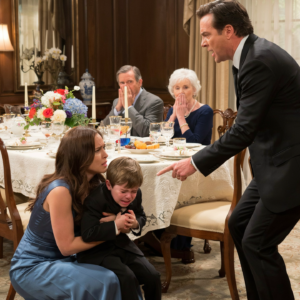
The Sterling Estate on Christmas Eve was less of a home and more of a suffocating masterclass in curated opulence. Every square inch of the sprawling, twelve-thousand-square-foot mansion was designed to project an image of generational wealth and untouchable aristocratic perfection. The air was thick with the scent of imported pine, expensive cinnamon candles, and the overwhelming, metallic sting of profound, sociopathic entitlement.
I stood near the edge of the grand living room, holding a half-empty glass of sparkling water. I was thirty-four years old. I was the Chief Financial Officer and Lead Auditor for a prestigious corporate firm downtown. I was brilliant, relentless, and highly respected in my field.
But in this house, I was merely the invisible, reliable mechanic who kept the engine of their delusions running.
For a decade, I had been the family “fixer.” When my father, Richard Sterling, over-leveraged his commercial real estate portfolio to fund his ridiculous lifestyle, I was the one who spent sleepless nights restructuring his debt to prevent foreclosure. When my mother, Evelyn, maxed out her platinum credit cards on designer clothes and country club dues, I was the one who quietly funled bonuses from my own accounts to cover the minimum payments and protect her pristine credit score. I managed their ledgers, buried their “creative” accounting, and swallowed my professional ethics whole, all under the guise of “keeping the peace” and honoring my family.
I did it because I was the scapegoat, desperately, pathetically trying to earn a seat at a table that was actively trying to bankrupt my spirit.
At the center of the room stood a towering, twelve-foot flocked Christmas tree. The base was entirely buried beneath a mountain of lavishly wrapped, oversized luxury gifts.
My younger sister, Victoria, the undisputed, perpetual golden child of the Sterling family, let out a piercing, theatrical squeal of delight. She clapped her hands over her mouth as my father handed her spoiled, sixteen-year-old son, Mason, a small, velvet box.
Mason opened it. Inside sat the gleaming, silver key fob to a brand-new, $80,000 BMW.
“Oh my god, Grandpa! Thank you!” Mason cheered, barely looking up from his phone before pocketing the key.
Victoria rushed forward, throwing her arms around our father’s neck, tears of manufactured joy in her eyes. “Dad, you are too generous! He’s going to be the coolest kid at his prep school! Look at his new car!”
Next to the tree sat three brand-new MacBooks, several pairs of designer sneakers, and a stack of expensive gift cards, all designated for Victoria and her family.
In the far, dark corner of the massive living room, sitting perfectly still on a hard wooden chair, was my eight-year-old daughter, Maya.
Maya was a sweet, incredibly timid, and profoundly observant child. She loved art, quiet mornings, and she possessed a gentle soul that was entirely alien to the Sterling bloodline. She was wearing a simple, neat red holiday dress I had bought on sale.
Resting in Maya’s lap was her only gift from her grandparents.
It wasn’t a toy. It wasn’t a book. It wasn’t even a cheap piece of clothing.
It was a free, promotional, spiral-bound wall calendar from a local insurance company my father did business with. The logo was stamped across the top in bold, ugly blue letters.
I watched Maya gently trace the edge of the cheap cardboard, her face a mask of quiet, heartbreaking acceptance.
Earlier that evening, when we had first arrived, Maya had walked up to my mother with trembling hands. She had presented Evelyn with a beautifully wrapped, hand-drawn portrait. Maya had spent three agonizing, meticulous weeks working on it after school. She had used her best colored pencils to draw a picture of our entire family standing in front of the estate, trying desperately to capture the exact shade of her grandmother’s hair. It was a masterpiece of pure, innocent love.
Evelyn hadn’t even looked at it. She had muttered a distracted, “How nice, dear, put it on the counter,” before immediately turning back to her caterer to complain about the temperature of the shrimp cocktail.
The glaring, sickening disparity in the room was a physical weight pressing against my chest. The luxury car for the teenager. The free, garbage promotional calendar for my eight-year-old daughter.
“Come on, sweetie,” I whispered, walking over to Maya and taking her small hand. “Let’s go to the kitchen and get some water before we head home.”
Maya nodded silently, slipping off the chair.
We walked through the arched doorway and into the massive, caterer-prepped kitchen. The staff had retreated to the pantry. The room was empty.
As I reached for a glass from the cabinet, Maya stopped dead in the center of the room. I turned around.
She was staring at the floor near the large, stainless-steel trash can.
Lying face down on the polished marble tile was the portrait Maya had drawn. It hadn’t just been dropped or misplaced.
It had been shoved off the counter, directly into the path of foot traffic. And stamped violently, unmistakably across the very center of the beautiful, hand-colored faces of our family, was the deep, muddy, grooved tread of a large men’s dress boot. My father’s boot.
Someone had stepped directly onto her heart, treating her three weeks of meticulous, loving work like literal, disposable garbage, and hadn’t even bothered to pick it up.
I froze. The blood roared in my ears, drowning out the sound of Victoria’s squealing laughter echoing from the living room.
I slowly knelt down. I peeled the ruined, muddy drawing off the marble floor. The paper was crushed, the colors smeared with dirty snow and grit.
I looked at my daughter. Maya’s bottom lip began to tremble violently. The brave, quiet facade she maintained around my family instantly shattered. Large, heavy tears spilled over her eyelashes, tracing hot paths down her pale cheeks.
She didn’t scream. She didn’t throw a tantrum. The tragedy was that she internalized the abuse entirely.
“Mommy…” Maya sobbed, her tiny, heartbreaking voice cracking in the quiet kitchen. She looked up at me, her eyes filled with absolute, profound devastation. “Am I not a good girl like my cousins? Did I color outside the lines?”
The sound of her weeping hit me with the kinetic, catastrophic force of a freight train.
In that exact, agonizing fraction of a second, the desperate, accommodating, enabling daughter inside me was violently, permanently executed. She died on the marble floor of the Sterling Estate.
I didn’t storm into the living room and scream at my parents. I didn’t demand an apology for the drawing or the pathetic calendar. I knew that confronting narcissists with emotion only feeds their power. It gives them the ammunition to call you “hysterical” and “jealous.”
I wiped the tears from my daughter’s face with my thumb, my own eyes turning as cold, flat, and hard as absolute zero.
“No, baby,” I whispered fiercely, pulling her into a tight, desperate hug, pressing her face into my shoulder so she couldn’t see the terrifying, lethal shift in my expression. “Your drawing is perfect. Their lines are just broken.”
Ten minutes later, we were in my car. I turned the heater on high, the freezing Chicago winter wind howling against the windshield. I pulled out of the massive wrought-iron gates of the estate, leaving the luxury cars and the fake smiles behind.
As I drove, my hands gripping the steering wheel with white-knuckle intensity, I felt a strange, freezing calm wash over my brain. I was a corporate auditor. I dismantled fraudulent companies for a living. I hunted white-collar criminals through labyrinths of offshore accounts. I knew exactly where every single body was buried in the Sterling family empire, because I was the one who had dug the graves.
I pulled into my own quiet, modest driveway. I carried my sleeping daughter inside and tucked her safely into her warm bed.
I didn’t pour a glass of wine to cry. I didn’t go to sleep.
I walked into my home office, closed the door, and immediately reached for my heavy, encrypted work laptop, initiating a sequence of catastrophic, federal financial destruction that could never, ever be undone.
Chapter 2: The 8:00 AM Strike
The house was profoundly, beautifully silent as Maya slept peacefully down the hall.
The glowing, blue light of my dual monitors illuminated my face in the dark home office. It was 2:15 AM on Christmas morning. The world was quiet, but my fingers were flying across my mechanical keyboard with the terrifying, rhythmic precision of a drone strike.
For ten years, I had been the silent, invisible architect of my parents’ financial survival. My father, Richard, was a man whose ego vastly outweighed his business acumen. He ran a mid-sized commercial real estate firm that bled cash. To maintain their opulent, high-society lifestyle—the country club dues, Evelyn’s designer wardrobe, Victoria’s endless bailouts, and the massive mortgage on the Sterling Estate—he had engaged in staggering, highly illegal tax evasion.
He had created dummy LLCs to write off personal luxury expenses as corporate losses. He had siphoned company funds into offshore, untraceable accounts to avoid capital gains taxes. He had fraudulently inflated property appraisals to secure massive, high-interest bridge loans from regional banks.
And for ten years, terrified of the emotional fallout and desperate for their approval, I had used my brilliant, professional expertise to scrub his ledgers clean. I had buried the fraud deep within complex, nesting-doll corporate tax returns. I knew the exact routing numbers, the passwords to the hidden accounts, and the specific dates of the illegal transfers.
I wasn’t just building a case. I was printing the receipts.
By 4:00 AM, my coffee was cold, but the dossier was complete.
I had compiled a massive, 500-page, highly encrypted digital file. It contained undeniable, irrefutable, and catastrophic proof of multi-million dollar federal tax fraud, wire fraud, and corporate embezzlement committed by Richard and Evelyn Sterling over a decade.
I didn’t stop there.
I logged into the secure portal of the regional bank that held the primary, heavily leveraged commercial loans keeping my father’s business afloat. I had been listed as a secondary corporate guarantor on those loans for five years—my pristine credit score acting as the invisible steel beam supporting their entire crumbling empire.
At exactly 8:00 AM on Christmas morning, I picked up my phone.
I didn’t call my parents to scream or issue threats. I made two highly specific, legally binding phone calls.
First, I dialed the direct, unlisted emergency line for the regional bank’s Vice President of Corporate Lending, a man I knew personally from my own firm’s auditing work.
“David, it’s Maya Sterling,” I said smoothly, my voice devoid of any familial hesitation. “Merry Christmas. I am formally, legally resigning my status as the corporate guarantor for the Sterling Real Estate Portfolio, effective immediately. Furthermore, as an officer of the court and a licensed CPA, I am officially flagging those accounts for fraudulent activity regarding inflated asset appraisals. I advise you to freeze the operational lines of credit immediately pending a full audit.”
“Maya… what?” the VP stammered, the shock evident in his voice. “If I freeze those accounts, Richard will default on payroll by Wednesday. The business will collapse.”
“Execute the freeze, David,” I commanded coldly. “Or my firm will report your bank for complicity in wire fraud.”
“Understood,” he replied, his tone instantly shifting to professional panic.
I hung up.
I took a deep breath. Then, I opened the secure web portal for the Internal Revenue Service’s Criminal Investigation Division.
I formally submitted Form 211—the official Application for Award for Original Information. I uploaded the 500-page encrypted dossier, providing the digital keys directly to the federal investigators. I wasn’t just reporting a crime; I was officially registering as the lead whistleblower in a multi-million dollar federal tax evasion case.
The trap was set, armed, and the countdown had officially begun.
I closed my laptop, turned my cell phone entirely on silent, and walked into the kitchen to make a massive stack of blueberry pancakes for my daughter.
We spent the morning laughing, opening presents, and watching Christmas movies in our pajamas. Maya’s eyes were bright, the trauma of the previous night pushed away by the warmth of our small, safe home.
At 10:30 AM, while Maya was playing with her new dollhouse, I finally picked up my phone from the kitchen counter.
The screen was a solid wall of panicked notifications.
I had 99 missed calls.
Forty were from my father. Thirty were from my mother. The rest were a frantic mix from Victoria and my brother-in-law. My text message inbox was flooded with increasingly hysterical, unhinged messages demanding to know where I was and why the bank wasn’t answering their calls.
Right as I looked at the screen, the 100th call rang through.
The caller ID flashed: Richard Sterling.
I took a slow, deliberate sip of my hot coffee, feeling a profound, terrifyingly serene calm wash over my entire body. I tapped the green button and brought the phone to my ear.
“Hello, Richard,” I said pleasantly.
“WHAT DID YOU DO?!” my father roared through the speaker, his voice cracking with absolute, unadulterated, hysterical panic. The arrogant, condescending patriarch who had crushed my daughter’s drawing under his boot was completely shattered. “The bank just called me! They froze all our operational accounts! The commercial lines of credit are locked! Victoria just called me screaming from the dealership—the cashier’s check for the BMW bounced! They threatened to arrest her for fraud! Fix this glitch right now, Maya! Log into the portal and fix it!”
I smiled, leaning against the kitchen counter, listening to the magnificent symphony of his destruction.
“There is no glitch, Richard,” I said, my voice dropping to a lethal, freezing whisper. “I removed my name as the guarantor. And I flagged the accounts for fraud.”
“YOU WHAT?!” he shrieked, the air leaving his lungs in a horrified gasp. “You can’t do that! You’re ruining Christmas! I am your father! You work for me!”
“I don’t work for you,” I corrected him smoothly. “I work for the IRS now. Enjoy your holiday.”
I hung up the phone.
I set the device face down on the counter, listening to Maya giggle in the living room, completely unaware that the frozen bank accounts and the bounced car check were merely the appetizer for the massive, inescapable federal nightmare that was currently pulling up to my father’s gated driveway.
Chapter 3: The Golden Child’s Walk of Shame
The silence in my kitchen was glorious, but I knew it wouldn’t last. The extinction burst of a dying, narcissistic family system is always violent, desperate, and incredibly loud.
It was 1:15 PM.
The harsh screech of expensive tires sliding aggressively on the icy pavement outside shattered the quiet of my suburban street. A heavy car door slammed shut with a violent, echoing bang.
I looked out the front window.
Marching up my driveway was Victoria. The golden child looked absolutely unhinged. She was wearing a massive, expensive fur coat, but her designer sunglasses were slightly askew, and her usually flawless hair was chaotic from the freezing wind. Her face was contorted into an ugly, furious mask of pure entitlement.
She wasn’t driving the brand-new, $80,000 BMW my father had gifted her son last night. She had been forced to drive her husband’s older, far less glamorous sedan.
She stormed up the steps to my small front porch and began pounding furiously, aggressively on the door, ringing the doorbell repeatedly like a manic metronome.
“MAYA! OPEN THIS DOOR RIGHT NOW!” Victoria shrieked, her voice muffled but clear through the heavy wood. “Open the door!”
I told Maya to stay in her room and put on her headphones. I took a deep breath, walked to the front door, and pulled it open.
I didn’t cower. I stood perfectly straight, blocking the threshold, my face a mask of terrifying serenity.
Victoria lunged forward, pointing a shaking, manicured finger directly at my face.
“Are you insane?!” Victoria screamed, spit flying from her lips in her panic. “The dealership literally towed the BMW out of my driveway an hour ago! In front of all my neighbors! The manager came with a tow truck and two police officers! He said the cashier’s check Dad gave us was fraudulent and bounced for insufficient funds! Mason is inside crying his eyes out because you took his car away on Christmas morning!”
“I didn’t take his car away, Victoria,” I replied, my voice chillingly calm. “Dad’s check bounced because Dad doesn’t have any money. He never did. He was using my credit lines to fund your vanity.”
“I don’t care about your stupid accounting jargon!” Victoria wailed, stamping her foot on the porch like a toddler throwing a tantrum. “Log into the accounts and wire the funds to the dealership right now! You are ruining my son’s Christmas! You are ruining our family! Do your job, Maya!”
“I did my job,” I said softly.
I reached into the pocket of my cardigan. I didn’t pull out my phone or a checkbook. I pulled out a thick, folded manila document bearing a heavy legal seal.
I handed it to my sister.
Victoria snatched it, her eyes darting frantically over the complex legal text. “What is this? Is this the wire transfer receipt?”
“I can’t wire the funds, Victoria,” I explained, leaning against the doorframe, watching her entire worldview begin to physically collapse. “The accounts are seized under an active federal freeze. Dad committed multi-million dollar tax fraud and corporate embezzlement over the last decade. And I am the lead whistleblower who handed his encrypted ledgers to the IRS Criminal Investigation Division this morning.”
Victoria’s jaw dropped. The angry, flushed color violently drained from her face, leaving her skin a sickly, ashen gray. Her hands began to shake so violently the legal document rattled loudly in the freezing air.
“Tax fraud?” Victoria gasped, her arrogant facade entirely shattering. The reality of federal prison finally penetrating her suffocating bubble of privilege. “No… no, Dad is a millionaire. He’s a real estate mogul. You’re lying! You’re just jealous of me!”
“He’s a broke con artist who leveraged his properties to the brink of collapse,” I corrected her coldly.
“But… the house,” Victoria stammered, her eyes wide with sheer, unadulterated terror. “Mom and Dad will lose the estate. If the accounts are frozen, they can’t pay the mortgage. They’ll lose the house!”
I smiled. It was a slow, sharp, terrifying curve of the lips that did not reach my dead eyes.
“They won’t lose the house to the bank, Victoria,” I whispered, delivering the final, fatal, structural blow to their empire.
Victoria frowned, confused. “What do you mean?”
“Five years ago, when Dad almost lost the house the first time, he was desperate,” I revealed, the culmination of my decade-long, silent strategy finally coming to light. “He needed a private lender to buy out the massive, defaulting primary mortgage to keep his precious country-club facade intact. I arranged a private buyout through a shell corporation called Apex Holdings LLC. He thought it was a silent investor.”
I took a step closer to my sister, relishing the absolute horror dawning in her eyes.
“I am the sole owner of Apex Holdings, Victoria,” I stated, my voice echoing like a steel trap snapping shut in the quiet suburban street. “I own the mortgage on the Sterling Estate. And because Dad missed his massive, ballooning monthly payment yesterday due to the federal account freeze I initiated…”
I tapped the legal document trembling in her hands.
“I am officially, legally initiating immediate foreclosure proceedings on the estate. The house belongs to me now.”
Victoria staggered backward, nearly tripping off the porch, clutching the folder as if it were highly radioactive. She looked at me not as a boring, invisible sister, but as a terrifying, apex predator she didn’t even recognize.
She turned and sprinted back to her car, fumbling wildly with her keys, completely, blissfully oblivious to the fact that her parents weren’t answering her frantic, screaming phone calls because they were currently sitting on the pristine white sofas of their living room, their hands secured behind their backs by heavy plastic zip-ties, surrounded by federal agents.
Chapter 4: The Foreclosure of an Empire
The drive to the Sterling Estate took twenty minutes. I didn’t speed. I drove the speed limit, enjoying the crisp winter air and the profound, beautiful silence of my car.
When I pulled up to the massive, wrought-iron gates of the estate, they were already pinned wide open.
The sprawling, circular driveway, usually reserved for imported luxury sedans and catered party vans, was completely overrun. Three unmarked black SUVs and two marked federal police cruisers were parked aggressively on the pristine, snow-covered lawn.
The house was swarming with activity. Agents wearing dark windbreakers with bright yellow IRS-CI lettering were carrying heavy cardboard boxes filled with hard drives, physical ledgers, and seized financial documents out the massive front doors, loading them into the back of the SUVs.
The illusion of the Sterling family’s wealthy, untouchable status had been violently, spectacularly shattered in real-time, right in front of the horrified, whispering neighbors in the elite subdivision.
I didn’t park in the driveway. I parked on the street, grabbed a thick, black leather folder from my passenger seat, and walked calmly up the long walkway.
An armed agent stood by the front door. He held up a hand to stop me.
“Excuse me, ma’am, this is an active federal staging area. You cannot enter,” the agent said sternly.
“My name is Maya Sterling,” I replied smoothly, producing my driver’s license. “I am the cooperating federal whistleblower for Case File 884-Delta. I am also the legal landlord of this property, executing a formal Notice of Default.”
The agent looked at my ID, his eyes widening slightly in recognition. He nodded respectfully and stepped aside, allowing me to pass the threshold.
I stepped into the grand foyer. The twelve-foot Christmas tree was still glowing, but the mountain of luxury gifts had been shoved aside by agents photographing the serial numbers on the electronics.
In the center of the massive, opulent living room, sitting on the expensive white silk sofas, were my parents.
Richard, the arrogant patriarch, looked entirely broken. His face was buried in his hands, his shoulders shaking as a federal agent stood over him, inventorying his seized Rolex watch.
Evelyn, my mother, looked absolutely pathetic. Her perfectly styled hair was a chaotic mess. Her expensive holiday makeup was running down her face in dark, ugly streaks of mascara. She was sobbing hysterically, arguing uselessly with a female agent who was cataloging her designer jewelry.
Evelyn looked up and saw me standing in the arched doorway.
“Maya!” Evelyn shrieked, a high-pitched, desperate wail of pure terror. She tried to stand up, but the agent firmly pushed her back down onto the sofa. “Maya, thank God! Tell them! Tell them you made a mistake on the taxes! Tell them you accidentally filed the wrong forms! We are your family! How could you let them do this to us?!”
She was still trying to use me as a shield. She was trying to force me to take the blame for her husband’s decade of deliberate, catastrophic federal crimes.
I didn’t yell. I didn’t cry. I walked slowly into the center of the room, my heels clicking sharply against the marble floor.
I reached into the deep pocket of my wool winter coat. I didn’t pull out a legal document or a bank statement.
I pulled out a crumpled, torn, and slightly damp piece of paper.
I smoothed it out as best I could and dropped it directly onto the heavy glass coffee table, right in front of my mother’s weeping face.
It was my daughter’s drawing. The beautiful, hand-colored portrait of our family, bearing the distinct, dark, muddy tread of my father’s dress boot stamped violently across the center.
Evelyn stared at the drawing, her sobbing hitching in her throat, genuine confusion crossing her face. “What… what is this? Maya, the federal government is taking our house! Why are you showing me a piece of garbage?!”
“Because it isn’t garbage, Evelyn,” I said, my voice echoing clearly, coldly, and perfectly in the silent, occupied room. “It is my daughter’s heart. She spent three weeks drawing that for you. And you threw it on the floor for Richard to step on, while you bought a luxury car for a teenager who couldn’t care less if you were alive.”
Richard looked up from his hands, his face pale and terrified. “Maya, please… it was just a drawing. I didn’t see it. It was an accident! You can’t send your own father to prison over a piece of paper!”
“I’m not sending you to prison over a piece of paper, Richard,” I corrected him, looking down at the broken man who had abused my loyalty for ten years. “I’m sending you to prison for thirty-two counts of federal wire fraud and tax evasion. The drawing was just the final calculation.”
I looked back at Evelyn, delivering the final, fatal, structural blow to their empire.
“You treated my daughter like garbage,” I whispered, the words carrying the heavy, inescapable weight of absolute justice. “You treated me like a servant. So, I ran the numbers. I calculated the exact, mathematical value of your love, and I realized you were a massive, toxic liability. I didn’t do this to you, Evelyn. I just finally decided to let you pay your own bill.”
I turned to the lead federal agent standing near the fireplace.
“The electronic ledgers and the offshore routing numbers are fully detailed in the encrypted file I provided,” I said professionally. “I am relinquishing all physical access to the property for your investigation. The foreclosure proceedings on the estate will be filed through my attorneys on Wednesday.”
“Understood, Ms. Sterling,” the agent nodded respectfully. “Thank you for your cooperation.”
As the federal agent formally read my parents their Miranda rights, their hysterical, panicked screams echoing off the vaulted ceilings of the mansion they no longer owned, I turned my back on the wreckage of my bloodline.
I walked out the heavy front doors, stepping into the cool, crisp, intensely liberating winter air, breathing deeply for the very first time in my entire life.
Chapter 5: The Masterpiece
Six months later, the universe had aggressively, flawlessly balanced the scales.
The contrast between the catastrophic, smoldering ruins of the Sterling family’s fake empire and the soaring, peaceful, and fiercely protected reality of my own life was absolute.
In a harsh, fluorescent-lit, wood-paneled federal courtroom downtown, the final act of Richard and Evelyn’s destruction played out. Faced with the irrefutable, meticulously documented forensic evidence I had provided—every hidden account, every forged appraisal, every illegal transfer—their high-priced defense attorney had strongly advised them to take a plea deal. They didn’t stand a chance in front a jury.
Richard sat at the defense table wearing a drab, faded orange county jail jumpsuit. He wept loudly, a broken, destitute old man, as the federal judge sentenced him to seven years in a federal penitentiary for massive corporate fraud and tax evasion.
Evelyn, having proven she was blissfully ignorant of the actual mechanics of the fraud, avoided prison time. But her reality was arguably worse. She was entirely bankrupted by the massive restitution fines levied by the IRS. She was forced to move into a tiny, depressing, low-income apartment on the outskirts of the city, entirely abandoned by the high-society friends she had sacrificed her soul to impress.
Victoria’s fairy-tale life had imploded with spectacular, humiliating speed.
Without the massive, silent cash infusions from my father’s stolen funds, her husband quickly realized he had married into a broke, legally radioactive family. He filed for divorce, taking their remaining assets. Victoria was currently working a grueling, minimum-wage retail job at a local mall, forced to take the bus because her son’s BMW had been permanently repossessed.
Miles away, the atmosphere was entirely, wonderfully different.
Brilliant, warm summer sunlight streamed through the massive, two-story windows of the former Sterling Estate.
I hadn’t sold the house after the foreclosure went through. I had kept it. But it looked entirely different now. The oppressive, pretentious, heavy mahogany furniture was gone. The dark drapes were gone. The entire ground floor had been gutted and transformed into a sprawling, vibrant, light-filled art studio.
As the primary whistleblower in a massive federal tax evasion case, the IRS had awarded me a standard percentage of the recovered stolen funds. The whistleblower reward was a staggering, multi-million-dollar, tax-free payout.
I was entirely untouchable. I was surrounded by peace, security, and a life I had built entirely on my own terms.
I stood in the doorway of the grand studio, holding a cup of coffee.
In the center of the room, standing at a professional, high-end wooden easel, was my eight-year-old daughter, Maya.
She was wearing an oversized smock, her hands covered in bright, vibrant smears of blue and yellow paint. She was laughing loudly, a bright, clear, and incredibly beautiful sound that filled the entire house, as she aggressively mixed colors on her palette to create a massive, beautiful canvas of the ocean.
There was no tension in the air. There were no cruel sneers. There were no terrifying threats of being inadequate, and absolutely no muddy boots allowed in the house.
There was only the immense, empowering, beautiful weightlessness of absolute safety, funded by a multi-million-dollar reward for telling the truth.
I smiled, taking a sip of my coffee. I was completely, blissfully unbothered by the fact that earlier that morning, a pathetic, multi-page, tear-stained begging letter from Victoria had arrived in my mailbox, pleading for a loan to help her pay rent.
It was a letter I had immediately, without reading a single word, dropped directly into the heavy-duty industrial paper shredder in my newly renovated home office.
Chapter 6: Outside the Lines
Exactly one year later.
It was Christmas Eve again. But the atmosphere inside the estate was a vibrant, warm, and unimaginably beautiful contrast to the nightmare of the previous year.
The house smelled richly of roasting cinnamon, fresh pine, and the loud, joyous, uninhibited laughter of my chosen family. The living room was filled with close friends, supportive colleagues, and neighbors who brought genuine joy and respect to our lives. They were people who loved us for who we were, not for the balance in our checking accounts.
A massive, beautifully decorated tree stood in the corner, but the gifts beneath it were thoughtful and meaningful, not an obscene display of wealth meant to buy affection.
I was standing near the fireplace, wearing a comfortable, elegant sweater, holding a glass of sparkling cider.
“Mom! Mom, look!”
Maya ran into the living room, pushing past my friends with a bright, fearless, gap-toothed smile. She was nine years old now, radiant, healthy, and completely free of the timid, anxious shadow that used to follow her in this house.
She held a beautifully framed, large piece of pristine white parchment paper.
She handed it to me, her eyes shining with immense pride.
I looked down at the artwork. It was a stunning, complex, incredibly detailed watercolor painting of a massive, beautiful bird soaring out of a dark cage and into a bright, vibrant sky. It was a masterpiece of color and emotion.
“It’s for you, Mom,” Maya beamed. “Merry Christmas.”
“Oh, baby,” I whispered, my voice thick with happy, relieved tears. I knelt down, pulling her into a fierce, tight, unbreakable hug. “It’s the most beautiful thing I’ve ever seen. I’m going to hang it right above my desk.”
As I held my daughter, surrounded by the warmth and safety of our new life, my mind drifted back exactly one year.
I remembered the freezing, dimly lit parking lot of the 24-hour pharmacy. I remembered the harsh wind, the smell of exhaust, and the tear-stained face of my little girl looking up at me, holding a ruined, muddy piece of paper.
I remembered her agonizing, heartbreaking question: “Did I color outside the lines?”
I smiled, a fierce, radiant, and deeply peaceful expression illuminating my face in the warm light of the fireplace.
We had spent years of our lives contorting ourselves, shrinking our spirits, and agonizing over trying to stay perfectly inside the suffocating, toxic, abusive lines drawn by my parents. We had desperately tried to follow their rules, hoping it would earn us a shred of love.
But as I looked at the beautiful, vibrant, limitless painting in my hands, I knew the absolute, undeniable truth.
Stepping outside those lines wasn’t a mistake. It wasn’t a failure.
It was the exact, singular, miraculous movement that had finally, permanently set us free.
My daughter didn’t need a luxury car or a mountain of expensive gifts to prove her worth. She had a mother who possessed the strength, the brilliance, and the terrifying resolve to buy her the entire world, and the wisdom to burn down the fake empire that tried to tell her she was anything less than a masterpiece.
As the living room erupted into cheers and my friends poured hot cocoa, I stood up, leaving the dark, pathetic ghosts of my past permanently locked behind the steel bars of a federal penitentiary. I turned my back on the shadows, and together with my daughter, I stepped fearlessly, brilliantly, and unapologetically into a beautifully colored, limitless future that we had painted entirely for ourselves.