The first missile didn’t just light up the radar screen—it ripped apart a carefully maintained illusion. For years, transits through the Strait of Hormuz had followed a tense but predictable script: surveillance, shadowing vessels, radio warnings, and the occasional fast boat probing too close for comfort. It was a choreography of deterrence, where both sides understood the rules even as they tested the edges. But in a single violent moment, that script was torn in half. What had begun as a “routine” passage through one of the most volatile waterways on Earth transformed into open confrontation. Iran believed it could calibrate the escalation, send a message without triggering catastrophe. What it misjudged was not the hardware facing it—but the speed, integration, and discipline behind it.
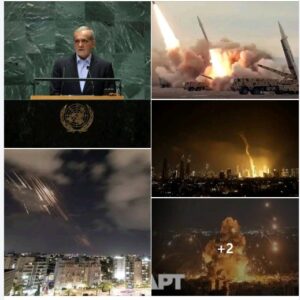
At 2:31 PM, the first anti-ship missiles erupted from concealed coastal launchers, streaking skyward before tilting toward their targets. Radar operators aboard the USS Theodore Roosevelt saw the signatures bloom almost instantly. The threat matrix populated in a heartbeat—trajectory lines, velocity estimates, probable impact windows. The calm voice over the internal net cut through the tension: “Multiple inbound. Confirmed hostile.” In that instant, training replaced shock. Years of drills compressed into seconds of action.
The sky above the Strait became a chaotic lattice of smoke trails and intercept arcs. A dozen Iranian missiles lunged toward the carrier strike group, their supersonic profiles designed to overwhelm defenses through sheer volume and speed. But the Aegis-equipped destroyers escorting the Roosevelt responded with mechanical precision. Vertical launch systems thundered as SM-2 interceptors leapt into the sky, climbing fast before pivoting toward their targets. Combat information centers glowed with data streams as sailors tracked each hostile vector in real time.
On deck and below it, close-in weapons systems spun to life—automated cannons calculating trajectories faster than any human could blink. They spat streams of tungsten into the air, building walls of metal against incoming threats. Electronic warfare teams flooded the spectrum with jamming signals, deploying decoys meant to seduce missile guidance systems away from steel hulls and into empty sea. Every layer of defense activated in concert, a symphony of countermeasures refined through decades of doctrine.
On the Roosevelt’s bridge, Captain Chen stood steady, eyes moving between displays and the horizon beyond the armored glass. There was no shouting, no visible panic—only clipped confirmations and disciplined execution. The crew had rehearsed this scenario countless times, though never under the knowledge that the missiles in the sky were real. Fear was present, but contained, compartmentalized behind training and duty.
By minute five, the first intercept flashes bloomed high above the water—brief bursts of light as incoming missiles were struck and torn apart mid-flight. Debris rained harmlessly into the Gulf. By minute twelve, more than half the threat had been eliminated. A few missiles penetrated deeper into the defensive envelope, skimming lower, forcing close-range engagements. Decoys splashed into the sea. Radar locks broke and re-formed. Yet none of the incoming weapons found their mark. Not a single missile reached the carrier.
And then, as swiftly as the attack had begun, the calculus shifted. The defensive phase gave way to response.
From well beyond Iran’s visual horizon—positions calculated to remain outside immediate retaliation range—American Tomahawk cruise missiles launched. They hugged the terrain at low altitude, guided by satellite and pre-programmed coordinates toward the very batteries that had fired minutes earlier. Simultaneously, Roosevelt’s fighters roared off the deck, their engines cutting through the humid Gulf air. Precision-guided munitions detached from their wings, each assigned to radar installations, launch platforms, and command nodes identified during the initial barrage.
Iran’s coastal confidence evaporated under the incoming wave. Launch crews scrambled. Communications spiked, then fractured. Concrete emplacements that had seemed untouchable from shore were struck in rapid succession. Fireballs rolled across hardened positions. Radar dishes folded and collapsed. In less than thirty minutes from the first missile launch, the batteries that had attempted to challenge a carrier strike group were reduced to smoking wreckage.