The cracked leather of the steering wheel bit into Sarah Mitchell’s bare palms. She had turned the heat in her heavy Ford pickup on high, but the relentless Montana blizzard still found ways to seep through the floorboards. Highway 287 was completely buried. The encroaching storm had choked the landscape into a suffocating corridor of swirling white, stealing her visibility inch by blinding inch. Beyond the frosted glass of her windshield, the world had been erased, leaving nothing but the roar of the wind and the bitter, mechanical rattle of ice striking the grill. It was February the fifth.
As the odometer rolled closer to Mile Marker 47, a familiar, sickening tremor began to radiate from Sarah’s wrists up through her forearms. It was a purely visceral reaction. Her conscious mind tried to focus on the faint depressions of tire tracks in the snow, but her body stubbornly held onto the muscle memory of the spin. This approaching curve was where the traction had given out three years ago. It was the precise geographic coordinate where black ice had sent this same truck sliding out of control, slamming the passenger side into the unyielding trunk of a massive ponderosa pine.
His side. The side she had been unable to protect.
She was doing this drive alone now. Her husband, Mark, had survived the crash with her, and for two years he had desperately tried to hold their fraying world together. He had insisted, over and over, that the ice was invisible, that the highway department hadn’t salted the curve, that it wasn’t her fault. He maintained that stance right up until the Tuesday morning he finally broke. He hadn’t left because he stopped loving her. He left because he had woken up at three in the morning to find her sleeping on the bare kitchen linoleum. The mattress had felt too soft, too much like a betrayal of the stiff, sterile hospital bed where Ethan had spent his final three hours. Mark had realized he couldn’t pull her out from under the ice, so he packed a bag and moved to Boise.
The dashboard clock clicked to exactly 4:14 p.m. The precise minute the glass had shattered.
Sarah eased her foot onto the brake, feeling the anti-lock system stutter as she pulled the heavy Ford onto the highway shoulder. She killed the engine. The silence inside the cab was immediate and heavy, broken only by the wind rocking the chassis.
Pushing the heavy door open, the sub-zero mountain cold struck her chest like a physical blow. She didn’t bother zipping her parka. She wanted the cold. Her heavy boots crunched deeply into the fresh powder, her breath pluming into thick, white clouds as she began the short walk toward the tree line. A weathered white wooden cross was bolted heavily into the thick, scarred bark of the ponderosa pine.
Then, a shape caught her eye.
Roughly sixty feet away from the memorial cross, on the exact patch of gravel where the ambulance had idled three years ago, the snow was disturbed. It wasn’t the smooth, wind-blown drift it should have been. A dark, textured mass lay clumped against the snowbank.
Sarah took a cautious step forward, the snow crunching under her boots.
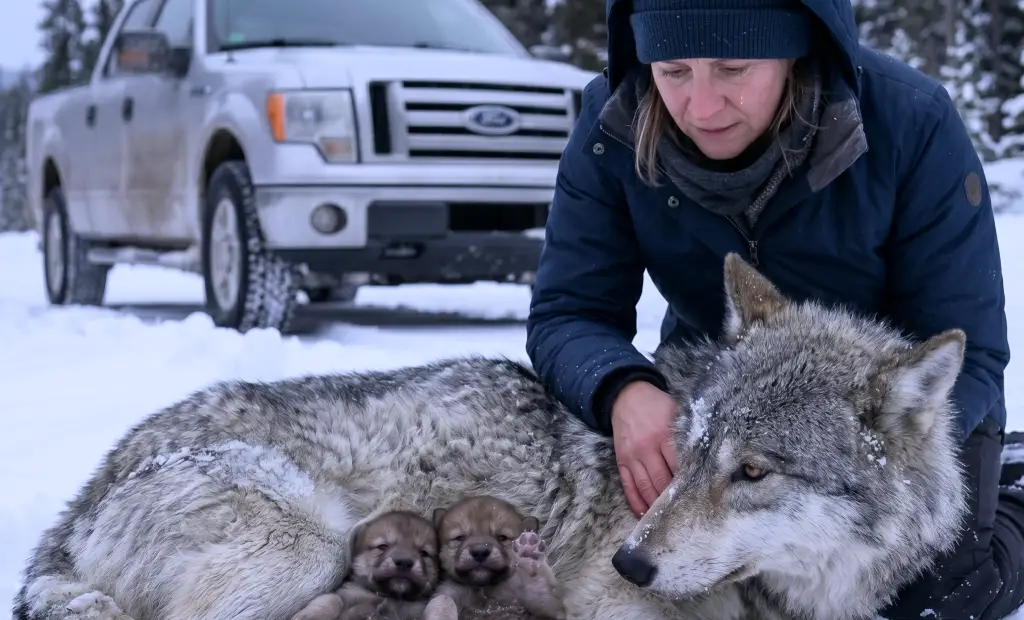
It was a wolf. She was a massive timber wolf, her thick coat a matted, freezing tapestry of deep grey and silver. She was lying entirely on her side. Tucked desperately against the curve of her belly were two tiny, violently trembling cubs. The mother wolf’s flanks rose and fell in shallow, irregular spasms—the undeniable physical marker of advanced hypothermia.
Sarah froze. Her mind instantly shifted into the hyper-clear, detached state of awareness that only trauma survivors know. She scanned the surrounding powder. The story was written plainly in the snow.
Large, heavy paw prints—unmistakably a second, larger adult—led from the dense tree line directly to the edge of the asphalt, terminating abruptly. A few yards away, the fresh snow failed to fully conceal erratic, deep skid marks from a heavy vehicle. A dark, frozen patch marred the pristine white bank. A ragged drag trail led from the center of the asphalt back to the snowy shoulder, flanked by smaller, uneven paw prints.
Sarah understood the brutal mechanics of the scene instantly. The male had been struck coming around the blind curve. The female had dragged his heavy body off the active road, driven by a desperate instinct to keep him from being hit again. But the male was gone. He had likely crawled into the brush to die, leaving the mother stranded at the exact geographic coordinates where Sarah had lost her own son. The wolf was using her rapidly fading body heat to keep her babies from freezing to death.
The wolf’s massive body was giving out, surrendering to the creeping lethargy of the cold. Sarah stood perfectly still in the blizzard. One mother who had been hollowed out at Mile Marker 47 was standing in the storm, bearing silent witness to another mother losing her entire universe at the exact same spot. On February the fifth…
Sarah dropped to her knees in the snow. The bright green plastic dinosaur slipped entirely forgotten from her numbed fingers, disappearing into the white powder.
The two cubs—they looked to be no more than eight weeks old—were rooting blindly against their mother’s stomach, desperately trying to nurse. But the mother wolf had nothing left to give them. The babies were so weakened that their tiny, high-pitched whimpers were completely swallowed by the roaring wind.
Gathering what looked to be a monumental amount of effort, the mother wolf slowly lifted her heavy head from the snowbank. Her pale yellow eyes found Sarah’s face. There was no wild predation in that stare, no territorial aggression, no baring of sharp teeth. The animal was simply too far gone. Her nervous system was actively shutting down. She dropped her heavy chin back into the snow, her eyes drifting half-closed in the terrible, lethargic surrender of severe hypothermia.
Sarah’s mind raced, calculating the brutal logistics of survival. She could retreat to the warmth of her idling truck and dial Montana Fish, Wildlife and Parks. They would eventually dispatch a ranger, but given the severity of the blizzard and the condition of the mountain pass, they would be two, perhaps three hours away. In this wind chill, the rescue team would arrive to find three frozen corpses.
She could turn her back. She could climb into her cab, turn up the radio, and drive away, leaving this fresh nightmare behind. But Sarah’s eyes tracked the ragged drag marks in the snow one more time. The mother hadn’t just collapsed immediately after dragging her mate. She had used the absolute last reserves of her failing strength to drag her two cubs closer to the asphalt. Closer to the danger of passing tires. She had been trying to keep moving until her muscles simply stopped firing.
Sarah moved before her conscious mind could formulate a rational plan. She scrambled up, her boots slipping on the ice, and sprinted back to her pickup. She cranked the heavy engine, instantly blasting the internal heater to its maximum output. Reaching behind the passenger seat, she grabbed the heavy, foil-lined emergency thermal blankets—supplies she had carried obsessively in her vehicle ever since the crash, a paranoid compulsion that had haunted her for three years.
Running back to the tree line, she approached the wild animals. The mother wolf did not issue a single growl. Her ears did not flatten. She simply watched the human approach with dull, unblinking eyes.
Sarah fell to her knees, reached out, and scooped the first cub into her arms. Its tiny body was horrifyingly stiff, its lips tinged a frightening shade of blue. She wrapped both trembling cubs tightly in the crinkling silver foil, carrying them to the truck and wedging them gently onto the floorboards, directly in front of the blasting heat vents.
Then she ran back into the storm for the mother.
The adult wolf weighed well over a hundred pounds. Sarah, hollowed out by years of skipped meals and restless sleep, barely weighed a hundred and thirty. She hooked her arms under the wolf’s front shoulders, burying her gloved hands into the thick, freezing ruff of fur, and attempted to lift. Her lower back screamed. The wolf was pure, terrifying dead weight. She didn’t fight, and she didn’t help. She was completely pliable, her body slowly giving up its final degrees of heat to the Montana winter.
Sarah adjusted her grip, dug the heels of her boots into the snow, and began to pull.
She dragged the massive predator backward, inch by agonizing inch. Her muscles burned, and hot sweat poured down her spine despite the sub-zero air. She slipped twice, falling hard onto the icy shoulder, scraping her knees through her denim jeans. She scrambled back up, grabbed the heavy fur, and pulled again.
It took fifteen grueling, muscle-tearing minutes to cover sixty feet. Sarah gasped for air, her throat burning, tears of pure exertion freezing to her eyelashes. When she finally managed to heave the mother’s heavy hindquarters onto the rear floorboards of the cab beside the swaddled cubs, Sarah collapsed against the side of the truck bed, her chest heaving violently.
She climbed behind the steering wheel and slammed the heavy door. Her frozen hands shook with such violence that she missed the gearshift twice. She glanced up at the rearview mirror. In the back, the mother wolf lay completely motionless, her dry, pale tongue lolling slightly over her teeth. Her eyes were shut, fighting a losing war against the encroaching darkness of shock.
Sarah slammed her heavy boot onto the accelerator. She didn’t turn the wheel back toward the empty house in Helena. She pointed the heavy Ford forward, pushing deeper into the storm toward Missoula. Toward the only twenty-four-hour emergency veterinary clinic that could handle serious trauma.
The blinding snow battered the windshield, the heavy wipers thrashing back and forth like a frantic heartbeat. The sterile smell of the truck cab was quickly overpowered by the heavy, pungent scent of wet fur, copper blood, and wild animal. Sarah gripped the wheel, her knuckles stark white, whispering a desperate, rhythmic mantra into the glowing dashboard.
“Hold on. Please hold on. Do not stop breathing.”
The heavy truck fishtailed violently twice on hidden patches of black ice, the rear tires kicking out toward the guardrail, but Sarah refused to ease her foot off the throttle. She corrected the steering with sharp, jerky movements. Her eyes darted to the rearview mirror every ten seconds, demanding to see the shallow rise and fall of the grey chest in the back seat.
The tiny cubs had stopped shivering entirely. She knew enough about cold exposure from living in the mountains to know exactly what that meant. It could mean they were finally warming up in the foil blankets, or it could mean their core temperatures had dropped past the point of autonomous regulation. They were either stabilizing, or they were actively dying. Sarah pressed the accelerator closer to the floorboards, ignoring the red needle of the speedometer climbing past seventy on an iced highway.
Her mind was suddenly under siege by the memory of the hospital room.
She felt the terrifying, phantom sensation of Ethan’s small fingers going completely limp in her grasp. She heard the steady, mechanical beep of his heart monitor stretching out into that flat, endless, deafening tone that still woke her up in a cold sweat. She saw the image of Mark standing perfectly still in the sterile corner of the room, staring at the linoleum because looking at his wife meant confronting the unbearable, unfixable truth that their life was over.
Sarah gripped the steering wheel harder, her jaw locked. She had been helpless in that hospital room. She had been helpless on the ice three years ago. But she was not going to be helpless today.
Part 3
Dr. James Reardon was methodically wiping down the stainless steel exam tables with heavy-duty disinfectant. It was a quiet Tuesday evening at the Missoula Emergency Veterinary Clinic, and he was mentally running through the inventory checklist before locking the front doors.
The violent, screeching grind of heavy tires braking hard on the iced asphalt outside cut sharply through the hum of the fluorescent lights. James looked out the front window. A woman practically threw herself from the cab of a snow-caked Ford pickup, leaving the driver’s door wide open to the storm.
James sprinted through the waiting room and pushed open the heavy glass doors before she even reached the concrete steps.
“I need a stretcher! Now!” Sarah yelled over the howling wind, her breath visible in the freezing air.
James didn’t ask questions. He turned, grabbed the heavy-duty reinforced gurney from the hallway, and pushed it out into the parking lot. When he yanked open the rear door of the pickup, the heavy, metallic smell of blood and wet fur hit him instantly. Lying across the floorboards were a massive timber wolf and two tiny cubs, all of them deep in the terrifying throes of severe hypothermic shock.
James froze for a fraction of a second, his hands hovering over the metal rails of the gurney. “You know I am legally required to report this to Fish and Wildlife immediately, right?” he said, his voice tight, professional instinct warring with the sheer shock of the cargo.
“I don’t care who you call!” Sarah shouted back, her hands already reaching into the cab to grab the thick fur of the adult wolf’s shoulders. “Just save them!”
They hoisted the dead weight of the mother wolf onto the stretcher, then quickly bundled the two wrapped cubs beside her. James pushed the heavy gurney through the double doors, bypassing the triage room entirely and heading straight for the sterile back surgical theater.
For the next four hours, the room became a frantic, highly synchronized blur of medical urgency. James worked with a quiet, intense focus. He moved quickly, barking short requests to his veterinary technician, who had rushed in from the breakroom.
“Get me a core temp. Start warming bags of lactated Ringer’s. Now.”
The mother wolf’s core body temperature registered at a terrifying 89.6 degrees Fahrenheit; a healthy baseline should have been over 100. She was experiencing severe systemic dehydration. Her ribs were starkly visible beneath her matted coat. It was obvious she hadn’t consumed food in days. Every single ounce of reserve nutrition in her body had been cannibalized by her own system just to produce enough milk to keep the cubs alive.
James immediately initiated warm intravenous fluids, sliding the needle expertly into her shaved foreleg. He layered her in active medical heating blankets and attached heavy cardiac monitor leads to her chest.
The technician carefully unwrapped the foil from the cubs. They registered dangerously low at 91 degrees and were severely hypoglycemic. The smaller of the two, a delicate, light grey ball of fur, was already exhibiting the wet, rattling breaths of early-stage pneumonia.
“Push a dextrose bolus for the little ones,” James ordered, adjusting the IV drip rate on the mother. “And get the incubator running on high.”
Sarah stubbornly refused to leave the treatment room. She backed herself into a corner and slid down the tiled wall, pulling her knees tightly to her chest. Her dark eyes remained aggressively glued to the steady, shallow rise and fall of the animals’ ribs. The smell of the clinic—rubbing alcohol, iodine, and cold linoleum—was suffocatingly familiar. It was the smell of the ER. The smell of losing.
Suddenly, the mother wolf arched her spine and convulsed—a violent, full-body muscle spasm as her failing nervous system violently fought the hypothermic shock. The metal table rattled loudly.
Sarah let out a sharp cry and scrambled forward, grabbing James’s arm. “Do something!”
“I am!” James shot back, his voice rising in stress. He quickly pushed a secondary injection into the IV line, his hands steady despite the chaos. “Her body is trying to rewarm too fast. It’s causing involuntary muscle contractions. Back up. Let me work.”
Sarah stepped back, her hands trembling so violently she had to shove them deep into the pockets of her damp parka. She watched the monitor. The erratic green line spiked and dipped, an electronic representation of a life teetering on the absolute edge.
At exactly eleven-thirty that night, the erratic beeping of the cardiac monitor attached to the mother wolf finally leveled out into a strong, steady rhythm. At a quarter past midnight, the two exhausted cubs ceased their violent shivering in the incubator.
At one o’clock in the morning, the heavy grey wolf slowly peeled her yellow eyes open.
Her gaze swept the bright, sterile room, passing over the stainless steel cabinets before landing on Sarah standing perfectly still against the wall. Then, the wolf looked toward the heated, clear plastic box where her two cubs were piled together, breathing steadily. The mother wolf let out a long, heavy exhale through her nose. She closed her eyes again, but the rigid tension had completely drained from her shoulders. It was the deep, restorative surrender of sleep, not the precipice of death.
James let out a long breath, pulling his surgical mask down to his chin. He slowly slid down the wall to sit on the cold floor next to Sarah. Both of them were running entirely on the fumes of spent adrenaline.
“Fish and Wildlife will be here first thing tomorrow morning,” he said, his voice quiet in the low hum of the machinery. “They have strict protocols for apex predators. They’ll take them to a state rehabilitation center. You did the impossible tonight, Sarah. But you know you cannot keep them, right?”
Sarah kept her eyes locked on the rhythmic breathing of the sleeping mother. She pulled her knees tighter to her chest. “I didn’t want to keep them,” she whispered, the words sounding hollow in the quiet room. “I just needed them to live.”
James studied the exhausted woman beside him, noting the scraped knees of her jeans, the dark circles under her eyes, and the lingering tremor in her hands. “Adult wolves stranded on a highway shoulder during a blizzard. Most people would have locked their doors and kept driving.”
Sarah didn’t answer right away. The only sound in the room was the steady, reassuring beep of the heart monitor. Then, she spoke, her voice flat and completely devoid of emotion.
“My son died on that exact curve. Three years ago today.”
James swallowed hard, his eyes dropping to the linoleum floor. He said nothing. In all his years of practicing medicine, he knew there were absolutely no words designed to absorb a confession like that.
“I couldn’t save him,” Sarah continued, her voice finally fracturing, the hard shell cracking just enough to let the pain bleed through. “But these… I could save these.”
Part 4
The harsh winter morning light filtering through the clinic blinds was met by the arrival of Rachel Torres. Representing Montana Fish, Wildlife and Parks, Rachel walked through the front doors at exactly nine o’clock. She wore a heavy green uniform jacket, carried a battered aluminum clipboard, and held an expression that was profoundly professional, gently empathetic, and completely immovable.
“Mrs. Mitchell,” Rachel began, her voice steady as she stood in the clinic hallway. “The state protocol for this type of incident is rigidly clear. Rescued wild animals, particularly apex predators, must be processed through certified rehabilitation centers. The adult female and her cubs will be securely transferred to the Northern Rockies Wildlife Sanctuary. There, they’ll receive specialized veterinary care and begin the conditioning process for eventual release back into their natural habitat.”
“No,” Sarah said. Her voice was quiet, but it possessed the hard, unyielding density of iron.
Rachel blinked, momentarily taken aback by the flat refusal. She dealt with well-meaning civilians often, but rarely with this level of immediate defiance. “Excuse me?”
“Not yet,” Sarah clarified. She shifted her weight, deliberately placing herself between the wildlife officer and the closed door of the recovery room. “The mother is severely weakened. The smaller cub is actively battling early-stage pneumonia. Shoving them into plastic transport crates and subjecting them to a bumpy, terrifying drive down a mountain pass right now could kill them.”
James, who had been quietly observing from the reception desk while logging the night’s charts, stepped forward. “She’s right, Rachel. Speaking strictly from a medical standpoint, transport today would be a high-risk endeavor. Their vital signs are stable but incredibly fragile. I strongly recommend a mandatory seventy-two-hour stabilization hold before we even consider moving them.”
Rachel let out a long, heavy sigh. She had been doing this job for nearly two decades. She saw this exact scenario play out constantly—civilians desperately bonding with wild creatures they had absolutely no business trying to keep.
“Three days,” Rachel said, tapping her pen against the clipboard. “That is all I can authorize. Then, they go to the rehabilitation center. And Mrs. Mitchell, you need to understand the reality of this. You cannot visit them at the sanctuary. We have to strictly minimize all human contact to ensure a successful release in the future. If they imprint on you, they die in a cage. Do you understand?”
Sarah swallowed the hard lump of panic rising in her throat. “Three days.”
During those following seventy-two hours, something deeply fundamental shifted within Sarah’s daily rhythm. She did not drive back to her empty house in Helena. Instead, she walked across the icy asphalt and rented a cheap, faintly cigarette-scented room at the motel adjacent to the clinic. She spent sixteen hours a day sitting on the cold linoleum floor of the veterinary recovery room. James bent the clinic rules to allow it because she was meticulously helpful with the mundane tasks—cleaning trays, swapping out soiled blankets, monitoring the IV lines—but the unspoken truth was that he recognized Sarah needed this silent vigil far more than the wolves needed her.
Sarah quickly learned the exact science of preparing the specialized formula required for the fading cubs. She carefully measured powdered milk replacement, immune-boosting supplements, and liquid proteins, warming the bottles in a mug of hot tap water until a drop tested perfectly tepid against the sensitive skin of her inner wrist. Every four hours, like clockwork, she fed them. The tiny cubs suckled with a surprising, desperate vigor, their miniature paws instinctively kneading the empty air as they drank.
In the quiet privacy of her own mind, knowing full well she was violating Rachel’s cardinal rule of detachment, Sarah named them. She was powerless to stop the overflow of maternal instinct. Ash was the slightly larger cub, wrapped in dark, charcoal-grey fur. He was bold, noisy, and demanded the bottle first. Echo was the smaller, lighter grey brother, the one still struggling with the rattling cough. He was more cautious, fragile, and hesitant to latch.
The mother wolf, whom Sarah exclusively referred to as Luna in her thoughts, was recovering at a slow, deliberate pace. On the second afternoon, Luna gathered her trembling legs and stood for the first time, her massive frame casting a long shadow across the tiles. By the third day, she was successfully digesting solid food, tearing into raw, processed venison with the sharp, terrifying teeth designed explicitly for brutal survival.
There was a singular moment on the afternoon of the second day that caught Sarah completely off guard. She was sitting cross-legged on the floor, holding a small bottle for Echo. The tiny cub greedily finished the last drop of warm formula. With his belly finally full and his body radiating a deep, contented warmth, he let out a squeaking yawn and instantly fell asleep directly in the center of Sarah’s open palm.
He trusted her implicitly.
Sarah stared down at that tiny, vulnerable ball of light grey fur slumbering against her bare skin. The physical weight, the radiating heat, the absolute, unearned trust—the sensation was so identical it stole the breath directly from her lungs. Suddenly, she wasn’t holding a wolf; she was holding Ethan at three months old, feeling his heavy, milk-drunk head resting against her collarbone while she rocked him in the middle of the night.
Sarah closed her eyes and wept silently. She pressed her free hand over her mouth to muffle the sound, her shoulders shaking with the suppressed force of her sobs. She cried for twenty uninterrupted minutes, the quiet grief spilling over onto the sterile floor. From her medical bed in the corner, Luna simply watched. The massive predator offered no growl, no reaction at all, save for a silent, incredibly intense observation of the grieving human.
As the sun set on the third day, Rachel Torres returned. She was flanked by a two-man transport team carrying heavy-duty, reinforced steel crates.
“Time to go, Mrs. Mitchell,” Rachel said quietly.
Sarah had spent the last three days lying to herself, desperately pretending she was emotionally prepared for this exact moment. But when the Fish and Wildlife team, wearing thick leather handling gloves, finally moved in to place the animals into the dark confines of the transport crates, the reality of the separation crashed down on her.
Luna actively resisted for the first time since the rescue. She planted her heavy front paws on the linoleum, looked directly past the handlers at Sarah, and smashed her wet nose aggressively against the metal bars of the crate. She let out a low, vibrating, mournful whine. The cubs, instantly sensing their mother’s sudden distress, began to cry in high, frantic pitches from their own carrier.
Sarah stepped forward, ignoring the nervous glances of the FWP handlers, and pressed her bare hand flat against the cold steel bars. Luna immediately pushed forward, inhaling the familiar scent of Sarah’s fingers through the metal grate.
“You are going to be okay,” Sarah whispered, her voice trembling so violently she could barely shape the words. “You are going to raise them. They are going to grow up so strong.”
Rachel stepped up behind her, touching Sarah’s tense shoulder with surprising gentleness. “You did something truly incredible here, Sarah. But right now, they need absolute distance from humanity. It is the only way they survive.”
Sarah nodded rigidly, not trusting her vocal cords to form another sound. She stepped back and let the men secure the latches. She walked out into the freezing parking lot and stood completely still in her unzipped parka, watching the white state van pull out onto the road. She watched the red taillights until they were entirely swallowed by the descending mountain darkness.
James stepped out into the clinic doorway behind her, shivering slightly in his thin scrubs. “Do you want a beer? Because you look like a woman who desperately needs a beer.”
“I need ten,” Sarah replied, not taking her eyes off the empty road.
Part 5
Sarah made the drive back to Helena the next morning. She parked in her driveway, unlocked the front door, and stepped into a house that was suffocating in its stillness.
The silence wasn’t peaceful; it was heavy and stagnant. Every single room still held the static, pressurized charge of Ethan’s permanent absence. His small, salt-stained snow boots remained perfectly aligned against the baseboard by the coat rack. Nudging them out of the way with her foot felt like a violent act of erasing him, so for three years, she had carefully stepped around them. She kept the thermostat set to sixty degrees, preferring to wear thick wool sweaters indoors rather than listening to the furnace kick on and fill the empty house with artificial warmth.
She attempted to force herself back into the hollow mold of her former routine. She returned to her job managing the local hardware store, walking the long aisles of lumber, PVC pipe, and brass fittings like a ghost going through the motions. She went grocery shopping, buying single portions of everything. She forced herself onto the treadmill at the gym three times a week, running until her lungs burned, just to ensure she would be exhausted enough to sleep.
During her scheduled Thursday therapy sessions, Dr. Helen would peer over her reading glasses, her notepad resting on her knee. “How are you doing this week, Sarah?”
“Fine,” Sarah would say, offering a tight, perfectly practiced smile.
But nothing was fine. Something heavy and securely sealed within her chest had been violently cracked open in that Missoula clinic, and she had absolutely no idea how to close it again. She felt the sudden absence of the wild animals like a fresh amputation. It wasn’t the old, familiar, crushing ache of losing Ethan—that specific grief was a constant companion, worn smooth by the passage of time like a river stone. This new pain was entirely different. It was sharp. It was restless. It was the distinct, echoing absence of Luna’s yellow eyes watching her from the corner of the room, of Ash’s noisy demands for the bottle, of Echo’s soft, warm weight sleeping in her palm.
In her next therapy session, Dr. Helen carefully brought up the anniversary. “It was obviously very different from your previous years at the memorial. How are you processing what happened?”
Sarah stared at the woven pattern of the office rug, tracing the geometric lines with her eyes. “I don’t know. I know that I saved their lives. But now that they’re gone, it feels like I lost them, too. Does that make sense?”
“It makes complete sense,” Dr. Helen said, her voice dropping into a quiet, analytical cadence. “You subconsciously connected your own profound loss to theirs. In saving those wolves, you were attempting to save a fractured part of yourself. Losing access to them now is incredibly complicated.”
Sarah simply nodded. She deliberately chose not to mention that she was dreaming about piercing yellow eyes staring at her from the dark tree line every single night, or that her empty house felt infinitely more cavernous and cold now than it had in the previous three years combined.
Exactly five weeks after surrendering the wolves to the state, Sarah was sitting at her small kitchen table, eating dinner alone. It was instant ramen noodles again, simply because the effort of cooking a real meal for one person felt like a pointless exercise. The refrigerator hummed loudly in the quiet kitchen.
Suddenly, her cell phone buzzed against the wood. The screen displayed an unknown, out-of-town number. She answered it.
“Hello, Mrs. Mitchell? This is Rachel Torres from Fish and Wildlife.”
Sarah’s heart instantly hammered a frantic rhythm against her ribs, her mind leaping to the worst possible conclusion. She dropped her fork into the broth. “Oh God. What happened? Did Echo die? The pneumonia came back, didn’t it? I knew he wasn’t ready to travel.”
“The wolves are fine,” Rachel interrupted firmly, cutting off Sarah’s spiraling panic. “They are doing great, physically. Luna has recovered completely. Her weight is up. The cubs are eating solid food and growing like weeds. But we have a situation.”
Sarah set her hands flat on the table. “What kind of situation?”
“Luna is refusing to socialize with the other wolves in the sanctuary. The rehabilitation center currently houses two other rescued adults. We attempted to introduce them—it is our standard integration protocol—but Luna becomes violently aggressive. She is pathologically protective of the cubs. She absolutely will not allow them to learn natural pack behaviors from the others. She keeps them entirely isolated in the corner of the enclosure. Just the three of them against the world.”
Sarah frowned, struggling to understand the implication. “What does that mean for them?”
“It means I cannot authorize her release back into the wild,” Rachel stated flatly. “A lone female wolf attempting to survive and hunt with two young cubs entirely on her own… the statistical survival rate in the wild is roughly twelve percent. They desperately need the structure of a pack to survive, but her trauma is making her refuse to join one. She treats her cubs like they need to be protected from their own kind.”
“So what happens to them now?” Sarah asked, a cold, heavy dread settling deep into her stomach.
“Permanent wildlife sanctuary. They will be fed, and they will live well, but they will be in captivity. Forever. They will never know what real freedom feels like. They will never hunt live prey, and they will never run through a forest that doesn’t eventually end at a chain-link fence.”
Sarah sat in the suffocating silence of her kitchen, feeling an immense, crushing weight pressing down on her shoulders. “Why are you calling to tell me this, Rachel?”
“Because there is another option,” Rachel said, her voice dropping slightly, stripping away the bureaucratic formality. “It is incredibly unconventional. Very experimental. And frankly, my department head is terrified of the liability. I am putting my neck on the line even suggesting it.”
“What is it?”
“Assisted release. Re-wilding. You would personally manage their transition back into the wild. It would take months of your life. It is physically brutal work, it is profoundly isolated, and we have absolutely never attempted this with a civilian who is not a formally trained wildlife biologist.”
Sarah was deeply confused. “Why would you choose me?”
“Because Luna trusts you,” Rachel said simply. “I saw it in that parking lot, Sarah. I saw the way she looked at you through the bars of that crate. I have spent eighteen years doing this job, and I know exactly what it looks like when an apex predator has bonded with a human. Luna views you as an extension of her pack. She will tolerate your presence. She will allow you to teach her cubs the survival skills she cannot currently teach them herself because her trauma has made her too hyper-vigilant.”
“You want me to raise wild wolves?” Sarah asked, the absurdity of the request hanging in the air.
“Not raise them. Re-wild them. You will teach them how to hunt again. You will teach them to fear humans again. And then, you will walk away and release them. It is a radical pilot program my director has been quietly considering for years. You would be the first test case. If it works, it could permanently change how we rehabilitate traumatized predators across the state. If it fails… those wolves spend the rest of their natural lives pacing in a cage.”
Sarah closed her eyes. “Where would this happen?”
“Deep on federal land. A highly remote area in the Bitterroot Mountains. There is an isolated ranger cabin we use for surveys. There is absolutely no electricity except for an ancient generator. You chop your own wood. There is no internet, and there is zero cell service. It would just be you and the wolves for four to six months.”
“I have a job. I have a house,” Sarah said automatically. But even as the defensive words left her lips, she looked around her dark, silent kitchen. She realized exactly how hollow and pathetic her argument sounded. What life was she defending? Managing a hardware store she didn’t care about? Eating instant noodles alone at a table meant for three? Paying a therapist every Thursday to talk in circles about a pain she knew she would carry until her dying day?
“I know,” Rachel said softly, entirely understanding the gravity of the request. “It is a massive thing to ask of anyone. If you need a few days to think about it…”
“When do I start?” Sarah interrupted.
Part 6
The Bitterroot cabin sat three long, arduous hours down a rutted logging road from the nearest semblance of an incorporated town. It was a rugged, unforgiving structure built of raw timber, featuring a temperamental wood-burning stove and a rusted generator that coughed and wheezed like a dying man every time it was coaxed to life.
Sarah arrived in early March. The bitter cold of the Montana winter was still firmly entrenched in the high elevations. Riding in the back of the reinforced state transport van were Luna and the two cubs, who were now fourteen weeks old and had already reached the physical dimensions of medium-sized dogs.
Rachel Torres stayed with them for the first three days to aggressively drill Sarah on the strict, unforgiving protocols of the re-wilding process.
“You must absolutely minimize all physical contact,” Rachel instructed, her tone leaving no room for negotiation as they stood on the frozen porch. “No petting. No soothing words. No eye contact if you can avoid it. From this moment forward, you are simply the food provider, not their mother. You are deliberately teaching them that humans mean food right now, but eventually, humans will mean danger. They need to learn the brutal reality of finding their own meals. If you coddle them, Sarah, you kill them.”
“Understood,” Sarah said, her jaw tight. She looked out at the dark tree line, fully aware that enforcing this sudden, icy distance would be infinitely harder than hauling the heavy animals through the blizzard had been.
The first few weeks were a grueling physical and emotional trial. Sarah’s battery-operated alarm clock would shatter the dark silence at exactly five in the morning. The cabin was always freezing, the fire having died out hours ago. She would layer up in heavy thermals, thick canvas Carhartt overalls, and insulated boots, her breath pluming in the dark kitchen.
Her mornings were defined by heavy labor. She hauled chopped wood, primed the stubborn generator, and then began the brutal work of feeding the pack. She hiked miles through the dense, unforgiving alpine forest, dragging heavy quarters of deer carcasses routinely dropped off by FWP supply trucks. The thick, metallic smell of raw meat sank permanently into the fabric of her coat.
Luna desperately needed to relearn the complex mechanics of the hunt. Her profound trauma had temporarily overridden her natural instincts, reducing her to a protective scavenger. Now, it was Sarah’s exhausting job to reignite that dormant fire.
At first, Luna would only consume the meat that Sarah left directly outside the cabin steps, refusing to let the cubs stray out of sight. But slowly, adhering strictly to Rachel’s escalating instructions, Sarah began leaving the food farther away. She hid the meat under heavy brush. She dragged it across freezing streams to mask the scent. She wedged it into difficult, rocky terrain. Luna had to search. She had to work for it. She had to remember what it meant to track.
One freezing morning in late March, Sarah lay flat on her stomach on a frozen ridge, peering through high-powered binoculars from two hundred yards away. Below her, Luna was actively teaching Ash and Echo how to follow complex scent trails. The boisterous cubs frequently stumbled, their juvenile attention spans easily hijacked by fluttering birds or the snapping of twigs.
But Luna was relentless. She corrected their lack of focus not with human-like patience, but with sharp, physical nose bumps and low, guttural snaps that demanded immediate obedience. Sarah smiled warmly behind the cold lenses of her binoculars, her gloved hands resting in the snow. She felt a massive surge of maternal pride that she knew wasn’t entirely hers to claim. Watching them painstakingly learn to navigate the harsh environment felt remarkably like watching something beautiful and enduring be born from the ashes of a tragedy.
In April, the dynamic shifted permanently.
Sarah was hiking back to the dark cabin at dusk, her shoulders aching from the heavy pack, when a sound stopped her dead in her tracks. It was howling. But it was not the low, mournful sound of distress she had heard in the clinic. It was a bright, piercing sound of absolute victory.
She dropped her pack and moved silently toward the noise, her heavy boots careful on the damp pine needles. Crouching behind a massive tree trunk a hundred yards away, she lifted her night-vision binoculars. Through the eerie green tint of the lenses, she saw Luna and the two large cubs actively surrounding a wild snowshoe hare.
Ash, driven by his usual impatience, lunged a fraction of a second too early and missed his mark entirely, his jaws snapping on empty air. But Echo—the smaller, more fragile cub who had nearly succumbed to pneumonia—had waited. He stayed perfectly still, his belly low to the ground, watching his brother’s mistake. On his second calculated attempt, Echo struck with lethal, instinctual precision.
He had caught it. It was his very first successful, independent hunt.
Luna threw her heavy head back and released a triumphant howl into the darkening sky, and her two sons immediately joined the chorus.
Sarah stayed completely hidden in the deep shadows of the forest. She pressed her cold, calloused hand firmly over her mouth and wept openly in the dark, knowing she had just witnessed the beginning of their true freedom.
Part 7
As the bitter mountain spring finally thawed into early summer, the distance between Sarah and the wolves expanded, just as the state protocols demanded. It was a necessary, intentional separation, but it hurt Sarah in quiet, unexpected ways she hadn’t fully prepared herself to endure.
Luna stopped approaching the perimeter of the cabin entirely. The cubs naturally followed their mother’s cautious lead. They began sleeping much deeper in the dense timber, and they hunted on their own with increasing frequency. Sarah would carry her heavy pack of meat out to the drop zones, her boots sinking into the muddy spring thaw, only to return the next morning and find the venison completely untouched.
The wolves no longer needed her. They had reclaimed their independence.
One quiet, breezy evening in late May, Sarah stepped onto the wooden porch with a mug of black coffee. She looked across the clearing and saw Luna standing perfectly still at the edge of the tree line.
The massive grey wolf was just watching her. She wasn’t approaching for food, nor was she aggressively guarding her territory. She was simply observing the human from a safe distance. It was a long, silent acknowledgment that felt incredibly like a slow goodbye.
Sarah set her coffee mug down on the porch railing. She raised her hand and gave a small, deliberate wave. It was a stupid, inherently human gesture, completely meaningless to a wild animal, but she simply had to do it. Luna held her gaze for a second longer, her pale eyes catching the fading evening light. Then, the wolf turned smoothly and disappeared into the darkening shadows of the forest.
Sarah stood completely alone in the silent clearing. The evening wind bit at her cheeks, and she allowed herself to truly cry for the first time since arriving at the Bitterroot cabin.
She had been so intensely, obsessively focused on the exhausting daily mechanics of teaching the wolves to be wild again that she had completely failed to process what their success actually meant for her. It meant losing them. Permanently.
There would be no weekend visits. There would be no reassuring photos, no way to ever know if they ultimately survived the harsh winters or if they thrived and expanded their pack. Once she released them, they would vanish into hundreds of thousands of acres of untamed federal wilderness.
Sarah realized, wiping her face with the rough canvas of her sleeve, that she was actively grieving a profound loss that hadn’t even fully happened yet. She was mourning while the wolves were still, technically, under her protective custody. But she understood now that they were never truly hers. They never had been. She was simply the temporary bridge spanning the terrible gap between captivity and freedom.
In early June, Rachel Torres drove her state-issued SUV up the rutted logging road for the final evaluation. The wildlife officer spent two full days silently observing from a distance with a spotting scope, meticulously testing the animals’ reactions to human scent, and watching Luna successfully execute a complex hunt with her remarkably capable offspring.
“They are ready,” Rachel stated finally. She sat on a worn log by Sarah’s outdoor fire pit on the second evening, closing her notebook. “Luna is hunting like a pure apex predator again. The cubs have learned the necessary skills to survive. They actively avoid human presence now. It’s time.”
Sarah stared deeply into the dancing orange flames of the fire pit. She had known this exact day was coming since she accepted the assignment, but the finality of it still felt like a physical blow to her chest.
“Where do we take them?” Sarah asked.
“You get to choose,” Rachel said softly, tossing a small twig into the fire. “The parameters allow a release anywhere within fifty miles of this current location. You decide where they have the absolute best chance at long-term survival.”
Sarah did not hesitate for a fraction of a second. “I know exactly where.”
Part 8
The bureaucratic logistics, the required state paperwork, and a shifting pattern of severe winter storms pushed the official date of the transport back considerably. When the morning of the final release finally arrived, the calendar had aligned with a quiet, heavy exactness.
It was February the fifth. Exactly four years since Ethan had died. Exactly one year since Sarah had dragged a dying Luna from the snowbank.
Sarah drove her heavy pickup truck slowly down Montana Highway 287. Secured tightly in the cargo bed were three heavy, reinforced steel state transport crates containing Luna, Ash, and Echo.
She eased her foot onto the brake, feeling the familiar stutter of the tires on the packed snow, and put the truck in park at Mile Marker 47. It was the exact curve where everything in her life had abruptly ended, and where a different kind of life had miraculously begun again. The weathered white cross was still bolted securely to the trunk of the ponderosa pine.
Sarah killed the engine. She walked to the back of the truck, her boots crunching loudly in the freezing air. She unlatched the heavy metal doors one by one. The loud, metallic clank of the deadbolts echoed sharply against the silent mountain pass. She dropped the tailgate, stepped back onto the asphalt, and waited, burying her bare hands in the pockets of her coat.
Luna emerged first.
The massive wolf stepped onto the snow-packed shoulder, her nose immediately lifting to process the frigid air. She recognized the topography of this place. She knew the scent of the pine and the specific, metallic smell of the highway. This was the exact ground where she had laid down to die, and where a stranger in a blizzard had made a desperate choice to pull her back.
Ash and Echo emerged seconds later, leaping gracefully from the tailgate, their heavy paws hitting the powder with a soft thud. They were no longer the fragile, shivering cubs wrapped in silver foil; they were large, powerful, magnificent animals in their physical prime.
They stopped at the edge of the asphalt. Before crossing into the tree line, all three wolves turned and looked at Sarah.
Their pale yellow eyes held a deep, unreadable wildness, a stark memory of their shared survival, and a quiet, instinctual recognition. Sarah knew, logically, that she was heavily projecting human emotions onto wild animals who owed her absolutely nothing. But standing in the freezing wind, her heart actively chose to feel it anyway.
Sarah desperately wanted to speak. She wanted to bridge the cold distance and say thank you. She wanted to yell across the snowy highway and tell them that they had saved her life just as much as she had saved theirs. But she kept her mouth firmly shut, biting the inside of her cheek until she tasted the sharp tang of copper. She said absolutely nothing, because they were wild creatures, and they did not belong to her.
Luna took one deliberate step toward the dense tree line, stopped abruptly, and looked back over her heavy shoulder one last time. The highway was entirely silent. Then, Luna threw her head back and let out a massive, echoing howl—a raw, primal sound of pack cohesion that bounced off the mountain rock and vibrated in Sarah’s chest. Ash and Echo immediately joined in, three distinct voices rising together into the grey February sky.
Then, they turned their backs to the road and ran. Within seconds, their thick grey coats blended perfectly with the winter shadows, and they were gone, vanishing into the deep timber as seamlessly as if they had never existed at all.
Sarah stood completely alone on the frozen shoulder of Highway 287 as a fresh layer of light snow began to fall. She walked slowly toward the white wooden cross and knelt in the powder. She placed a fresh bundle of bright yellow sunflowers at its base, faithfully executing the ritual she had kept every year.
But this year, her hands moved to her heavy coat pocket, and she placed something entirely new in the snow. It was a small, meticulously sanded wooden carving of three wolves that she had whittled by the woodstove during those long, isolated months in the Bitterroot cabin. She set the small wooden pack gently on the snow, right next to Ethan’s flowers.
As she turned and walked back to the idling engine of her truck, she heard it. Floating on the wind. Distant, incredibly faint, but absolutely unmistakable. Three distinct howls ringing out from deep within the mountains. They were moving fast, claiming their territory. It was their final goodbye.
Part 9
Sarah climbed into the cab of her pickup, pulled the heavy door shut, and shifted the column into drive. As she steered the Ford past Mile Marker 47 for the first time in four agonizing years, she instinctively braced herself. She waited for the familiar, suffocating grip of panic to seize her chest, for her breathing to turn shallow and frantic. It didn’t happen. Instead, she felt an incredibly fragile, unfamiliar lightness.
She did not drive all the way back to Helena immediately. Twenty miles down the highway, she pulled into a sprawling, brightly lit truck stop. She parked in the back row, surrounded by the low rumble of idling eighteen-wheelers, and left her engine running. She sat there with the heater blasting for three solid hours, staring blankly as snow accumulated on her windshield. She didn’t cry, and she didn’t call Rachel to seek validation. She simply sat in the quiet warmth, making peace with the invisible ghosts of wild wolves and the enduring ghost of her young son.
When Sarah finally returned home and unlocked her front door, the silence of the house was still there, but the oppressive weight of it had shifted. She walked straight down the hallway and stopped in front of Ethan’s bedroom.
For four years, that door had been an impenetrable wall. She reached out, her fingers wrapping firmly around the cold brass knob, and pushed it open.
The physical smell of the room hit her instantly. It was a dusty, perfectly preserved mixture of wax crayons, old laundry detergent, and the specific, sweet scent of pure childhood. She walked past the meticulously arranged action figures on the dresser and sat heavily on the edge of the twin mattress. She put her face in her hands and cried. But this crying was entirely different from the hyperventilating, raw sobs of early grief, or the hollow emptiness that had defined the years after. It was soft. It was exhausting. It felt like a rusted emotional release valve finally being forced open.
“I will always love you,” she whispered into the dark room. “But I cannot keep dying with you, Ethan. I have to try to live.”
The next morning, Sarah called her manager at the hardware store and formally gave her notice. Then, she got into her truck and drove directly to the county animal shelter on the outskirts of town.
She walked slowly past the loud, energetic puppies at the front of the facility, heading straight for the chain-link runs in the very back corner. Sitting quietly on a thin blanket was a heavy black lab mix. He had a severely greying muzzle, cloudy eyes, and he didn’t bother getting up when she approached the cage. He simply watched her with a calm, tired dignity.
“That’s Duke,” the shelter volunteer said, walking up behind her with a clipboard. “His owner passed away a few months ago. He’s a good dog, but given his age and his joints, he probably won’t ever get adopted.”
“I’ll take him,” Sarah said.
Bringing Duke home forced Sarah back into a mandatory, grounding routine. She had to wake up at a reasonable hour because he needed his arthritis medication wrapped in a slice of cheese. She had to measure his kibble. She had to walk him twice a day, matching his slow, deliberate pace down the sidewalk. It wasn’t the frantic, life-or-death need of dying wolves; it was the quiet, steady requirement of an old dog who just wanted a warm place to sleep.
She tapped into her remaining savings and enrolled in an accredited online program for professional wildlife rehabilitation. The collegiate coursework was demanding—behavioral ecology, foundational veterinary medicine, and biology. She spent late nights hunched over her small kitchen table, rubbing her tired eyes and flipping through vocabulary flashcards while Duke snored heavily on the linoleum at her feet. Whenever the material felt too overwhelming, she simply thought about Luna fighting hypothermic shock in the back of her truck. If a dying animal could muster that kind of impossible strength, Sarah could pass a biology exam.
In June, her cell phone buzzed on the kitchen table. It was Rachel Torres.
“Just calling to check in,” Rachel said warmly. “How are the classes going?”
“Some days are good, some are really hard,” Sarah answered honestly, leaning against the counter. “But I’m building something new.”
“Do you want to know about the wolves?” Rachel asked carefully, sensitive to the emotional weight of the question.
“Yes.”
“We haven’t had a single confirmed visual sighting of them,” Rachel said, her voice carrying a deep professional satisfaction. “Which is fantastic news. It means they are successfully avoiding human settlements. But a couple of seasoned bow hunters reported tracking a massive adult female running with two large juveniles about thirty miles northeast of the original release site. They found fresh kill sites. The wolves are hunting, Sarah. They are thriving.”
Sarah pressed her hand flat against the cool laminate of the counter, closing her eyes. “They’re alive.”
“You did that,” Rachel reminded her gently.
Part 10
Summer eventually bled into the crisp, biting air of a Montana fall. Sarah successfully completed her first round of certification courses and immediately began picking up volunteer shifts at a local raptor and wildlife rescue center. She found herself surrounded by a loud, practical community of people who deeply cared about broken, damaged things and were actively working to fix them. She made friends. In early November, she even agreed to go on a casual coffee date. She drove home that evening feeling a sudden, sharp pang of guilt for actually laughing out loud at a joke across the table, but as she unlocked her front door and bent down to scratch Duke behind the ears, she realized with sudden clarity that Ethan would have wanted his mother to smile again.
February the fifth arrived on a Tuesday. It marked exactly five years since the crash.
Sarah made the familiar drive down Highway 287. She carried fresh sunflowers and a brand-new wooden carving. This year, the carving featured four wolves—Luna, Ash, Echo, and a much smaller pup meant to represent Ethan. She nailed the flowers to the ponderosa pine and stood by the cross, talking quietly to her son. She told him about Duke’s funny, rattling snores, about how hard the biology exams were, and about how she was genuinely trying to figure out how to be a person again in a world without him.
“I am not entirely okay,” she admitted quietly to the biting wind. “But I’m getting better. I’m trying.”
She turned up the thick collar of her parka and started walking back to her idling truck. Halfway across the shoulder, she froze completely.
On the opposite side of the sprawling highway, standing perfectly still just inside the dark edge of the dense tree line, were three massive shapes. Grey, powerful, and absolutely unmistakable.
Wolves.
The female positioned in the center was massive, her thick winter coat a vibrant silver. The two wolves flanking her shoulder-to-shoulder were nearly identical in size now, their chests broad and heavy. Sarah’s heart stopped in her chest. Luna, Ash, and Echo.
The biological odds of this encounter were practically nonexistent. They were supposed to be holding a territory thirty miles away, lost in hundreds of thousands of acres of deep wilderness. Logically, Sarah knew that wild packs cover massive territories, often following the elk herds down to lower elevations in deep winter to hunt. But seeing them here, today, felt like the universe briefly folding in on itself.
Luna took one slow, deliberate step forward out of the shadows, her heavy paws sinking into the powder. Her two sons—no longer fragile cubs, but formidable, wild apex predators—stayed tight to her flanks. They stood there and watched Sarah across the asphalt. They showed no fear of the idling truck, and no aggression. It was a silent, powerful pause. A mutual observation across the dividing line of the highway.
Sarah slowly raised one gloved hand and whispered across the empty expanse of the road, “Thank you.”
The three wolves stood like statues for another long moment. Then, Luna turned fluidly. Ash and Echo immediately followed their mother’s lead. The pack disappeared completely into the dark forest, vanishing like smoke on the wind without a single backward glance.
Sarah climbed into her truck, gripped the cracked leather steering wheel, and exhaled a long, shaky breath. She put the truck in gear and drove the two hours back home to Helena, returning to old Duke waiting patiently by the front door, returning to a life that was quiet and small, but was undeniably, fiercely hers.
The next morning, Sarah parked downtown and walked into a local, crowded coffee shop. She ordered a black coffee, sat by the frosted front window, and wrapped both hands around the warm ceramic mug. She watched regular people walk past on the sidewalk—people carrying groceries, checking their phones, dealing with normal, mundane problems.
For the very first time in five long years, Sarah truly felt like she was one of them again. She knew she would never again be the carefree woman she was before the accident. That version of herself had died on the ice. But this new version of Sarah—scarred, cautious, and slowly rebuilding herself piece by piece—could finally walk alongside her grief, rather than being entirely consumed by it.
She took a slow sip of her coffee and looked out at the distant, snow-capped peaks of the mountains. Somewhere out there in the deep timber, Luna was running, strong and wildly alive. If a dying wolf could fight her way back to the wild, Sarah could too. You survived by simply putting one foot, one paw, one single breath in front of the other. Sarah finished her drink and stood up to head back out into the cold. It was time to go home and feed the dog. She was alive, she was trying, and for today, that was absolutely enough.