The courtroom had never felt so heavy. The usual shuffle of papers, quiet whispers, and faint murmurs of movement were entirely absent. For once, every person present seemed suspended in the moment. Reporters held their pens frozen over notebooks. Officers sat rigidly in the back rows. Spectators leaned forward, trying to catch even the smallest detail. Only the judge’s voice echoed clearly, formal and commanding, carrying the weight of authority across the still room.
For Daniel Mercer, the former police officer at the center of the proceedings, each word hammered into him like a series of blows. Once a respected member of the force, Daniel had spent nearly fifteen years serving his community. His reputation, painstakingly built through years of dedication, training, and countless dangerous missions, was now reduced to whispers and accusations that clung to him like shadows. Standing at the defense table, he could feel every stare, every judgment, every expectation bearing down on him.
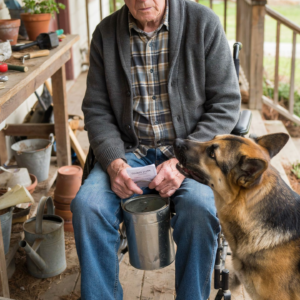
Daniel had earned his reputation as a K9 officer. Alongside Rex, his German Shepherd partner, he had helped in missing person searches, narcotics investigations, disaster responses, and high-risk police operations. Their partnership was legendary in the department. Colleagues often joked that Rex understood Daniel better than most humans did—and they weren’t entirely wrong. The bond between handler and K9 was rare, and theirs was extraordinary.
Everything changed after a complicated internal corruption investigation rocked the department. Allegations of financial misconduct, abuse of authority, and evidence tampering spread like wildfire. Though Daniel insisted he was innocent and had been caught in a web of internal politics, public opinion turned swiftly against him. The uniform he had once worn with pride became a symbol of suspicion. His career crumbled, his colleagues’ trust evaporated, and worst of all, he was separated from the partner who had been by his side through everything.
The department’s policy dictated that Rex be reassigned while the investigation continued. The day the dog was taken away was said to be one of the most heartbreaking moments in Daniel’s life. Witnesses later reported seeing him standing frozen, silent, as Rex resisted, whining softly, but ultimately being led away by handlers. From that day on, Daniel spoke less, retreated further, and carried the burden of loss silently.
Months later, the courtroom was packed for the final hearing. Journalists filled the back rows. Retired officers and colleagues sat stiffly along one side. Many avoided looking directly at Daniel, unwilling to witness the man they once respected in such a vulnerable state. The judge meticulously reviewed the findings before asking the formal question: “Do you have anything you’d like to say before sentencing?”
For a long moment, Daniel remained silent. Then, in a voice low and weary, he spoke: “I only want one thing. Please… let me say goodbye to Rex.” The words sent a ripple through the courtroom. Some reporters exchanged surprised glances; others shifted uncomfortably in their seats. This wasn’t a typical legal request. This was deeply human, painfully raw.
“He’s all I have left,” Daniel added, swallowing hard. The courtroom fell into a tense silence. Even the prosecutor hesitated, uncertain how to respond. Judges rarely make exceptions for emotion in a formal legal proceeding, but after a brief consultation, permission was granted. An officer quietly left to retrieve Rex, and the entire room seemed to hold its collective breath.
Minutes later, the courtroom doors opened. Rex, majestic and alert, stepped in beside a handler. The German Shepherd’s eyes scanned the room, but then, impossibly, locked onto Daniel. Instantly, everything changed. Rex pulled against his leash, barking softly at first, whining, desperate to reach the man who had been his constant partner for years. Daniel dropped to his knees, tears streaming, and whispered, “Hey, buddy.” The dog surged forward, pressing against Daniel’s chest, tail wagging uncontrollably.
The courtroom, which had felt icy and detached moments before, became electric with emotion. Jurors and spectators alike fought to maintain composure, many wiping tears quietly, unable to look away. Years of loyalty, training, and companionship were visible in the dog’s every gesture. For a brief moment, the headlines, accusations, and political maneuvering vanished. There was only the bond between man and dog—pure, unyielding, and unmistakable.
Daniel whispered apologies, brushing his tears and hair against Rex’s fur. “I’m sorry,” he said, voice breaking. “I couldn’t protect everything… but I never stopped trying.” Rex remained pressed to him, offering comfort without words, a partner in sorrow and solace. And then, unexpectedly, Rex shifted. He pulled away slightly, pacing anxiously toward the prosecution’s table, barking sharply.
At first, the observers assumed the dog was overstimulated or reacting to the overwhelming emotions in the room. But seasoned K9 handlers immediately recognized the behavior as something different. Rex wasn’t acting out of fear or excitement. He was working—focused, alert, and responding to a cue invisible to most human eyes.
Rex circled the area near a particular evidence container repeatedly, barking insistently. Officers exchanged hurried glances, understanding immediately that this was not ordinary canine behavior. A retired K9 supervisor in the gallery quietly muttered, “That dog’s alerting.” The courtroom atmosphere shifted instantly. The emotional reunion had turned into a scene of professional alarm.
Careful inspection revealed improperly logged materials inside the evidence container. The discovery caused chaos. Lawyers argued, reporters scrambled, and judges called for immediate reviews. In minutes, the courtroom had shifted from a stage of mourning to a hub of legal urgency. Rex remained close to Daniel, unwavering, seemingly aware of both the emotional and factual stakes in the room.
The incident prompted investigators to revisit parts of the original corruption case, questioning whether procedural errors had influenced outcomes. While no immediate conclusions were reached, the attention to detail spurred by Rex’s behavior reminded everyone that even the most trusted processes can have flaws.
News coverage quickly focused on Rex’s extraordinary instincts. People marveled at how a dog could display such loyalty, understanding, and awareness in a courtroom filled with tension. Former handlers explained that K9 partners retain a deep connection to investigative cues, routines, and the emotional states of their handlers, even long after separation. Whether instinct, training, or a mixture of both, Rex’s actions were a testament to the unbreakable bond between man and animal.
The case became a talking point not just for its legal implications, but for what it revealed about loyalty, empathy, and trust. Daniel’s relationship with Rex showcased the power of connection in ways words often fail to capture. Public opinion became divided, but nearly everyone recognized the extraordinary loyalty displayed that day.
What began as a routine sentencing hearing became one of the most unforgettable courtroom moments in recent memory. A former officer seeking one last goodbye. A loyal German Shepherd refusing to forget his partner. And one shocking, instinctive intervention that reminded everyone that sometimes, truth and loyalty arrive on four legs, with a heart as devoted as any human’s.
Because in the end, some bonds speak louder than evidence. Some truths are first noticed not by eyes, but by instincts honed over years of shared service, trust, and love.
The barking would not stop.
Rex stood rigid beside the prosecution’s evidence container, his body tense, ears forward, every muscle sharpened with purpose. The deep sound echoing through the courtroom no longer felt emotional—it felt procedural, trained, deliberate.
Judge Eleanor Hayes raised her hand sharply.
“Order,” she commanded.
The room erupted anyway.
Reporters leaned forward, whispering furiously into phones. Attorneys exchanged alarmed looks. Deputies moved cautiously toward Rex, uncertain whether to calm him or investigate what had triggered the reaction.
But Daniel Mercer knew that bark.
His chest tightened.
For years, that exact tone had meant only one thing.
An alert.
Not uncertainty.
Not confusion.
An alert.
Daniel slowly rose from his knees, still holding Rex’s collar lightly.
“That’s his detection bark,” he said, voice rough from emotion. “He doesn’t do that unless he’s sure.”
The prosecutor immediately objected.
“Your Honor, this is highly irregular—”
“And yet,” Judge Hayes interrupted, staring toward the container, “so is the dog’s behavior.”
Rex barked again.
Short.
Sharp.
Then he sat beside the container.
The courtroom froze.
A retired K9 supervisor seated in the back stood halfway from his chair.
“That’s a final indication,” he muttered.
The words spread through the room like electricity.
Judge Hayes looked toward the bailiffs.
“Open it.”
The prosecutor stiffened.
“With respect, Your Honor—”
“Open it.”
No one argued again.
A deputy approached the evidence container carefully. The box had been part of the original corruption investigation—sealed months earlier, cataloged, supposedly reviewed dozens of times. It contained financial records, photographs, digital storage devices, and materials prosecutors claimed helped establish misconduct inside Daniel’s former department.
The seal was inspected.
Then broken.
The sound alone seemed louder than it should have been.
The deputy removed folders first.
Then envelopes.
Then a small locked pouch.
Rex remained seated, eyes fixed.
Daniel watched without breathing.
The deputy frowned.
“This…” he said quietly.
Judge Hayes narrowed her eyes.
“What is it?”
The deputy hesitated.
“There are additional items.”
The prosecutor looked startled.
“That’s impossible.”
But it wasn’t.
Inside the pouch were two flash drives and a stack of documents that had never appeared in discovery records.
Silence swept the room.
The defense attorney, Michael Lawson, stepped forward immediately.
“Your Honor, my office has never seen those materials.”
The prosecutor’s face paled.
“That must be some clerical issue.”
“Clerical?” Lawson snapped. “Evidence doesn’t materialize out of thin air.”
The courtroom dissolved into chaos.
Judge Hayes slammed her gavel.
“Enough!”
Her voice cut through the noise.
“No one speaks until this court understands what is happening.”
The deputy handed the items toward the bench.
The flash drives were labeled with departmental evidence numbers.
But something felt wrong.
The numbering sequence didn’t match.
One of the retired detectives in attendance quietly whispered to another officer.
“That coding system was retired years ago.”
Daniel heard it.
His stomach tightened.
Because suddenly, memories long buried began rising again.
And for the first time in months, he stopped thinking about sentencing.
He started thinking about Lieutenant Frank Donovan.
Donovan had once been Daniel’s commanding officer.
Decorated.
Respected.
Politically connected.
And dangerous in ways few people openly discussed.
Years earlier, Daniel had admired him.
Until small inconsistencies began appearing.
Missing inventory reports.
Evidence transfers delayed without explanation.
Confidential informants disappearing from paperwork.
Nothing obvious.
Nothing dramatic.
Just enough to leave a bitter taste.
Daniel had raised concerns once.
Only once.
Donovan’s response had been immediate.
“You want to survive in this department?” he had said coldly. “Learn which questions keep you employed.”
Daniel never forgot that sentence.
And now, staring at those unexpected files, he felt the old dread returning.
Judge Hayes ordered a recess.
Nobody moved quickly.
It felt as though the room itself had become unstable.
Rex finally relaxed slightly and returned to Daniel’s side, pressing against his leg.
Daniel scratched behind the dog’s ears.
“You still working, huh?” he whispered.
Rex looked up at him.
Same eyes.
Same loyalty.
Nothing forgotten.
Outside the courtroom, the hallway became a storm of cameras and speculation.
News alerts exploded online.
FORMER K9’S COURTROOM ALERT HALTS SENTENCING.
MYSTERY EVIDENCE DISCOVERED.
LEGAL DRAMA TAKES SHOCKING TURN.
But inside a secured conference room, the atmosphere was far more serious.
Judge Hayes, attorneys, and senior investigators reviewed the materials immediately.
The first flash drive contained internal department emails.
The second contained surveillance footage.
And within minutes, the temperature of the room changed.
Michael Lawson stared at the screen.
“No…”
Judge Hayes folded her arms.
“Explain.”
The footage showed evidence storage.
Date-stamped.
Late at night.
A man entering alone.
Lieutenant Donovan.
Nobody spoke.
The video continued.
Donovan opened shelves.
Moved boxes.
Handled evidence containers.
Then left.
No authorization visible.
No secondary officer.
No recorded chain-of-custody approval.
The prosecutor looked sick.
“That video was never submitted.”
Lawson looked furious.
“Exactly.”
The second discovery was worse.
Emails.
Encrypted communications discussing pressure surrounding the corruption task force.
Political concerns.
Media strategy.
And references to “controlling Mercer exposure.”
Daniel’s name appeared repeatedly.
His breathing slowed.
Cold.
Controlled.
Because suddenly pieces began fitting together.
He remembered how abruptly investigators had focused on him.
How alternative suspects vanished from reports.
How witnesses changed stories.
How certain officers refused eye contact.
For months he had wondered whether paranoia or grief had distorted his memory.
Now he was no longer sure.
Judge Hayes removed her glasses.
“This hearing is suspended pending immediate review.”
The prosecutor tried speaking.
“Your Honor—”
“No.”
Her voice remained calm.
“If evidence integrity is compromised, this court proceeds no further.”
Outside, reporters nearly trampled one another trying to break the story.
By evening, national media had picked it up.
Not because of Daniel.
Not even because of alleged corruption.
But because of Rex.
The German Shepherd had become the center of public fascination.
Clips of the reunion spread across social media.
Millions watched the moment Rex entered the courtroom and rushed toward Daniel.
Then came the footage of the alert.
Comment sections exploded.
Some called it instinct.
Others called it coincidence.
Former handlers disagreed.
“That dog wasn’t guessing,” one retired trainer said during an interview. “K9s don’t randomly perform a final indication.”
Public opinion shifted fast.
And suddenly Daniel Mercer—once publicly condemned—was no longer viewed so simply.
That night, Daniel sat alone in temporary holding.
But for the first time in months, he wasn’t drowning in despair.
A guard approached quietly.
“You got a visitor.”
Daniel frowned.
“At this hour?”
The guard nodded.
Daniel entered the meeting room expecting Lawson.
Instead, he froze.
A woman stood near the table.
Gray coat.
Dark hair.
Tired eyes.
Emily Donovan.
Lieutenant Donovan’s daughter.
Daniel hadn’t seen her in nearly eight years.
She looked nervous.
“I know this is strange,” she said.
Daniel remained silent.
Emily swallowed.
“My father died last year.”
Daniel already knew.
Heart attack.
Sudden.
Quiet funeral.
No closure.
“I found something after he died,” she continued.
Daniel’s stomach tightened.
“What?”
She placed a small envelope on the table.
“My father kept records.”
Daniel stared.
“I didn’t understand them before.”
Emily looked shaken.
“But after seeing today…”
His pulse quickened.
“What’s in there?”
Her voice dropped.
“He wrote names.”
Daniel slowly opened the envelope.
Pages.
Dates.
Transfers.
Payments.
And then—
A notebook entry.
His own name.
Beside it:
Mercer won’t cooperate.
Handle internally.
Daniel felt the room tilt.
Emily looked devastated.
“I think he was afraid near the end,” she whispered. “He kept saying he’d made mistakes he couldn’t fix.”
Daniel said nothing.
She wiped tears.
“I’m sorry.”
He looked at her.
For years anger had lived inside him like fire.
But staring at Donovan’s daughter, he saw only another person carrying inherited wreckage.
“You didn’t do this,” he said quietly.
She nodded weakly.
“No. But maybe I can help finish it.”
Over the following weeks, investigators reopened the case.
What they uncovered stunned the department.
Donovan had allegedly orchestrated selective evidence manipulation to protect a network involving procurement fraud and financial kickbacks.
Several officials faced scrutiny.
Others resigned before questioning.
Some denied everything.
But the damage had begun unraveling.
And Daniel?
He remained suspended between freedom and uncertainty.
Cleared?
Not yet.
Convicted?
No longer.
Meanwhile Rex became impossible to ignore.
The department had planned permanent reassignment.
Public backlash changed that.
Petitions gathered thousands of signatures.
Former officers advocated fiercely.
Children mailed drawings.
Veterans wrote letters about service dogs and loyalty.
And through it all, Daniel waited.
One rainy morning nearly six weeks later, Judge Hayes reconvened proceedings.
The courtroom was packed again.
But this time the mood was different.
No whispers of spectacle.
Only anticipation.
Daniel stood beside Lawson.
And beside him—
Rex.
Judge Hayes reviewed findings carefully.
Her voice remained measured.
“The integrity of the original proceedings has been materially compromised.”
The room held its breath.
“Charges dependent upon tainted evidentiary foundations are hereby vacated pending further prosecutorial review.”
Daniel closed his eyes.
Not triumph.
Relief.
Pure and overwhelming.
The judge continued.
“This court also acknowledges the extraordinary circumstances that led to these findings.”
Her eyes shifted toward Rex.
A faint smile appeared.
“Though legal conclusions belong to people… vigilance sometimes arrives from unexpected partners.”
Soft laughter spread.
And then—
Applause.
Quiet at first.
Then growing.
Court officers usually silenced it.
Nobody did.
Daniel looked down.
Rex leaned against him.
Same partner.
Same loyalty.
After adjournment, reporters flooded the steps outside.
Questions flew everywhere.
“Do you feel vindicated?”
“Was Rex responsible for saving you?”
“What happens next?”
Daniel paused.
Microphones surrounded him.
He looked toward Rex sitting calmly beside him.
Then answered.
“Rex didn’t save me today.”
The crowd quieted.
“He did what he always did.”
Daniel’s hand rested on the dog’s neck.
“He stayed loyal.”
His voice thickened.
“And maybe that’s what matters most.”
Cameras flashed.
But Daniel barely noticed.
Because for the first time in a very long while, the future no longer looked like punishment.
It looked uncertain.
Messy.
Unfinished.
But possible.
As he walked down the courthouse steps, Rex matching him stride for stride, Daniel remembered something an old trainer once told him:
A K9 never forgets who stood beside him in danger.
Perhaps people forget.
Departments forget.
Systems fail.
But loyalty remembers.
And sometimes, when truth becomes buried beneath fear and politics, it returns not through speeches or headlines—
but through four steady paws… and a partner who refuses to let go.