Alex Miller stared at the mortality report on his desk, rubbing a layer of fine, red dust from the rim of his coffee mug. Seven years as a senior wildlife veterinarian with the Mara Conservation Project had taught him that the dry season always brought out the worst in the region. He was halfway through documenting the loss of a young elephant to a wire snare when Samuel Kiprop opened the office door.
The anti-poaching unit coordinator didn’t knock. His normally composed features were tight, his uniform stained with fresh sweat.
“We need your medical kit,” Samuel said. “The local Maasai herdsmen found something off the northern boundary.”
Samuel kept his eyes on the uneven terrain, raising his voice over the roar of the diesel engine. “They’ve changed tactics. We’re not finding carcasses anymore.”
Alex frowned, watching the acacia trees blur past the window. “Live transport?”
“Looks like it,” Samuel said. “The black market is shifting. Private collectors in the Middle East and Asia are paying a premium for live specimens. A healthy male lion can pull in fifty thousand dollars. But they can’t move them immediately, so they’re building holding cells. Underground.”
The implications settled heavily in the cab of the truck. Standard poaching—horns, tusks, pelts—was brutal, but it was usually fast. Live trapping meant prolonged starvation. The traffickers accounted for a high mortality rate; as long as one or two animals survived the journey to a private menagerie, the operation remained immensely profitable.
The rangers fanned out. Alex waited by the truck, knowing better than to trample potential tracks. It took Kibo twenty minutes of methodical pacing before he stopped and raised a hand.
“Here,” the young ranger called out.
Alex moved through the high grass. Kibo was standing beside a thicket of thorn bushes that appeared natural, but as Alex got closer, he noticed the subtle geometry of the deadwood. It had been woven together.
Together, Samuel and Kibo took hold of the brush and hauled it backward.
The stench hit them before they even saw the bottom. It was a physical wall of ammonia, dried blood, and the unmistakable, suffocating odor of rot.
Alex stepped to the edge and looked down. The poachers had dug a pit ten feet deep, reinforcing the crumbling dirt walls with scavenged sheets of corrugated metal and rotting timber.
At the bottom lay a fully grown male lion.
He wasn’t moving. His ribs protruded sharply through a dull, matted coat that was caked with dirt and his own waste. Where there should have been four hundred pounds of heavy muscle, there was only a ruined, skeletal frame. His golden mane was black with dried blood from the deep lacerations around his neck and shoulders, injuries earned from throwing himself against the metal walls.
“My God,” Alex said softly.
“Is he alive?” Samuel asked, stepping back from the edge.
As if in answer, the shallow rise and fall of the animal’s ribcage hitched.
“Barely,” Alex said. He dropped to one knee, unzipping his trauma bag. “Severe dehydration. His kidneys are probably already shutting down. We need a transport cage and the heavy rigging gear. Contact Dr. Kimathi. Tell her to prep the medical bay.”
Kibo scanned the tree line, his grip tightening on his rifle. “The poachers could come back to check the trap.”
“Then we work fast,” Alex said. He pulled a specialized dart gun from its hard case, his hands moving with practiced, mechanical efficiency. He loaded a vial of sedative, drastically cutting the standard dose. Sedating an animal in this condition was a massive gamble; the drugs could easily stop the lion’s weakened heart. But trying to extract a conscious apex predator was impossible.
He aimed down into the pit and fired. The dart struck the lion’s heavy shoulder muscle. The animal didn’t roar. He didn’t even flinch. He simply let out a low, rattling exhale.
Alex didn’t wait for the timer on his watch to reach the ten-minute mark. He grabbed a coil of heavy climbing rope from the back of the Land Rover, secured one end around the thick trunk of a nearby acacia, and tossed the rest into the hole.
“What are you doing?” Samuel asked, stepping forward. “Protocol says we wait for the rigging team.”
“Protocol assumes we have an animal with blood pressure,” Alex said, slinging his medical backpack over his shoulders. “He needs intravenous fluids right now. If we wait for the transport truck to get here, we’re going to be hauling out a corpse.”
“Alex, you can’t go down there with him.”
“Watch me.”
Alex grabbed the rope and repelled over the edge. The heat inside the pit was stifling, the air thick and airless. His boots hit the dirt floor with a soft thud. The ground was littered with the small bones of scrub hares and dik-diks—inadequate scraps thrown down to keep the animal just alive enough to sell.
The lion’s massive head rested in the dirt. His eyes, a pale, glassy amber, tracked Alex’s movement. Even sedated and starved, the sheer size of the predator’s skull was terrifying. Alex was kneeling less than two feet away. A single swipe of the paw, a sudden surge of adrenaline, and it would be over.
But the lion didn’t move. He lacked the strength for violence.
Alex took a steadying breath, the lingering traces of his Australian accent entirely gone when he murmured, “Easy, mate. Just going to give you a pinch.”
He pulled an IV catheter from his kit and ran a hand along the lion’s front leg. The skin felt like dry leather. He had to shave a small patch of fur and search for a vein that hadn’t completely collapsed. When he finally found a pulse, it was dangerously faint. Alex slid the needle in, taped it down securely, and attached a liter bag of saline, hanging it from a jagged piece of wood protruding from the pit wall.
He watched the clear fluid begin to drip down the line, disappearing into the ruined body of the animal.
Alex keyed the radio clipped to his chest harness. “Samuel. Fluids are in. Tell Nadia I’m bringing him in.” He looked down at the slow, heavy rise of the lion’s chest. “I’m calling him Lazarus. Because he’s going to need a miracle.”…
Two hours passed before a heavy transport truck finally rumbled to a stop beside the Land Rover, throwing up a thick cloud of dust. Samuel’s men immediately lowered a reinforced canvas stretcher into the pit. It took four rangers operating a mechanical winch just to haul the sedated lion back to the surface.
The thirty-mile drive back to the sanctuary was a brutal, bone-jarring nightmare over washed-out dirt roads. Alex sat in the back of the transport bay, bracing his boots against the metal wall while holding the IV bag high. He never took his eyes off the rise and fall of the animal’s ribs. Twice during the journey, Lazarus’s breathing simply stopped. The first time, Alex had to scramble across the vibrating floorboards to administer a harsh dose of epinephrine into the lion’s heavy shoulder muscle, his hands slick with sweat as he waited agonizing seconds for the portable EKG monitor to register a heartbeat again.
When the truck finally backed up to the sanctuary’s medical building, the loading dock floodlights were blinding. Dr. Nadia Kimathi, the sanctuary’s director, was waiting on the concrete ramp. She was sharp, meticulous, and widely considered the foremost big-cat trauma specialist in the region.
She took one look at the animal on the stretcher, her penlight sweeping over the protruding ribs, the dull coat, and the deep, infected lacerations along his flanks.
“Another twelve hours down there and we wouldn’t be having this conversation,” she said, already pulling on a pair of nitrile gloves. She glanced up at Alex’s pale, dirt-streaked face. “Go hit the showers, Miller. We’ve got him from here.”
“I’m staying,” Alex said.
Nadia looked at him, recognizing the hollow, stubborn look of a veterinarian who had pushed past the point of objective detachment. In their line of work, the sheer volume of tragedy usually required an emotional wall, but occasionally, an animal broke right through it. She didn’t argue. She just nodded toward the supply closet and told him to grab a fresh set of scrubs.
The next three days blurred into a single, grueling marathon under the harsh fluorescent lights of the intensive care bay. The work was mechanical, constant, and exhausting. They swapped out empty bags of saline, pushed broad-spectrum antibiotics, carefully raised the animal’s core temperature with forced-air warming blankets, and ran two full blood transfusions from the sanctuary’s donor supply. Alex slept in fragmented intervals, slumped in a hard plastic chair beside the surgical table. He woke every time the telemetry monitor changed its rhythm, or whenever the heavy smell of iodine and necrotic tissue seemed to shift in the air.
Against all medical probability, Lazarus held on.
On the morning of the fourth day, the steady, rhythmic beeping of the monitors suddenly spiked. Alex sat up, blinking against the glare of the lights.
On the stainless-steel table, the lion was conscious. He didn’t thrash. He didn’t panic. With a slow, agonizing effort, Lazarus lifted his massive head. Those pale amber eyes found Alex and locked onto him. The glassy resignation from the pit was gone; his gaze was clear, tracking Alex’s slight movements, entirely present.
Alex found Nadia in the hallway twenty minutes later. She was reviewing lab results on a tablet, a heavy mug of coffee in her free hand.
“I want to take him off the feeding tube,” Alex told her. “I want to try direct feeding. Real meat. Hand-offered.”
Nadia lowered the tablet. “Absolutely not. Alex, he’s a compromised apex predator in a confined space. It’s too dangerous, and it violates every rehabilitation boundary we have. We do not imprint animals we plan to release.”
“Look at those charts, Nadia,” Alex replied quietly. “He’s not going back to the wild. The muscle atrophy is too severe, and his joints are damaged. He’s going to need long-term sanctuary care.” What Alex didn’t say—what he couldn’t quite articulate in clinical terms—was the strange, tenuous thread of trust he felt forming between them. Standard medicine required minimizing human contact to preserve wild instincts. But Alex had a gut feeling that this lion’s survival now depended on a different set of rules.
Nadia stared at him, her professional instincts warring with the undeniable reality of the animal’s ruined body. The clash between them was quiet but absolute.
Finally, she let out a slow breath. “We try it once. Under strictly controlled conditions. With a dart team standing right outside the mesh. If he shows any food aggression—any sign at all, Alex—we revert to standard protocol. Understood?”
Part 3
That afternoon, the tension outside the indoor recovery enclosure was palpable. Two of the sanctuary’s safety officers stood on the concrete walkway just beyond the heavy chain-link mesh, both holding dart rifles with the safeties off.
Inside the enclosure, the air was warm and smelled faintly of bleach and animal sweat. Lazarus lay in the center of the rubberized matting, his massive head resting on paws that looked entirely too fragile to support the heavy bone of his skull. As Alex stepped through the double-gate system, carrying a stainless-steel bowl of raw, cubed beef, the lion didn’t tense. Those pale amber eyes simply tracked Alex’s slow approach, registering the movement with a quiet, unsettling awareness.
Alex stopped a few feet away, well within striking distance. He lowered himself into a crouch. “Hey, big guy,” he murmured, his voice pitched low and steady. “Let’s try something else today.”
He placed the bowl on the matting and slid it forward. The meat stopped three feet from Lazarus’s nose.
Standard protocol dictated leaving the enclosure immediately. Instead, Alex reached into his scrub pocket, pulled out a pair of long, stainless-steel feeding tongs, and picked up a single cube of beef. He extended it directly toward the lion’s mouth.
Outside the mesh, one of the safety officers shifted his weight, the rubber sole of his boot squeaking loudly against the concrete.
Lazarus didn’t look at the guards. His heavy nostrils flared, taking in the scent of the first solid food he had been offered in nearly a month. With an agonizing slowness that highlighted the severe atrophy in his neck and shoulders, the lion raised his head. He didn’t lunge. He didn’t pin his ears back or let out the low, possessive growl typical of a starving predator. He simply extended his thick, raspy tongue, wrapped it around the meat, and pulled it from the metal tongs with startling care.
Alex let out a breath he hadn’t realized he was holding. “Good. Nice and slow.”
Over the next twenty minutes, Alex fed Lazarus the entire bowl, piece by piece. There was no resource guarding, no defensive posturing. Just the quiet, mechanical sound of heavy jaws working the meat.
“I’ve never seen anything like it,” Nadia admitted later in the staff break room, washing her hands at the industrial sink. “He’s not exhibiting a single baseline defense mechanism.”
“He knows we pulled him out of that hole,” Alex said, staring into his lukewarm coffee. “Or at least he associates this place with the pain stopping.”
Nadia turned off the tap, her expression skeptical. “Alex, he’s starving. He’s too weak to display normal food aggression. Do not start projecting human emotions onto a compromised animal.”
But as the days bled into weeks, Lazarus’s behavior became impossible to explain away with simple exhaustion.
As the lion’s physical strength incrementally returned, his wariness toward the other clinic staff remained obvious. He would flatten his ears and emit a low, rumbling warning when the junior technicians came to clean the enclosure. But the moment Alex walked through the gate, the tension drained from the animal’s heavy frame. By the second week, Lazarus actively shifted his body weight to keep Alex in his line of sight during rounds.
The most disturbing, yet fascinating, shift came during the daily wound treatments. Lazarus had developed severe, deep-tissue pressure sores from his time in the pit. Flushing them with antiseptic was a painful, invasive procedure. A wild cat should have required heavy sedation every time.
Instead, Lazarus remained eerily still. When Alex knelt beside him with the syringe of diluted iodine, the lion would deliberately shift his weight, exposing the injured flank to the veterinarian. He would flinch when the cold liquid hit the raw tissue, his heavy muscles twitching involuntarily, but he never raised a paw.
“It’s like he’s cooperating,” one of the junior techs whispered, watching through the mesh as Alex carefully packed a deep laceration with sterile gauze.
But despite the behavioral breakthroughs, the physical reality of prolonged starvation was catching up to them.
Three weeks into the rehabilitation, Alex found Nadia in the lab, staring at a printed sheet of blood chemistry results. The harsh fluorescent light caught the deep lines of fatigue around her eyes.
“His kidney values are getting worse,” she said without looking up. “And his calcium levels are dropping again. The nutritional support isn’t crossing the barrier. His body is still cannibalizing its own bone mass.”
Alex leaned against the counter, studying the numbers. The medical interventions had plateaued. They were pushing fluids, proteins, and antibiotics, but the animal’s system was simply refusing to fully restart.
“Medicine isn’t going to be enough,” Alex said finally, dropping the lab report onto the counter. “He’s surviving, but he’s not trying to live. He needs a reason to fight.”
Coming from anyone else, it would have sounded like a naive, sentimental cliché. But Nadia had watched the footage of the wound cleanings. She looked up at Alex, waiting to hear exactly what lines he intended to cross next.
Part 4
They didn’t call it an experiment, at least not officially. But the next morning, instead of leaving after the feeding and wound care, Alex dragged a heavy plastic crate into the corner of the indoor recovery pen and sat down.
He didn’t try to engage the animal. He simply brought his clipboard, a thermos of coffee, and a stack of backlog paperwork. For the first two hours, the only sound in the enclosure was the scratch of Alex’s pen and the monotonous hum of the ventilation system. Lazarus remained on his rubber mat, his massive head resting on his paws, watching the human with unblinking focus.
Standard protocol dictated that human presence should be minimized to prevent habituation. But over the next week, Alex spent hours in that corner. He sat there while reviewing supply logs, sometimes reading clinical trial reports aloud just to let the cadence of his voice fill the sterile room.
The shift happened by degrees. First, the lion stopped tracking Alex’s every minor movement. Then, on the fifth day, Lazarus deliberately dragged his wasted frame across the floor, settling down just a few yards closer to the plastic crate.
By the end of the week, the lion had established a new routine. Whenever Alex sat down, Lazarus would pull himself across the matting until he was within arm’s reach. He would close his eyes, let out a heavy sigh that stirred the dust on the floorboards, and go to sleep.
The true breaking point of protocol came on a quiet Tuesday afternoon.
Outside the mesh, the safety detail stood by, their hands resting near their holsters. Alex had just finished logging a temperature check. He set his clipboard down. Lazarus was lying beside him, the heavy, scarred head resting inches from Alex’s boot.
Slowly, telegraphing his movement, Alex extended his hand. He lowered it until his palm made contact with the coarse, iodine-stained fur of the lion’s mane.
The safety officers went entirely still.
Lazarus didn’t flinch. Instead, he closed his eyes and leaned into the pressure. A moment later, a deep, rhythmic vibration started in the animal’s chest. It was a low, subsonic hum that reverberated through the floor. Adult male lions did not purr like domestic house cats, but this sound—steady, heavy, and undeniably content—defied biological expectations.
“This is unprecedented,” Nadia said later, watching the recorded security feed in her office. She pressed her fingertips to her temples. “I’ve worked with captive-born lions, hand-raised since they were cubs. They aren’t this comfortable with touch.”
“It’s a cognitive break,” Alex said, leaning against her doorframe. “We pulled him out when he was hours away from organ failure. He didn’t just habituate to us. His brain rewired itself in the pit. He imprinted on the one thing that stopped the pain.”
Whatever the psychological mechanism, the physical results were undeniable. As the interactions deepened, the lion’s blood chemistry finally began to stabilize. His appetite surged. The hollow, sunken cavities around his hips began to fill out, and the open sores finally scabbed over with healthy tissue.
Six weeks after the rescue, Lazarus stood up.
It happened late in the evening. The security cameras caught the footage. The lion pushed himself up on trembling front legs, his rear quarters swaying as his atrophied muscles fought against his own weight. His paws slipped on the rubber matting, and his back legs gave out, sending him crashing heavily to the floor. He rested for three minutes, his chest heaving, and then tried again.
This time, he locked his joints. He stood, shaky and gaunt, but fully upright.
He didn’t pace. He didn’t investigate the food bowl. Instead, Lazarus turned his heavy head and stared directly at the heavy steel door where Alex always entered, as if waiting for the veterinarian to walk through and see.
The next morning, Alex requested the transfer. “He needs real sunlight,” he told Nadia. “The sensory deprivation in the medical wing is holding him back. He’s ready for the outdoor pen.”
Moving Lazarus outside changed everything. The sensation of dry earth and tall grass beneath his paws seemed to flip a switch in the animal’s nervous system. He spent hours resting in the shade of a built-in platform, listening to the distant sounds of the savannah. His muscles rebuilt themselves as he progressed from a halting walk to a slow, deliberate patrol of the perimeter.
Alex remained a constant presence. His emergency rotation in Kenya was supposed to end after a month, but the sanctuary administration quietly extended his contract. The case was simply too unique to hand off.
It was also becoming too visible.
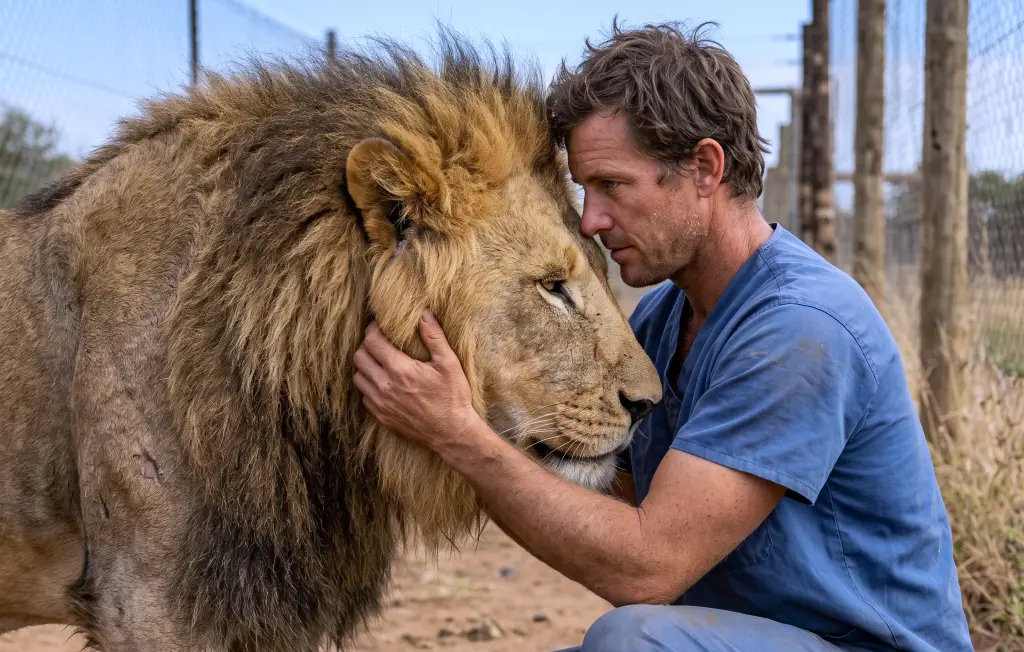
A wildlife photographer, commissioned to shoot a standard promotional spread for the sanctuary’s donor newsletter, caught a candid frame of them in the outdoor enclosure. The image showed Alex kneeling in the red dirt, checking a healed laceration, while the massive lion leaned his heavy skull affectionately against the veterinarian’s shoulder.
The photograph hit the international wire services by the weekend. It went viral across global conservation networks, framed as a rare piece of undeniable hope in the middle of a brutal poaching epidemic.
The attention brought donations, but it also brought a severe reality check.
Eight weeks into the recovery, Alex and Nadia were reviewing diet modifications when the sanctuary’s head of security stepped into the clinic. He closed the heavy door behind him and locked it.
“We have a problem,” the security chief said flatly. “Local intelligence just intercepted chatter from the trafficking network. They’re losing money because the northern route got exposed, and they don’t like the noise this lion is generating.”
Nadia lowered her pen. “Are you saying they would risk hitting a secure compound?”
“I’m saying we are doubling the perimeter guard tonight,” the chief replied. He turned his gaze to Alex. “And I’m strongly suggesting Dr. Miller relocates to the capital until things cool down. Your name was specifically mentioned.”
Part 5
Alex didn’t hesitate. “I’m not abandoning the sanctuary, and I’m not leaving Lazarus because a trafficking ring is annoyed about a photograph.” He leaned against the examination table, crossing his arms. “Just tell me what protocol I need to follow for the perimeter shifts.”
The security chief stared at him for a long moment, recognized the absolute finality in the veterinarian’s tone, and gave a curt nod before outlining the new lockdown procedures.
That night, sleep was impossible. The heavy, humid air of the savannah pressed against the mesh screens of Alex’s quarters. At 2:00 a.m., he finally gave up, grabbed a heavy-duty flashlight, and walked out into the compound.
He didn’t bring a dart gun, and he didn’t wake the night-shift safety officer. Breaking the final, most absolute rule of his profession, Alex unbolted the heavy gate of the outdoor enclosure and stepped inside.
The beam of his flashlight swept across the dry grass and caught the reflective tapetum lucidum of two large, amber eyes. Lazarus was awake. The lion had regained nearly two hundred pounds since the pit. He was no longer a skeletal ghost; the heavy musculature of a mature male was finally filling out his frame, making his sheer physical presence overwhelming in the dark.
“Hey, big guy,” Alex murmured, clicking off the flashlight. He sat down in the dirt, his back against the rough wood of a structural post.
For a few minutes, there was only the sound of the wind through the acacia trees. Then, the dry grass rustled. A massive shadow detached itself from the darkness. Lazarus moved with a slow, deliberate heavy-footed gait, stopping inches from Alex.
The lion didn’t lie down in his usual spot. Instead, he shifted his bulk and leaned his entire body weight against Alex’s side. The pressure was immense, pressing Alex firmly against the wooden post. Lazarus dropped his massive, heavy skull across Alex’s lap, letting out a long, rattling exhale that smelled of raw meat and dry earth.
Alex rested his hand on the coarse, thick fur of the animal’s neck. “Rough day for both of us,” he said quietly.
They sat in the dark, a man and an apex predator, bound by a quiet, impossible logic. Alex found himself talking, his voice a low murmur in the empty enclosure. He talked about the poachers, about the friction with the sanctuary board, and about the sheer, undeniable reality of the calendar.
“I don’t know how we fix this,” Alex confessed to the heavy, sleeping animal. “Your blood work is clean. Your joints are healing. But you’re never going to be releasable. If I leave you here, they’ll have to sedate you just to clean the pen.” He swallowed hard, staring out at the perimeter fence. “And my leave of absence from the clinic in Sydney expires in three months. I have a job to go back to.”
Lazarus twitched in his sleep, a heavy paw shifting in the dirt, entirely oblivious to the bureaucratic reality that would eventually separate them.
At 6:00 a.m., the morning shift arrived to find the senior veterinarian fast asleep in the dirt, his head resting against the flank of a three-hundred-pound lion.
The image forced an immediate reckoning.
By noon, Nadia had convened an emergency meeting of the sanctuary’s leadership team in the main conference room. The atmosphere was tense, the air conditioning struggling against the midday heat.
“The physical recovery is extraordinary,” Nadia said, projecting Lazarus’s latest chart onto the screen. “But we have a behavioral crisis. The animal is fully imprinted. He tolerates the staff, but his attachment to Alex is absolute.”
Samuel Kiprop leaned forward, resting his elbows on the long table. “The attachment goes both ways, Nadia. Alex is just as bound to the animal.”
“Which is exactly why it’s a problem,” she replied firmly. “We are a wildlife rehabilitation center, not a petting zoo. We maintain strict boundaries to prevent dangerous imprinting, and we have fundamentally failed to do that here.” She looked directly at Alex, who sat at the far end of the table. “He will never survive in the wild. But what happens to him when your contract ends and you go back to Australia? A sudden separation could trigger a psychological collapse, leading to a refusal to eat.”
Alex looked down at his hands. He had known this conversation was coming. He had spent the last three weeks quietly making phone calls, negotiating across time zones, and drafting a document he had initially thought was crazy.
“He doesn’t stay here,” Alex said, sliding a thick, bound folder across the table toward Nadia. “And I don’t go back to Sydney.”
Nadia opened the folder. It was a formal, meticulously detailed proposal. Alex had arranged for a transfer of employment to a highly secure, private conservation facility in South Africa—a massive sanctuary funded by a wildlife philanthropist who had been following Lazarus’s story. The facility offered sprawling, multi-acre natural habitats for non-releasable big cats. More importantly, they had offered Alex the position of chief veterinary director.
“You want to move a recovering, highly dangerous predator across three borders,” Nadia said, her voice tight with disbelief, “just so you can remain his primary caregiver?”
“I want to document a one-on-one recovery protocol,” Alex corrected, his tone entirely professional, though the emotional stakes were obvious to everyone in the room. “We establish a precedent for individualized care for extreme trauma cases. I oversee his transition, maintain the bond to keep him stable, and slowly introduce him to a controlled habitat.”
The board of directors took two days to deliberate. The arguments were fierce. Critics in the wider conservation community called it a dangerous exercise in anthropomorphism. But the sheer volume of medical data Alex had already collected on trauma recovery could not be ignored. Reluctantly, with a massive list of safety stipulations, the board approved the transfer.
By the fifth month, preparations for the move were underway. Lazarus had crossed the four-hundred-pound mark. His coat was a deep, healthy gold, and his mane had grown in thick and dark around his shoulders. With his strength returned, so did his natural instincts. He began territory marking, shredding heavy enrichment logs with his claws, and letting out deep, resonant roars at dusk that shook the clinic windows.
Yet, his behavior with Alex remained an inexplicable anomaly.
The depth of that anomaly was proven during a late afternoon perimeter walk. To rebuild the lion’s stamina for the long transport ahead, Alex had begun walking him along the secure, double-fenced inner corridor of the sanctuary.
They were rounding the corner of the large enclosures when the resident female lion caught Lazarus’s scent.
She was a massive, aggressive female, rescued from a circus ring years ago. She charged the chain-link fence without warning, her heavy body slamming against the heavy-gauge wire with a deafening crash, her jaws snapping as she let out a furious, territorial snarl.
Alex stumbled back, his heart slamming against his ribs.
Standard biological programming dictated that Lazarus should have responded with either competitive mating behavior or reciprocal aggression toward the female.
Instead, Lazarus dropped his weight and stepped laterally. He completely blocked the female’s line of sight to Alex. The male lion squared his massive shoulders, placed himself squarely between the chain-link fence and the veterinarian, and let out a deafening, concussive roar.
It wasn’t a mating call. It was a clear, violently aggressive warning directed entirely at the female.
On the other side of the compound, Nadia dropped her clipboard and stared through the mesh in absolute shock.
Lazarus held his ground until the female backed away from the fence, pacing angrily in the dust. Only then did the heavy male turn his massive head, check on Alex, and let out a low, calm chuffing sound.
Nadia walked over slowly, keeping her distance from the wire. “He didn’t just ignore her,” she breathed, staring at the male lion. “He protected you.”
Alex swallowed the metallic taste of adrenaline in his mouth. “He’s resource-guarding,” he said, though his voice shook slightly. “He’s categorizing me as his pride. Not as competition, and not as prey.”
The social imprinting had completely overridden millions of years of reproductive instinct. Lazarus had rewritten the fundamental wiring of his own species, creating an entirely new category for the man who had pulled him out of the dark.
Part 6
The logistical reality of moving a four-hundred-pound apex predator across the continent was staggering. It required heavy-gauge steel transport crates, specialized aviation permits, and a meticulously timed sedation schedule. By the time the transport day arrived, the tension at the Kenyan sanctuary was exhausting.
On his final night in the outdoor enclosure, Alex sat with Lazarus for the last time on Kenyan soil. The lion’s massive frame took up most of the space near the reinforced gate. He was no longer the broken, skeletal creature they had pulled from the dark. He was heavy, vital, and incredibly dangerous.
“Tomorrow is going to be rough,” Alex murmured, resting his hand on the thick, coarse muscle of the animal’s shoulder. “But we’re doing it together.”
Lazarus didn’t merely tolerate the touch. The lion shifted his weight, turning his massive head to look directly at the veterinarian. Then, with a slow, deliberate movement, Lazarus pressed his broad forehead flat against the center of Alex’s chest. The sheer weight of the animal forced the breath from Alex’s lungs, but the gesture was startling in its gentleness.
The next sixteen hours were a grueling blur of noise and chemical management. Lazarus was darted with a precise cocktail of sedatives. Alex rode in the cargo hold of the chartered transport plane, sitting on the cold, vibrating floor plating beside the reinforced crate. Every hour, he checked the lion’s vitals through the narrow steel mesh, monitoring heart rate and respiratory depth over the deafening drone of the aircraft engines.
When they finally touched down and backed the transport truck up to the release chute at the South African facility, the drugs were beginning to wear off.
The new environment was a sprawling, state-of-the-art transitional habitat, designed to let rescued animals acclimatize before moving to the larger multi-acre reserves. But as the heavy steel door of the transport crate slid open, Lazarus did not quietly explore.
The lion staggered out, his heavy paws slipping slightly on the foreign soil. As the last fog of the sedative cleared, disorientation gave way to intense, explosive stress. Lazarus realized he was in an unknown territory. He began to pace the perimeter fence with aggressive, agitated speed. His tail lashed, and he let out a series of short, deafening roars that rattled the heavy plexiglass of the observation deck.
The South African staff backed away from the mesh, their hands hovering near their radios. The sheer, violent power of the animal was terrifying. This was not a compliant medical patient; this was a fully armed predator in a state of high alarm.
“Open the inner gate,” Alex said over the radio, stepping away from the observation deck.
The facility director hesitated. “Dr. Miller, he’s extremely agitated. Protocol dictates we give him twenty-four hours to baseline.”
“Open the gate,” Alex repeated. “I’m not leaving him alone in there.”
The heavy electric locks disengaged with a loud clack. Alex stepped through the secondary mesh door and walked out into the dirt of the transitional pen.
At the sound of the gate, Lazarus spun around, his ears pinned flat against his skull, his heavy muscles bunching for a defensive charge. He locked eyes with the human.
For three agonizing seconds, the lion remained frozen, a coiled spring of muscle and instinct.
Then, the tension simply evaporated. The heavy shoulders dropped. The ears swiveled forward. Lazarus let out a deep, rhythmic chuffing sound—the distinct greeting of his species—and closed the distance between them at a heavy trot. He didn’t attack. He simply drove his massive head into Alex’s thigh, nearly knocking the veterinarian over, leaning his entire body weight against the man in profound, undeniable relief.
“Welcome home, mate,” Alex breathed, burying his hands in the thick mane, feeling the heavy, steady thud of the animal’s heart.
Over the next two years, the South African reserve became the permanent landscape of their impossible routine. Under Alex’s supervision, Lazarus successfully transitioned into a massive five-acre natural habitat. He learned to navigate the elevated platforms, drank from a natural water source, and even established a tentative, heavily monitored social boundary with a neighboring female through a reinforced fence line.
While the lion thrived, the bureaucratic machinery of justice ground forward in Kenya. The physical evidence Alex had collected from the underground pit, combined with GPS data from the poachers’ discarded equipment, eventually led to a sweeping federal indictment. Fourteen men, including the logistics coordinators who had arranged the live-transport orders, were sentenced in a Nairobi courtroom, effectively dismantling one of the most profitable trafficking routes in East Africa.
By the third anniversary of the rescue, the sanctuary agreed to allow a small documentary crew to film the facility’s trauma rehabilitation program.
They set up their cameras near the boundary of the five-acre enclosure in the late afternoon, as the South African sun began to cast long, golden shadows across the dry grass. Alex sat on the hood of a dusty utility vehicle, a few feet from the heavy perimeter fence.
Inside the enclosure, Lazarus emerged from the tall brush. He weighed well over four hundred pounds now, a picture of absolute leonine majesty. The lion walked with a slow, heavy confidence, stopping directly across from where Alex sat. Through the heavy steel mesh, Lazarus pressed his forehead against the wire, waiting.
Alex stepped forward and pressed his own hand against the opposite side of the steel.
The interviewer, standing safely behind the camera operator, lowered his microphone. “Dr. Miller, neurologically speaking, how do you explain this? An apex predator shouldn’t retain this kind of bond.”
Alex kept his eyes on the lion, watching the slow, calm rise and fall of the animal’s massive ribs.
“I can give you a clinical explanation,” Alex said, his voice quiet, devoid of any academic pretense. “I can talk about trauma imprinting, cortisol levels, and the psychological impact of prolonged starvation. I can show you the behavioral charts we’ve built over the last three years.”
He stepped back from the fence, and Lazarus immediately shifted, his amber eyes tracking the veterinarian with absolute, unbroken focus.
“But the truth is,” Alex continued, looking back at the camera, “some connections exist outside of our data. He survived because we intervened, but he chose to trust when every instinct he had told him to fight. That wasn’t a biological imperative. That was a choice.”
As if the sound of Alex’s voice was a cue, the massive lion turned and began to walk along the interior perimeter of the fence.
Alex turned and walked with him. They moved in silence, separated by the heavy steel wire, a man and a predator walking perfectly parallel in the fading light—bound by a history of violence, and a quiet, enduring grace that defied the natural order.